Tracing a Hidden Presence:
The Story of Mexican and Mexican American Indianapolis, 1850–2020
By Nicole Martinez LeGrand | 2026
Coauthorship from: Hannah Cortes, Jessica Fischer, Benjamin Looker, Amelia Simpson, Jyoti Verderame
Introduction
According to the 2020 US census, Indianapolis residents claiming Latine or Hispanic background constitute nearly 16 percent of the city’s inhabitants, with the majority identifying as Mexican or Mexican American. While this population has grown dramatically since the 1950s, the city’s Mexican-descended community has a deep, if often unacknowledged, history locally. From the early twentieth century forward, Mexican and Mexican American residents have made significant contributions to Indianapolis’s economy, culture, and institutional life. At the same time, community members have needed to confront ethnic discrimination and economic marginalization, as well as a broader invisibility in the region’s understanding of its own past and present. A deeper knowledge of Indianapolis’s civic identity can be achieved by exploring this population group’s background and growth.
Expansive accounts of Indianapolis’s Mexican American history have only recently become available. This is partly because of a lack of easily accessible sources for much of the early and mid-twentieth century. For instance, the presence of early Mexican residents is only sporadically apparent in US census records, due to constant shifts in how the federal government’s population count recorded race, ethnicity, and nationality. Local newspapers, meanwhile, tended to ignore or stereotype local Mexican communities. And the relative absence of established Mexican-identified institutions and neighborhoods during these decades means that surviving historical records can be elusive or scarce. It would not be until the 1980s that Indianapolis’s Mexican and Mexican American residents become statistically and socially visible to the wider regional population.
As a result, the history of Mexicans and Mexican Americans in Indianapolis survives largely through partial snapshots. Yet, as with a collage, these snapshots can be pieced together to reveal a longer, more complex story. That story begins with the small handful of Mexican migrants who settled in Indianapolis around the turn of the twentieth century, and it stretches to our present moment. It encompasses the aspirations and struggles of new migrants and long-settled inhabitants, workers and students, business owners and artists, community leaders and insurgent activists—all seeking ways to survive and thrive within Indianapolis’s larger social fabric.
1900s
7 Mexicans and Mexican Americans in Indianapolis and Marion County per US Census
Why this number deserves a second look…
This figure accounts only for individuals born in Mexico. After the Treaty of Guadalupe Hidalgo (1848) transferred approximately 55% of Mexico’s northern territory to the United States, residents of the ceded region were granted US citizenship and classified as white. As a result, many people of Mexican ancestry remained statistically invisible in census data.
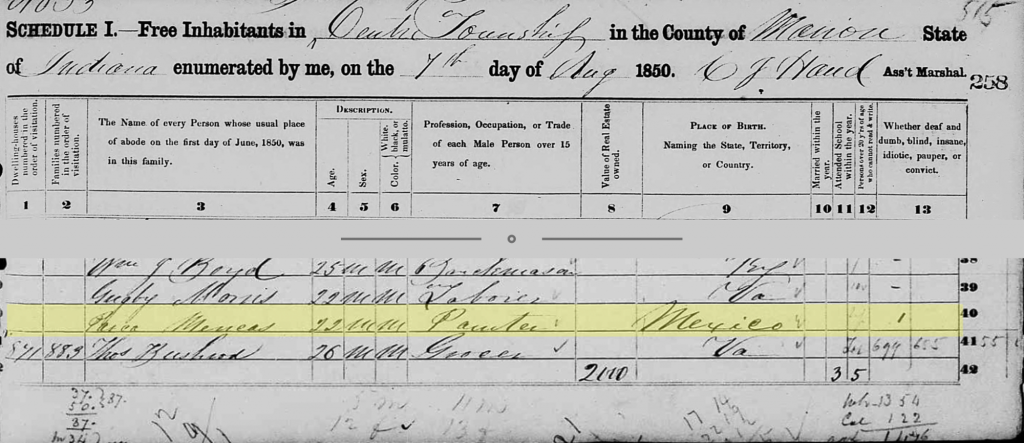
As the twentieth century dawned, there were only seven foreign-born residents of Mexican background living in Indianapolis, according to available records. This group had grown only incrementally over the half century since the city’s first officially recorded Mexican resident, “Pasca Meneas” (Pascual Mejias), had first appeared in a US census count. Though Meneas was of Mexican origin, census takers in 1850 had categorized him as “Mulatto,” meaning a mixed-race individual with one parent of white European descent.
The new century’s first decade would see the beginnings of a significant change in the visibility of the local Mexican population. The first indication came in 1907, when Indiana and Mexico established an international diplomatic relationship. Mexican President Porfirio Diaz appointed Indianapolis politician and attorney Colonel Russell B. Harrison as vice consul (honorary consul) of Mexico in Indianapolis.
One of Harrison’s responsibilities as vice consul included the protection of Mexicans living in Indiana. Safeguarding them from labor exploitation, in turn, required the development of more accurate counts of the region’s inhabitants of Mexican background, many of whom had previously gone unnoticed by government recordkeepers. While this project brought greater clarity to the extent of the region’s Mexican population, consistent misclassifications in official records mean that many Mexican residents of Indiana may remain unaccounted for during this period.
1910s
12 Mexicans and Mexican Americans in Indianapolis and Marion County per US Census
Why this number deserves a second look…
Mexican nationals, naturalized citizens, and US-born people of Mexican descent remained largely invisible in census data, as they were typically classified as white or mulatto. The community remained highly mobile, with population numbers fluctuating because of seasonal labor, contract work, and educational enrollment.
The number of Mexicans immigrating to Indiana increased due to hemispheric events of the 1910s. By the middle of the decade, about one hundred Mexican people lived in the state, most of them college students and laborers.
During the decade-long Mexican Revolution that began in 1910, the US maintained its diplomatic ties to Mexico to protect American business investments in that country. Due to Indiana’s existing flow of exports to Mexico, state business and political leaders envisioned an expansion of this profitable trade relationship, driven partly by Mexican needs amid the internal conflict and the anticipated postwar rebuilding process there. As honorary consul of Mexico in Indianapolis, Harrison noted that:
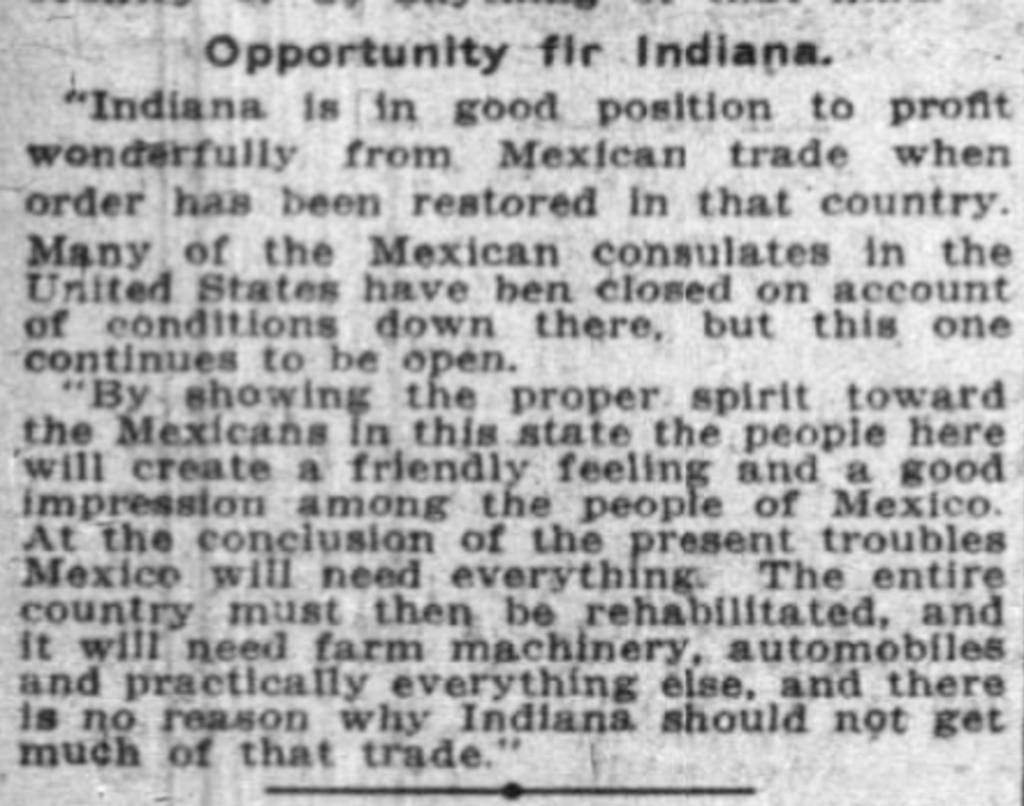
“Indiana is in good position to profit wonderfully from Mexican trade when order has been restored in that country, Many of the Mexican consulates in the United States have ben [sic] closed on account of conditions down there, but this one continues to be open. By showing the proper spirit toward the Mexicans in this state the people here will create a friendly feeling and a good impression among the people of Mexico. At the conclusion of the present troubles Mexico will need everything. The entire country must then be rehabilitated, and it will need farm machinery, automobiles and practically everything else, and there is no reason why Indiana should not get much of that trade.”
In 1918 the Department of Labor suspended immigration restrictions imposed by the Immigration Act of 1917 due to US labor shortages during World War I. Mexican nationals over sixteen years old were no longer required to take a literacy test and Mexican workers regained their exemption from the head tax, a benefit they had held since 1882. These short-term provisions allowed war relief laborers to fill jobs in railroads, packing houses, steel production, and the agricultural sector. This temporary exemption continued until 1921. It resulted in populations of Mexican workers (mostly men) moving further into the United States, especially to Indiana and the larger Midwest.
Early Mexican settlers to Indianapolis did not form distinct neighborhoods or cultural enclaves. The transience and seasonality of available work in Indianapolis led many Mexicans to live in boarding houses, resulting in a lack of fixed settlement patterns. Other temporary Mexican populations in this decade included students from wealthy families who sent their children to American colleges, safeguarding them from the Mexican Revolution.
Another small yet recognizable local Mexican group included entrepreneurs who opened local chili parlors or became hot tamale vendors. These food outlets could be found on Indiana and Massachusetts avenues as early as 1907. Thomas Garcia, who ran a restaurant on Capitol Avenue (and later Indiana Avenue), is considered Indianapolis’s first chili parlor proprietor. Soon enough, chili parlors gained popularity among non-Mexican entrepreneurs, who also began to open such restaurants.
1920s
32 Mexicans and Mexican Americans in Indianapolis and Marion County per US Census
Why this number deserves a second look…
Mexican nationals, naturalized citizens, and US-born people of Mexican descent were largely statistically invisible, typically classified as white or mulatto. Population figures remained fluid due to seasonal labor, contract work, and student enrollment. A 1910 US-Mexico labor agreement increased the number of Mexican workers in the United States, while the Mexican Revolution drove additional migration northward.
During and after the Mexican Revolution, which ended in 1920, Mexican migration to the US increased significantly. In Indiana, the 1920s brought expanded opportunities—but also increased discrimination—for Mexican inhabitants, whether new arrivals or long-established residents.
The Indianapolis Chamber of Commerce, through its Education Committee, encouraged migration of Mexican students to the state through a national student exchange program supported by scholarships. Under the program, Mexican students attended Indiana universities and Indiana students attended Mexican universities of the same rank. By 1921, DePauw and Purdue universities were providing several full-tuition scholarships for Mexican nationals.
At the same time, the Indianapolis Star, mirroring attitudes of other big-city US newspapers, framed the nation’s growing Mexican population as “the Mexican Problem.” The demand for agricultural labor had kept Mexicans exempt from restrictive immigration quotas passed by the US Congress in 1917 and 1924. But other federal policies established new barriers to cross-border movement. In 1924, the Labor Appropriations Act militarized the US–Mexico border through the creation of the US Border Patrol, tasked with reducing unauthorized crossings.
By the decade’s end, the US Department of State had begun enforcing visa requirements that severely restricted Mexican immigration. These legal and social pressures intensified throughout the 1920s, peaked with the US stock market crash of October 1929, and continued into the Great Depression.
1930s
38 Mexicans and Mexican Americans in Indianapolis and Marion County per US Census
Why this number deserves a second look…
Population growth during the 1920s prompted concern at the national level. By the end of the decade, a federal repatriation program had significantly reduced this growth by sending many people of Mexican descent, including US citizens, to Mexico. The US Census also introduced “Mexican” as a racial category for the first time.
Amid the Great Depression, Indianapolis’s small but growing Mexican and Mexican American community began to establish neighborhood roots. At the same time, fear-based anti-Mexican sentiment grew nationally and fueled coercive repatriation efforts.
The decade’s economic travails left many Indianapolis residents unemployed and reliant on social relief and charity. Many native-born white US citizens viewed underemployed and unemployed Mexicans and their families, no matter their citizenship status, as a threat to an already strained social relief network. Fear spread within Mexican communities across the US as national political leaders questioned their presence and desirability. President Herbert Hoover, for example, scapegoated immigrants as taking jobs from native-born white Americans. US Secretary of Labor William Doak, meanwhile, pushed to locate and deport foreign nationals with the help of local and state officials. The latter effort, which stretched beyond Doak’s cabinet tenure and well into the Roosevelt administration, resulted in the Mexican repatriation of approximately 300,000 to two million people of Mexican descent between 1929 and 1939.
In northwest Indiana, Paul E. Kelly, commander of the American Legion Post 266, spearheaded a vigorous local repatriation effort aimed at the large population of Mexicans living there. Kelly coerced the region’s Mexican residents to leave based on the Mexican government’s promise to find jobs and land in Mexico for the repatriates. Post 266 oversaw the repatriation of roughly half of the 5,000 Mexicans living in the Indiana city of East Chicago. By contrast, the smaller Mexican population in Indianapolis was not considered a significant threat to jobs or social services available to native-born whites.
The 1930s also marked the end of an active Mexican consulate in Indianapolis. The consulate would not be reestablished until the twenty-first century. Before leaving his post in 1931, honorary vice consul Russell Harrison worked with local US congressman Louis Ludlow and Indianapolis attorney Minton Clawson to prove that a recently deported Mexican national from East Chicago, Indiana, was denied due process while awaiting a court appeal. Harrison helped secure the man’s return to Indiana.
Despite these challenges, Indianapolis’s Mexican and Mexican American residents began to form a cohesive community. This was particularly visible in a downtown eastside area where a small Mexican enclave, later known as El Barrio, took shape as a cultural and residential hub.
1940s
44 Mexicans and Mexican Americans in Indianapolis and Marion County per US Census
Why this number deserves a second look…
Population numbers rebounded during the 1940s. Many US-born people of Mexican descent who had been repatriated to Mexico returned to the United States during World War II, while the Bracero Program, established in 1942, brought thousands of temporary agricultural laborers into the country. Although “Mexican” was no longer listed as a racial category, US-born people of Mexican ancestry were typically classified as white or mulatto, making them largely invisible in census data. As a result, these figures account primarily for Mexican-born residents appearing in foreign national numbers.
The national and local growth of the Mexican and Mexican American population in the 1940s was shaped in large part by the Bracero Program. On August 4, 1942, Indiana native and US Secretary of Agriculture Claude R. Wickard reached an agreement with the Mexican government to address US wartime labor shortages. The agreement established a guest worker plan, called the Bracero Program. Mexican officials hesitated initially, largely due to previous exploitation and discrimination faced by Mexican workers in the US. The final agreement allowed for the importation of Mexican laborers under expanded protections, including guaranteed wages and sanitary living conditions, though those were not always honored by employers.
By early 1943, approximately 4,000 workers labored in southwestern US agricultural fields and canneries. Outside the Bracero Program, the same migratory labor streams brought other farmworkers of Mexican descent to US agricultural sites. Within one year, braceros began working on rural Indiana farms and in northwest Indiana’s urban canning operations. They also worked on Indianapolis’s railroad construction projects tied to wartime needs, often under large contractors such as the HJ Heinz Corporation and the Pennsylvania Railroad.
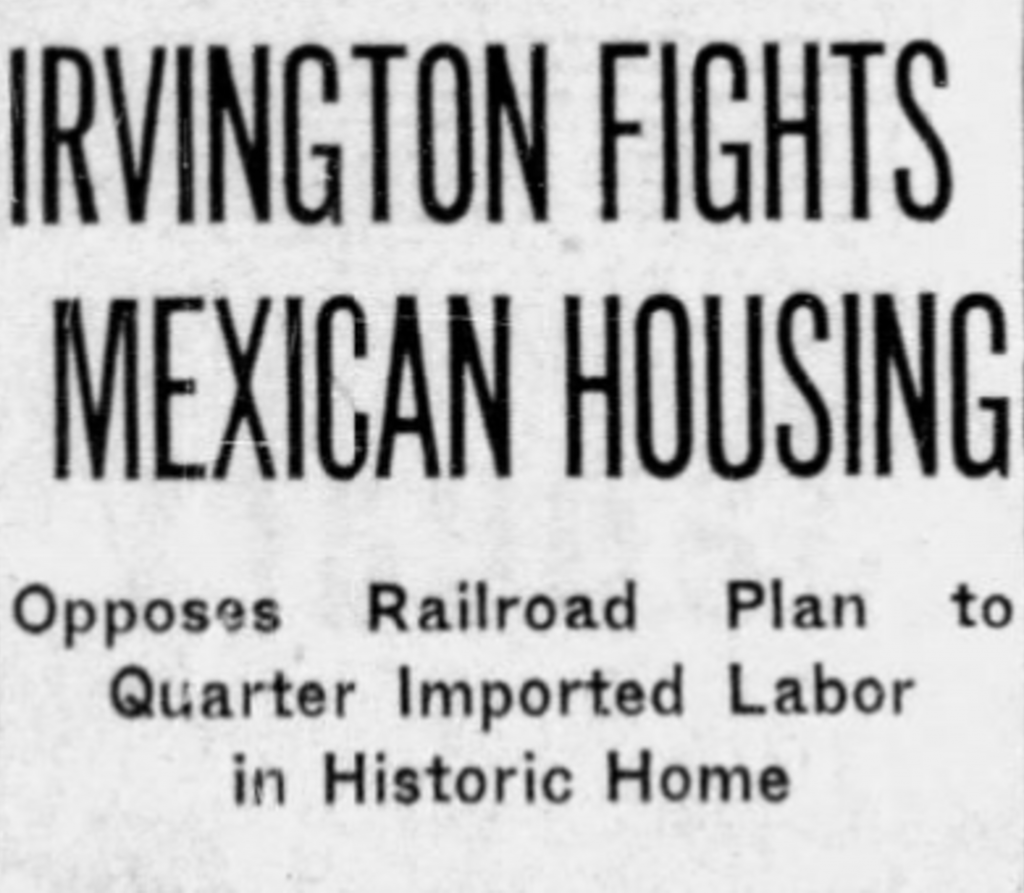
In 1944, about thirty braceros laboring for the Pennsylvania Railroad in Indianapolis were housed in a deteriorating nineteenth-century mansion in Irvington, located at 115 South Audubon Road. Their arrival sparked controversy and sharply divided the neighborhood. This was largely due to Irvingtonians’ opposition to repurposing the structure, formerly the home of abolitionist and community founder George Washington Julian, as a boarding house for laborers.
Not all of the known Mexicans and Mexican Americans in Indianapolis during the 1940s were guest workers. Some, present in the city since as early as the 1910s, held jobs in other sectors such as hospitality work and independent entrepreneurship.
The Mexican Trio
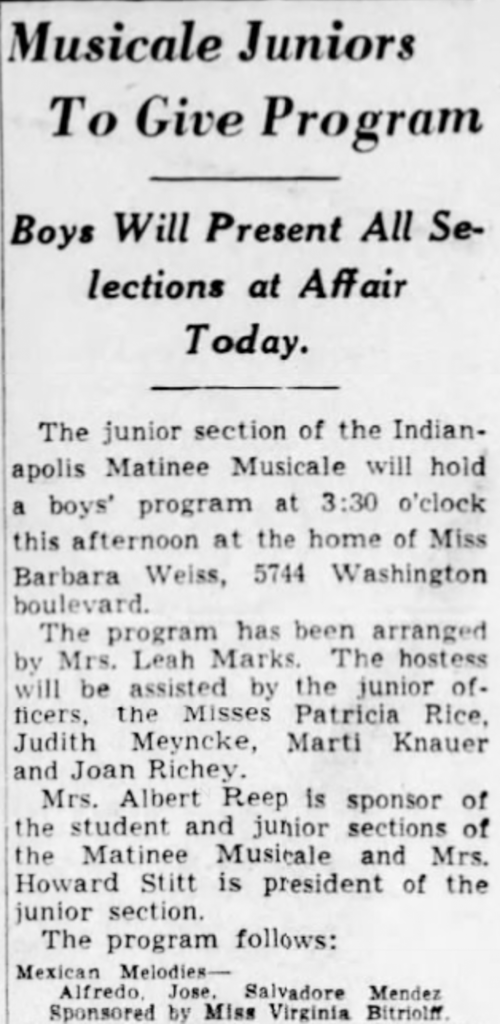
A growing contingent of Indianapolis Latines began working in the arts and entertainment during this period. El Barrio residents Alfredo, Jose, and Salvador Mendez began performing as a trio in 1940. They joined the junior division of the Indianapolis Matinee Musicale, playing violin, mandolin, and guitar while featuring Mexican music. They became known locally as the Mexican Trio.
Credit: The Indianapolis Star, Mar 10, 1940
1950s
73 Mexicans and Mexican Americans in Indianapolis and Marion County per US Census
Why this number deserves a second look…
US-born children of Mexican nationals were typically classified as white or mulatto, making them largely invisible in census records. As a result, these figures primarily reflect Mexican-born residents, who appeared in census data as foreign nationals.
The postwar years were marked by economic instability in Mexico and other parts of Latin America. This, paired with new federal labor programs and industrial job opportunities in the US, drove migration of Mexicans to the US, as well as internal US migration of Mexican Americans to Indianapolis. As more Mexican-descended families settled in the city, they established businesses, social organizations, and community networks.
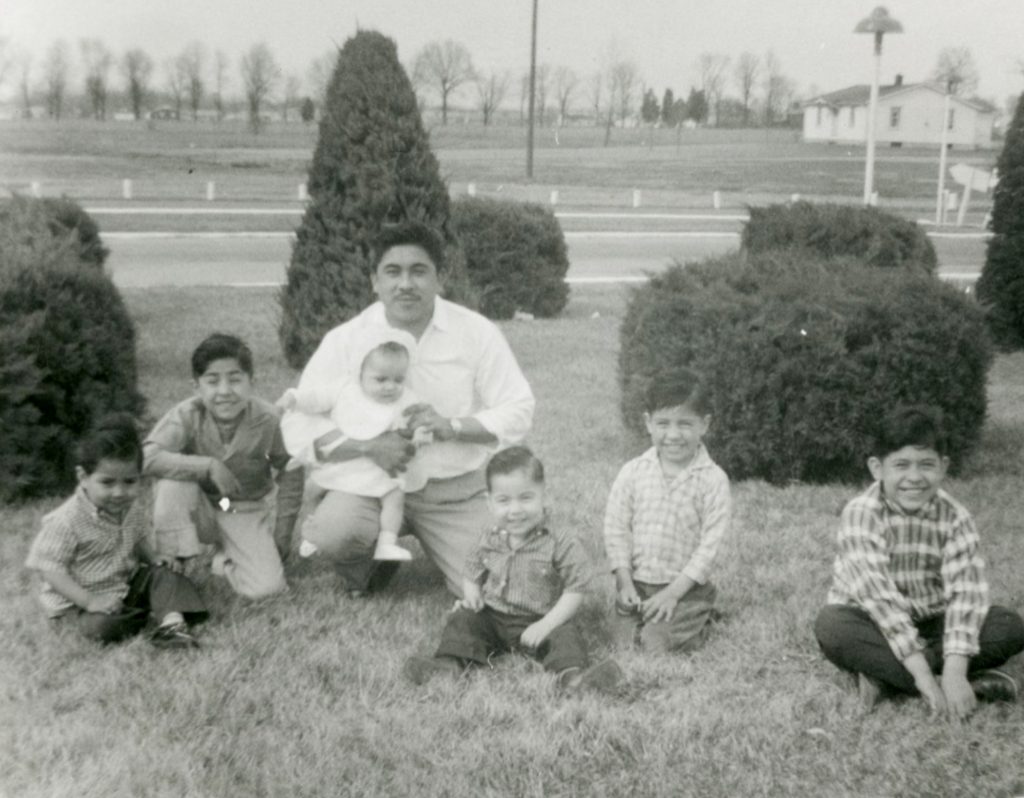
Job availability played a large role in migration flows from Mexico to Indianapolis. In 1951, the US government expanded the Bracero Program from a wartime expediency into a formal, ongoing system for procuring agricultural labor. This not only brought new guest workers from Mexico but also created openings for Mexicans already living in Indianapolis to find work in industries like canning and meatpacking. Large local meatpacking plants—particularly Armour and Company, Hygrade Food Products (formerly Kingan and Company), and Stark & Wetzel—provided well-paying jobs that helped Mexican and Mexican American laborers and their families move from agricultural employment settings to a more settled urban life in Indianapolis.
Yet this community’s growth was accompanied by intensified discrimination. In 1954, Operation Wetback, a federal immigration enforcement campaign targeting undocumented Mexican workers, created fear and uncertainty in Mexican communities across the US. Although that effort was centered in the Southwest, families of Mexican background in Indianapolis felt the initiative’s effects as a climate of anxiety spread through the Midwest. In Indianapolis, the group kept a low profile while working to establish permanent homes and community institutions.
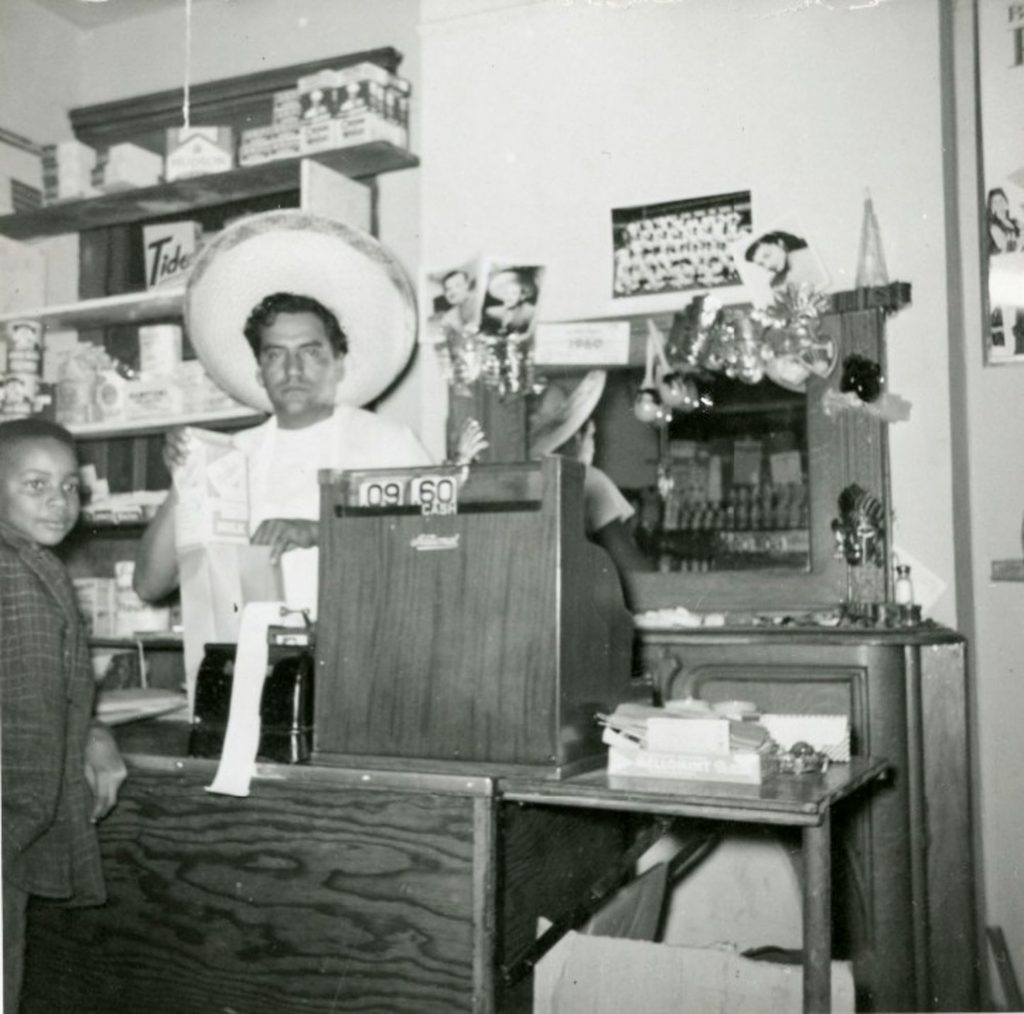
By this decade, a large group of Mexican and Mexican American families lived or ran businesses in El Barrio. The neighborhood soon became a destination for Mexicans living in other parts of Indianapolis, who came there to socialize and shop. Among El Barrio’s best-known businesses was El Nopal Market. Owners Feliciano and Maria Espinoza operated this shop from the first floor of their home at 801 E. North Street.
By the end of the decade, Mexican inhabitants began to establish social institutions in areas other than El Barrio. On Indianapolis’s west side, Sociedad Sociales Mexicano (Mexicano Club) elected its first officers in 1958. These social organizations were pivotal in helping the Mexican and Mexican American community enter Indianapolis’s civic life.
1960s
451 Mexicans and Mexican Americans in Indianapolis and Marion County per US Census
Why this number deserves a second look…
US-born children of Mexican nationals were typically classified as white or mulatto, making them largely invisible in census records. As a result, these figures primarily reflect Mexican-born residents, who appeared in census data as foreign nationals.
Indianapolis’s Mexican and Mexican American community experienced significant change as the 1960s progressed, with US immigration, labor, and social policies reshaping daily life. At the national level, immigration reform, including the Migration and Refugee Assistance Act (1962) and the Immigration and Nationality Act (1965), created new supports for refugees and ended discriminatory entry quotas. These acts opened legal pathways to the US, which altered Indianapolis’s immigrant demographics. The resettlement of Cuban refugees fleeing the Fidel Castro regime and the abolishment of immigration quotas helped to increase Indianapolis’s Latin American immigrant population. At the same time, the end of the Bracero Program in 1964 deprived many migrant workers of pre-existing protections, exposing them to greater exploitation and poor living conditions.
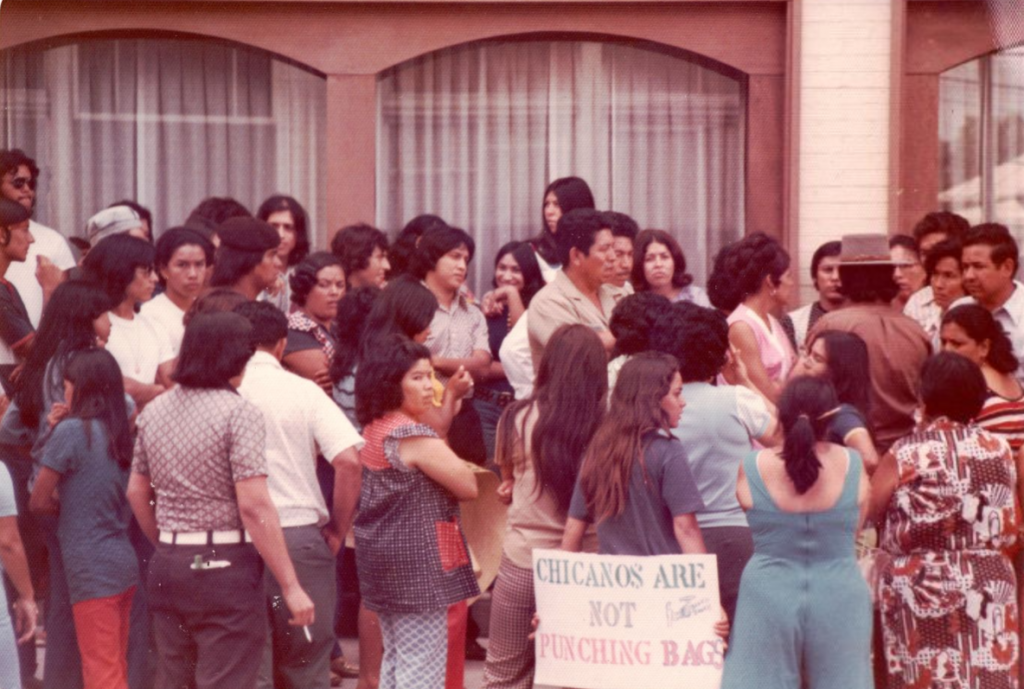
These challenges fueled growing advocacy for farmworkers’ rights. Starting in mid-decade, economically struggling migrant communities in Indiana received some support from President Lyndon B. Johnson’s War on Poverty initiatives. In 1968, President Johnson also established National Hispanic Heritage Week, scheduled to align with the September 15 and 16 independence anniversaries of many Latin American countries.
Together, these events propelled community advocacy efforts by Indianapolis’s Mexican-descended residents, while bringing more public visibility to the community.
Expand sections below for more info.
1965: Associated Migrant Opportunity Services Inc, and Labor Camps
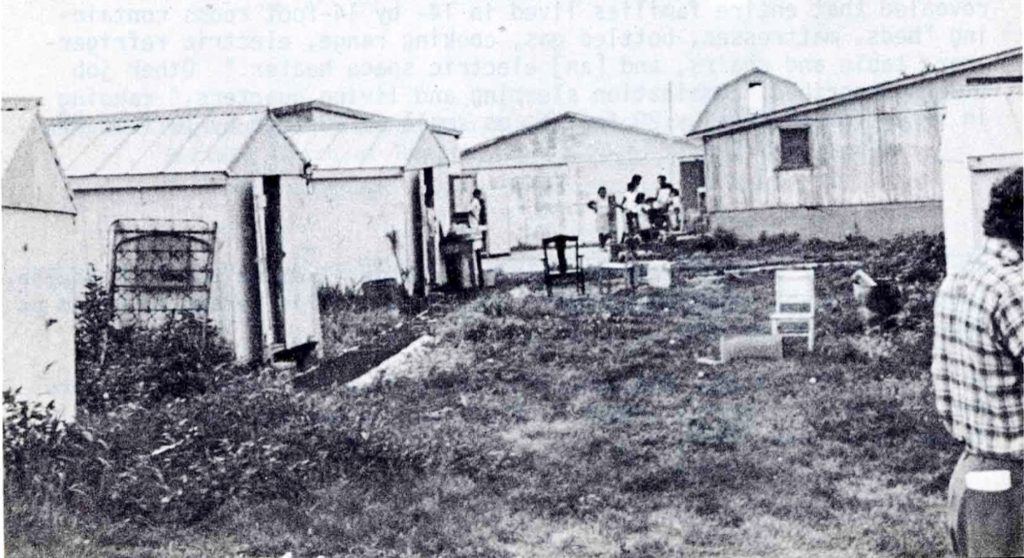
On March 27, 1965, the Indiana Council of Churches and the state’s several Catholic archdioceses formed an organization named Associated Migrant Opportunity Services (AMOS) Inc., which provided education, social services, and childcare for migrant farmworkers. With nearly half a million dollars in federal funding, AMOS expanded rapidly and partnered with state agencies to improve living and working conditions. That same year, Indiana passed the Migrant Housing Law, establishing minimum standards for labor camps. Some lawmakers criticized expanded government involvement in social welfare. But later investigations uncovered substandard living conditions at several migrant camps in Indiana, including those run by the HJ Heinz food-processing company, underscoring the need for stronger regulatory enforcement.
1969: Hispano-American Association
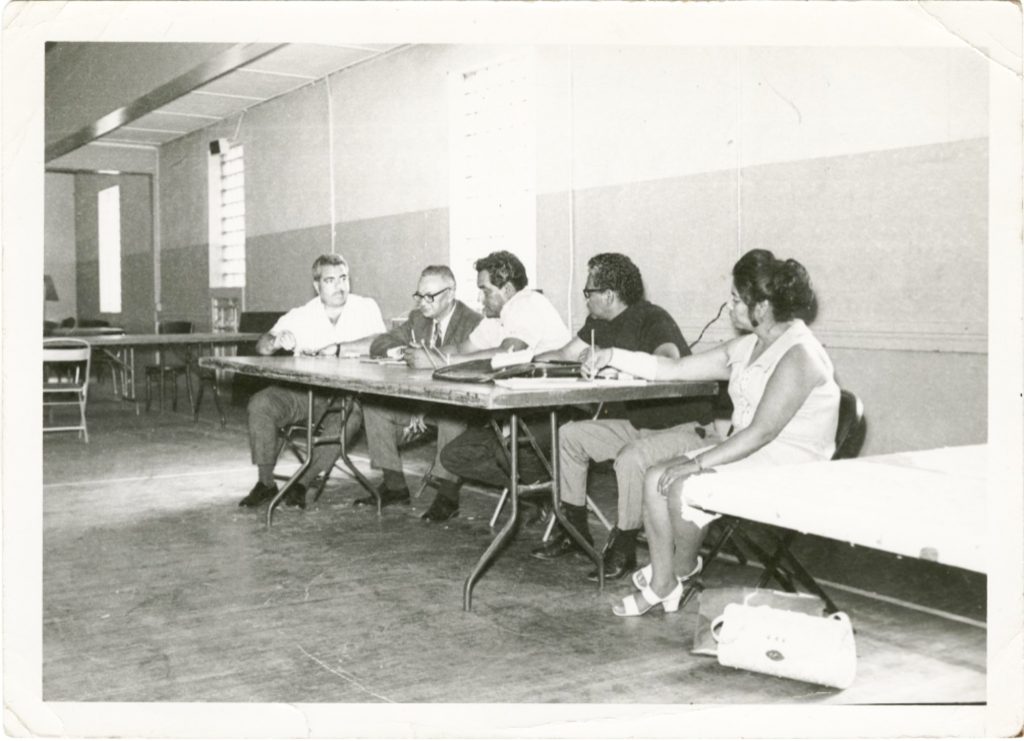
By the late 1960s, Mexican-descended Indianapolis residents, along with other local Latine populations, had begun organizing more assertively to address community needs and gain a political voice. A major catalyst included the displacement of Latine families from El Barrio, beginning in 1965, for the construction of Interstate 65/70. In November 1969, Feliciano Espinoza and other Indianapolis Latine leaders founded the Hispano-American Association. Espinoza brought with him political connections developed during his advocacy among Latine voters for Richard Lugar’s 1967 mayoral campaign and Richard Nixon’s 1968 presidential campaign. Aided by Espinoza’s strong relationship with Lugar, the Hispano-American Association secured federal grants and local church backing, which led to the establishment of a dedicated Latine community center. At the same time Tulio Guldner, a Mexican American community leader living in Indianapolis, became state executive director of the Associated Migrant Opportunity Services Inc. signaling the expansion of Hispanic leadership in the region.
1970s
684 Mexicans and Mexican Americans in Indianapolis and Marion County per US Census
Why this number deserves a second look…
The 1970 US Census was the first to attempt to count Latine and Hispanic residents, using the category “Spanish Origin.” Because many people of Mexican and other Latin American backgrounds did not consider themselves to be of Spanish origin, many identified as white instead. Combined with the survey’s limited distribution, this led to a significant undercount, with approximately 98% of Latine and Hispanic residents recorded as white.
Indianapolis’s growing Mexican-origin population organized cultural, civic, and social institutions to build a community and advocate for recognition. Regional groups like the Hispano-American Association and the Hispano-American Multiservice Center fostered cultural celebrations, social services, and political engagement, often with support from local leaders but amid ongoing discrimination. Expanding media representation, religious ministries, and small businesses further reflected this emerging presence. At the same time, statewide efforts such as the Governor’s Migrant Task Force signaled continued concerns over the needs of migrant workers. Together, these developments marked a period of mounting internal organization and more public cultural expression for the Mexican American community in Indianapolis.
Expand sections below for more info.
1970: Representation in Local Media
In 1970, the city’s Mexican and Mexican American population gained access to a Spanish-language radio talk show, La Hora Internacional on WFMS (95.5). Though it was hosted by a Colombian American, Carlos Pedrazza, the show offered the city’s various Latin American residents—including Mexican Americans—a cultural connection to Spanish music and vital news affecting their communities.
Soon, WIAN (90.1) also featured a Spanish-language program, La Voz Latina. With support from the Hispano American Association and the Hispano-American Multiservice Center, La Voz Latina programming included Spanish-language music and Latine community updates. Later, Indianapolis’s WTTV Channel 4 featured a talk show by the same name, highlighting Latine cultures and issues in Indianapolis. In 1973, Tom Alvarez, a Mexican American broadcaster, began his television career on WRTV Channel 6 as co-host of the public affairs show Opportunity Knocks. He took a special interest in Indianapolis Latine communities with the 1975 documentary, A Portrait of La Gente (A Portrait of the People). By the end of the decade, he became known for his prime-time specials featuring local musicians and community news.
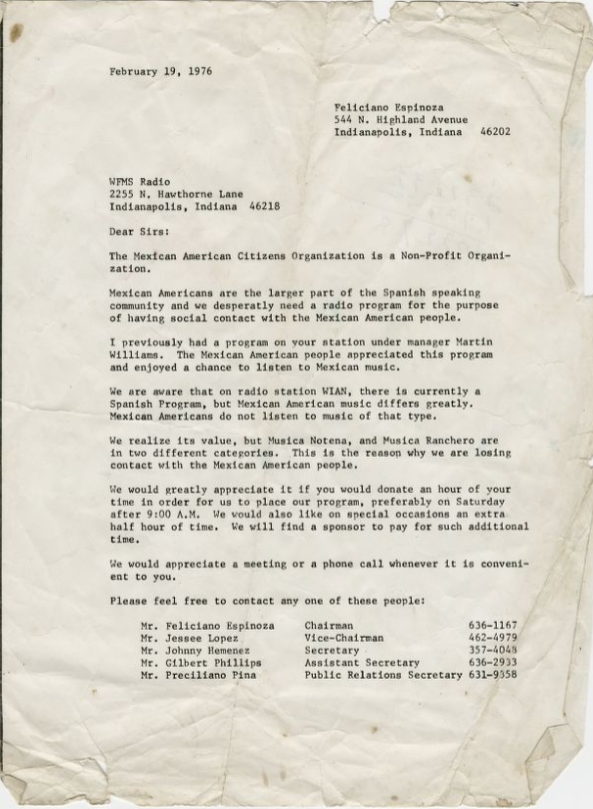
Letter to WFMS Radio from Feliciano Espinoza, February 19, 1976 Credit: Connie Hamm, Indiana Historical Society View Source
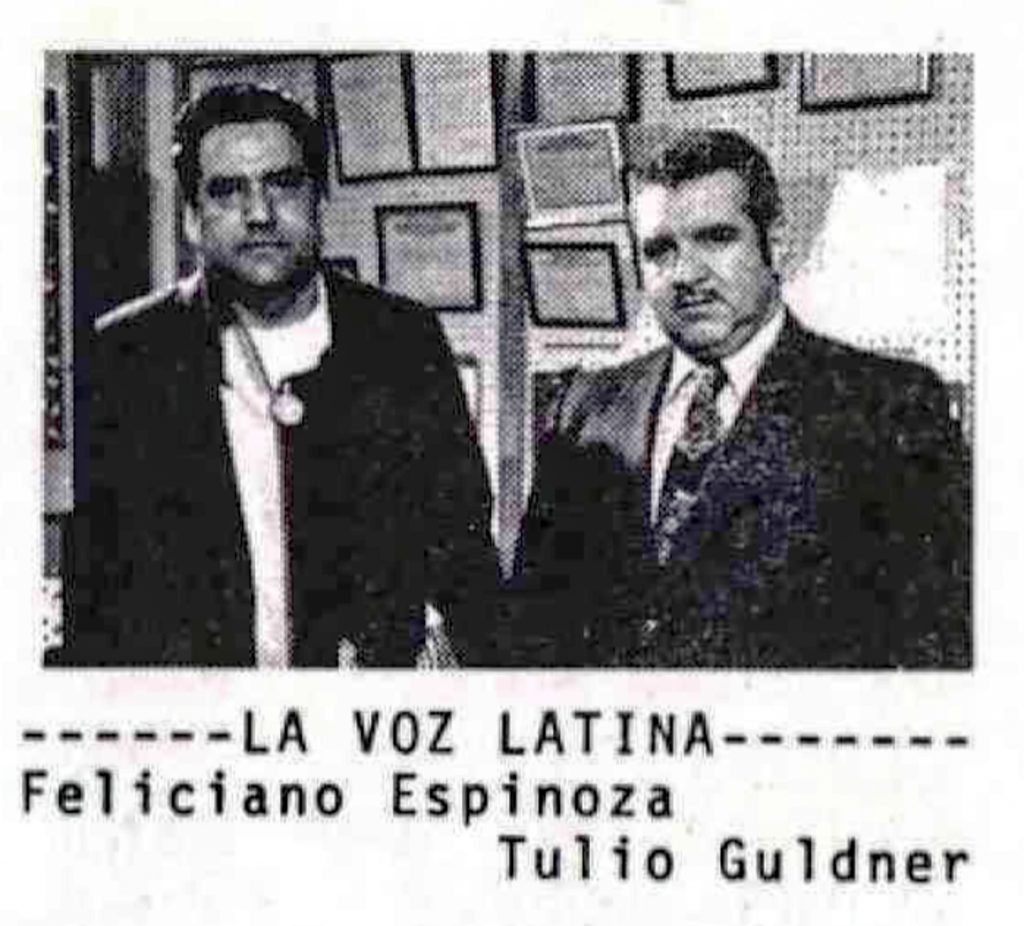
Feliciano Espinoza and Tulio Guldner for La Voz Latina, 1973 Credit: Indianapolis Public Library View Source
1970: Downtown Mexican Restaurants
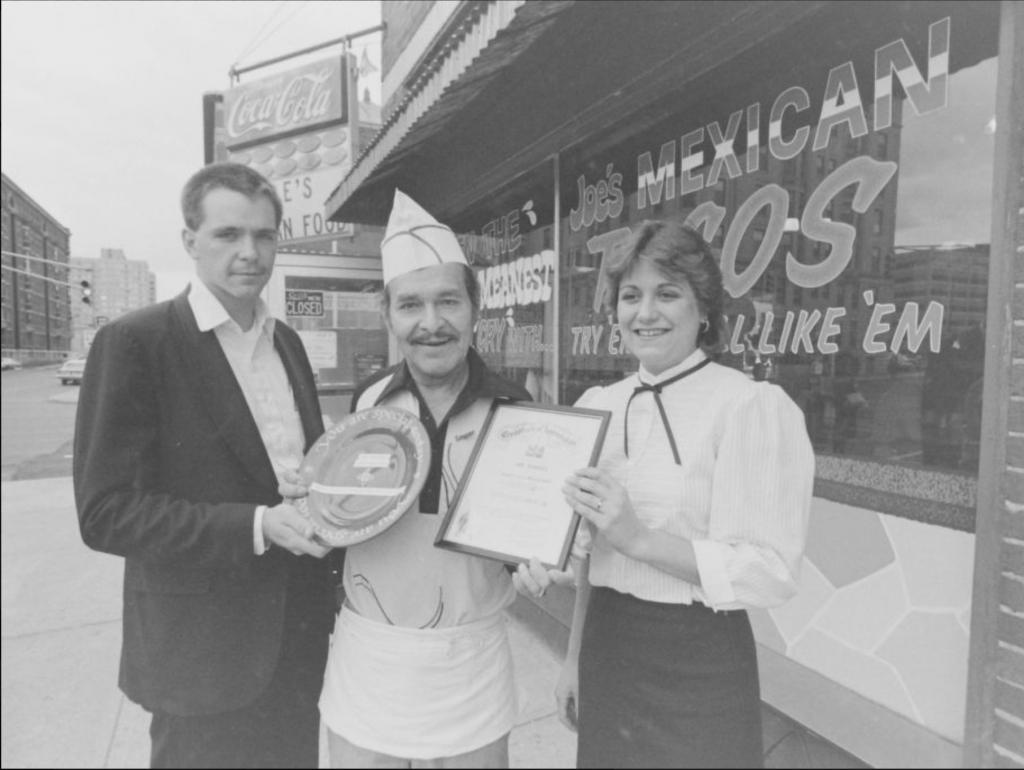
In 1961, Mexican native Joe Rangel opened Joe’s Fine Foods at 342 N. Illinois Street. Nine years later, he began serving Mexican food specials on Tuesdays and Wednesdays, which became a major draw for his small restaurant. After becoming a US citizen that same year, Rangel changed the name of his eatery to Acapulco Joe’s and exclusively served Mexican food. In 1978, Mexican American entrepreneur Maria Ramirez Taylor opened El Sol Restaurant and Market at 2444 E. Washington Street. In 1979, Taylor sold El Sol to Javier Amezcua, a native of Tala, Jalisco, Mexico, who renamed the restaurant El Sol de Tala and Market.
1971: The Hispano-American Multiservice Center
The Hispano-American Multiservice Center, founded in 1971, was borne out of the Hispano-American Association. Its founders included Feliciano Espinoza, Fred Bowman, Tulio Guldner, and Tony Dominguez. In 1972, using a term common in that era, the center estimated that nearly 9,500 “Spanish-Americans” lived in Indianapolis. Like its parent organization, the Multiservice Center focused its efforts on providing job assistance, English classes, and other social services for Indianapolis residents of Latin American backgrounds.
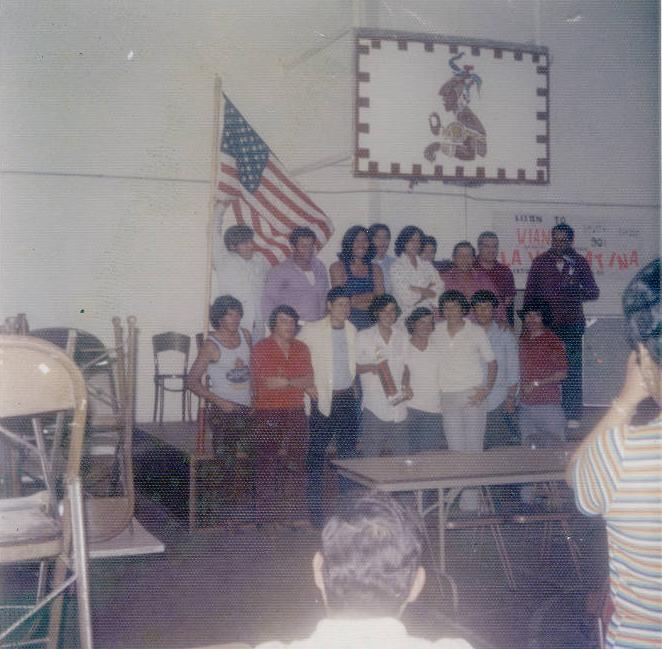
Latine youth at the Hispano-American Multiservice Center, ca. 1975 Credit: Connie Hamm, Indiana Historical Society View Source
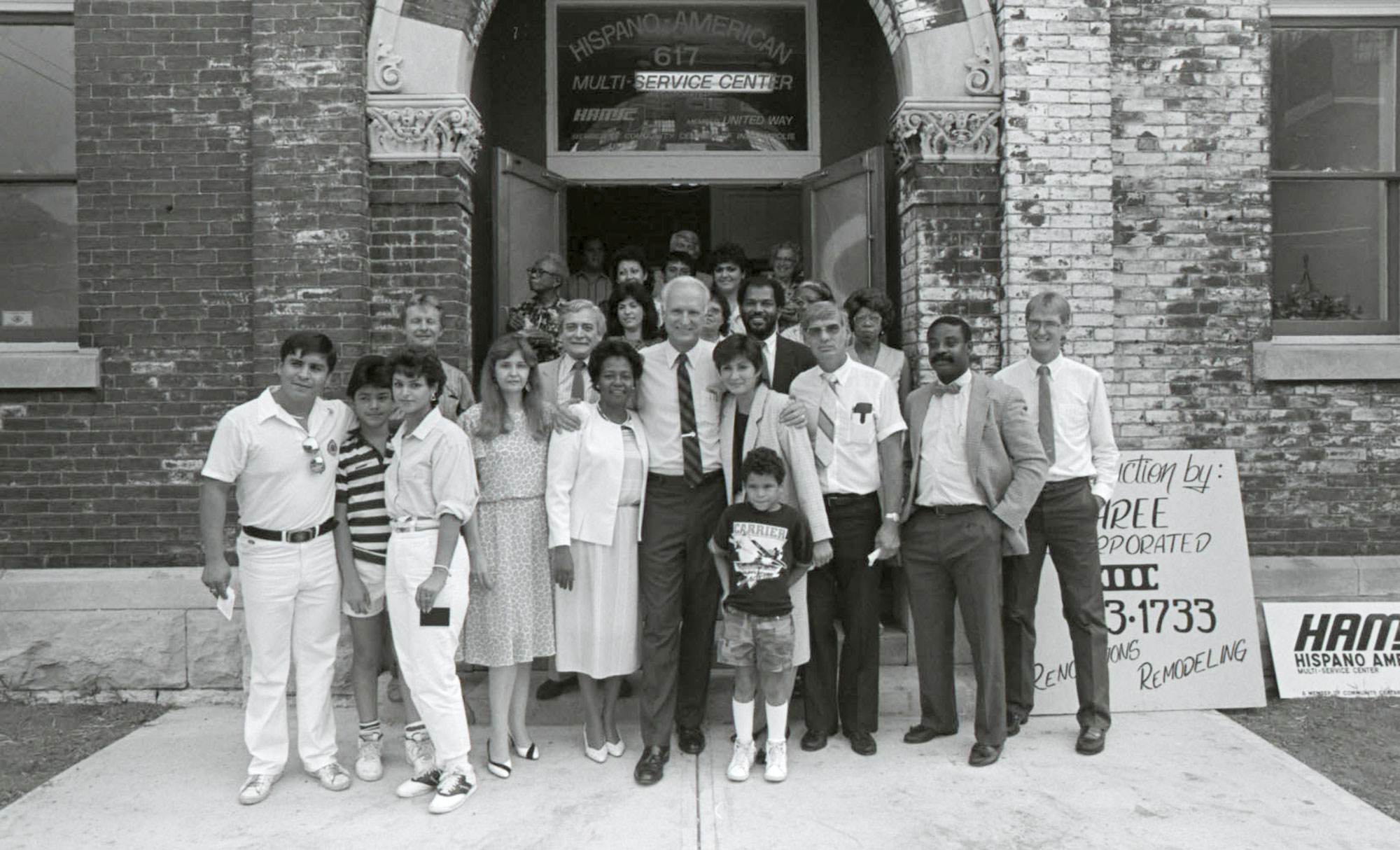
Mayor Hudnut visits the Hispano-American Multi-Service Center at 617 E. North St. in Indianapolis, 1987 Credit: University of Indianapolis View Source
1974: Hispanic Political Affiliations
In 1974, organized Mexican American involvement in Indiana politics expanded after the Republican National Hispanic Assembly received its charter with full recognition from the Republican National Committee. Indiana quickly developed a state-level chapter. The chapter’s early years were marked by contentions with some Republican state officeholders. The chapter’s state chair, Fausto Vergara, resigned in March 1975 after disagreements with Governor Otis Bowen over migrant farmworker advocacy, as well as dismay over the Republican-controlled state senate’s failure to establish a Spanish Heritage Commission. Nonetheless, many Mexican Americans in 1970s Indianapolis became favorable to the Republican Party, due largely to Mayor Richard Lugar’s active outreach to the community. Though local Latine voting patterns later trended toward the Democratic Party for national elections, strong Republican affiliations at the municipal level would persist through the twentieth century’s end.
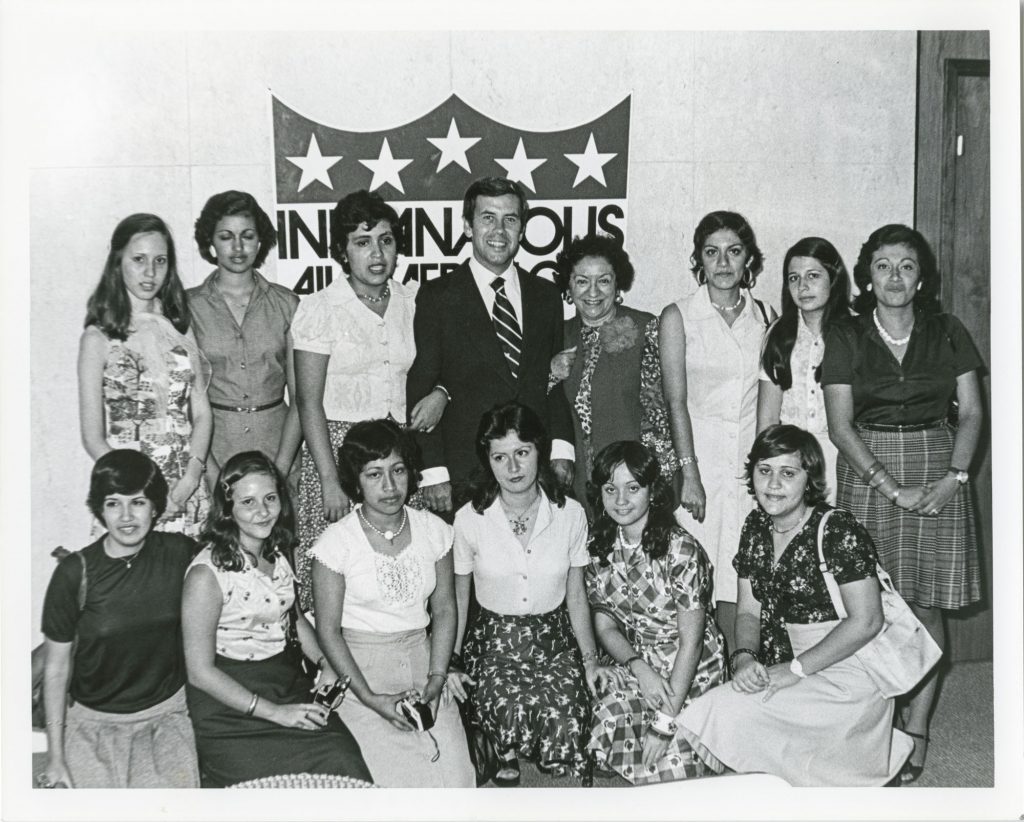
Mayor Lugar meets with a group of Hispanic women visiting Indianapolis, 1976 Credit: University of Inddianapolis View Source
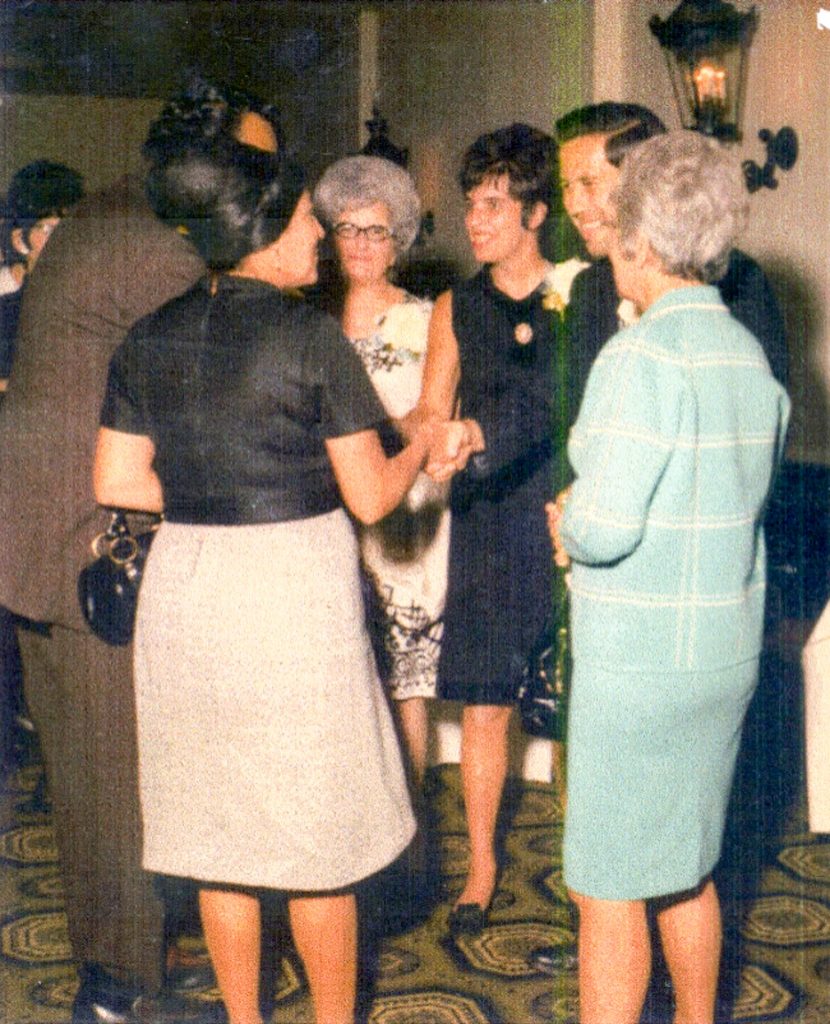
Maria and Feliciano Espinoza shaking hands with Indianapolis Mayor Richard Lugar and his wife Charlene Smeltzer Lugar, ca. 1971 Credit: Connie Hamm, Indiana Historical Society View Source
1975: Governor’s Task Force on Migrants
In 1975, Indiana governor Otis Bowen organized the Indiana Task Force on Migrant Affairs to advise on plans, programs, and services for migrant and seasonal farmworkers, many of whom were Mexican or Mexican American. By 1979, it included four advisory committees and was composed of several state agencies. Notably, the organization AMOS, Indiana’s only Latine-led farmworker advocacy organization, was excluded from the group. A year later, AMOS was forced to dissolve when federal antipoverty grants, upon which it had relied, were redirected to state agencies rather than nonprofit groups.
1975: Hispanic Heritage Week Celebrations
Local public celebrations of National Hispanic Heritage Week began in September 1975, seven years after the commemoration was established nationally by President Lyndon Johnson. That year, Indianapolis’s first annual recognition of the week took place at Ft. Benjamin Harrison, with partnership from the Hispano-American Multiservice Center. Events at the Fort included a guitar mass at the Catholic chapel, a softball game, a variety show, and an evening street dance. The Hispano-American Multiservice center hosted an “El Grito” traditional folkloric dance at the center that featured the crowning of a festival queen.
1977–1978: Hispanic Ministries: Catholic and Protestant
In 1977, the Congregation of Christian Churches (Disciples of Christ), headquartered in Indianapolis, appointed a director of program services to support the denomination’s Hispanic and English-Spanish bilingual congregations. This came at a time when only twenty-three Hispanic Disciples of Christ congregations and three bilingual congregations existed nationwide. A year later, Ecuadorian Roman Catholic priest Mauro Rodas began leading the newly established Spanish Speaking Apostolate of the Archdiocese of Indianapolis. By the late 1970s, Father Rodas had assumed full-time duties at St. Mary, home of the largest Latine congregation in Indianapolis and host to parishioners from Colombia, Costa Rica, Cuba, and Mexico, as well as many long-settled Mexican Americans.
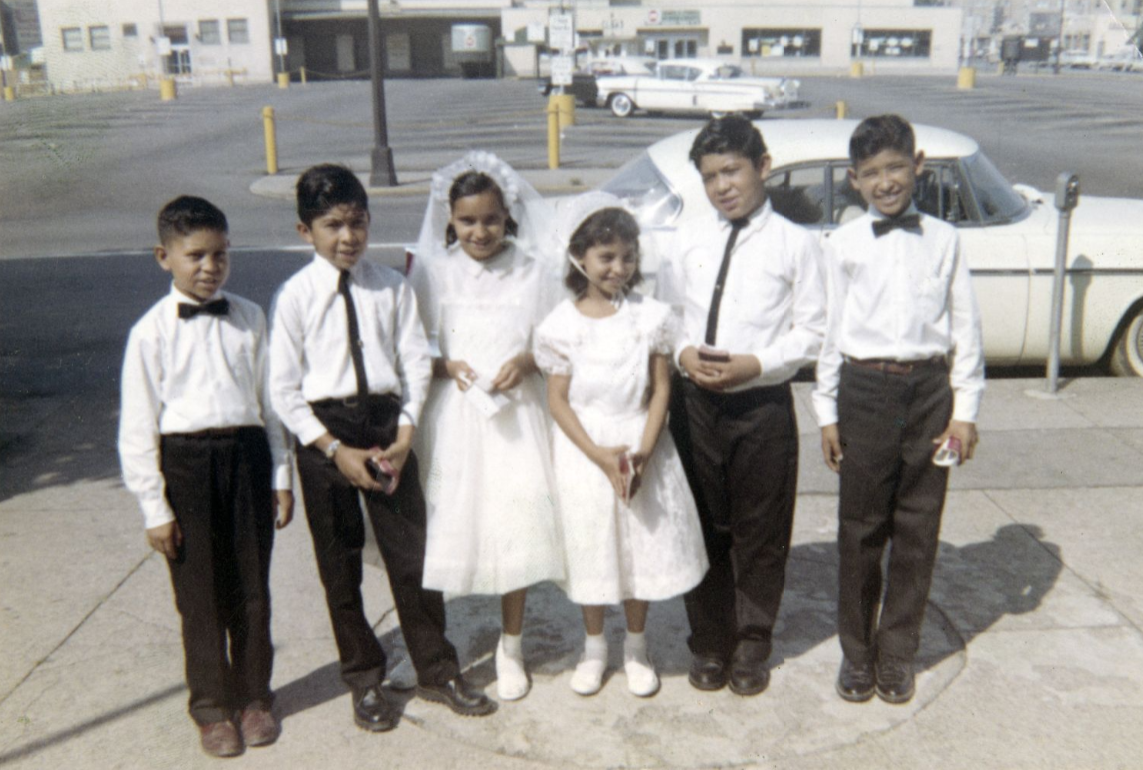
1980s
6,143 Hispanics in Indianapolis and Marion County per US Census
Why this number deserves a second look…
The 1980 US Census made a second effort to count Latine and Hispanic populations through improved questionnaire design and expanded outreach. As a result, these communities became more statistically visible, with Indianapolis ranking fourth among Indiana cities in reported Hispanic population. However, census data remained limited, reporting ethnicity primarily at the state level and grouping individuals under the broad category “Hispanic” without distinguishing between specific national or ethnic origins.
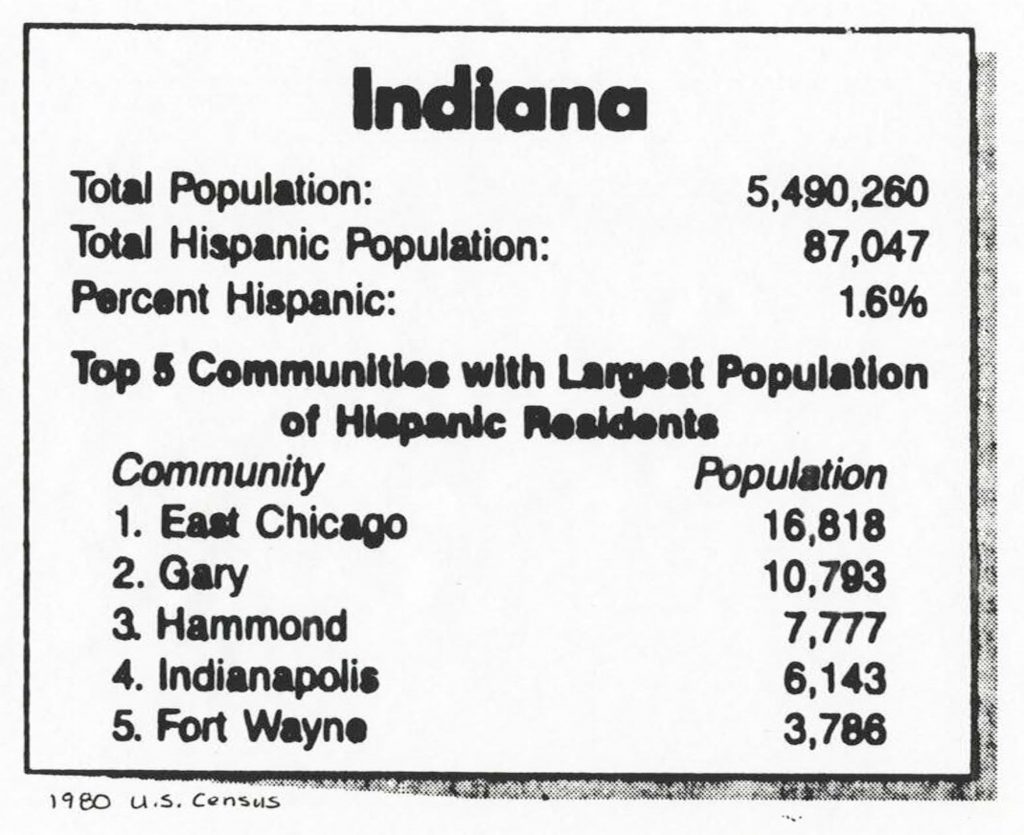
The 1980s marked a period of visible activism and self-advocacy by Latine community members in Indianapolis and nationally, leading to increased support from political leaders. In 1986, the federal Immigration Reform and Control Act, signed by President Ronald Reagan, granted nearly three million undocumented immigrants legal status. About 85 percent of the beneficiaries were from Mexico and other parts of Latin America. In the Indianapolis area, growing numbers of large-scale events were developed that celebrated local Latine heritage—as well as the histories and cultures of specific Latin American counties—as a way to foster appreciation among wider regional audiences.
Expand sections below for more info.
1981: Fiesta Indianapolis
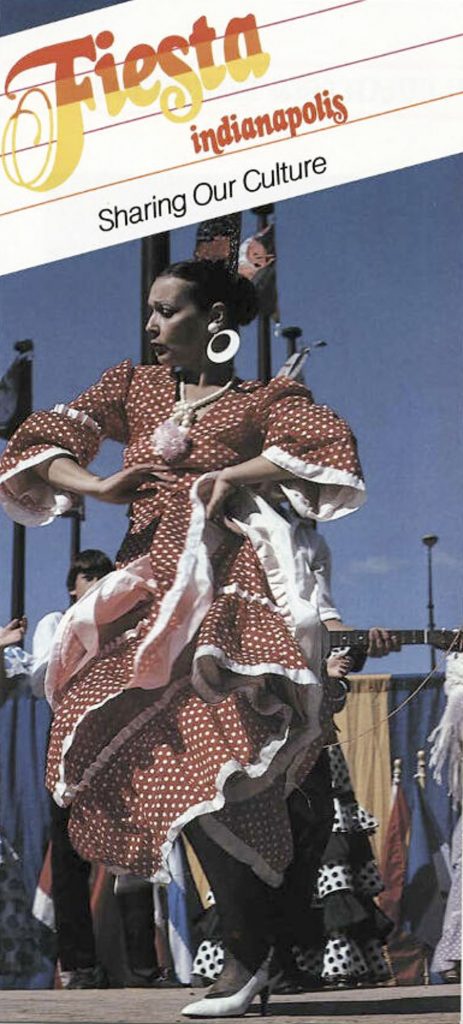
In September 1981, Fiesta Indianapolis, a cultural education organization supported by the Hispano-American Multiservice Center, held its first annual festival using Obelisk Park in downtown Indianapolis as the venue. Then and now, the all-day celebration aims to educate visitors and participants about the diversity of cultures and countries in the Caribbean, Mexico, and Latin America. By the end of the 1980s, Fiesta Indianapolis had become the largest Hispanic festival in the state. Yet the contested nature of Latine communities’ presence in central Indiana was demonstrated when La Plaza canceled the 44th annual Fiesta in 2025. Organizers attributed their decision to concerns over the safety and well-being of Latine guests amid intensified federal immigration enforcement measures.
1984: Securing the 1987 Pan American Games for Indianapolis
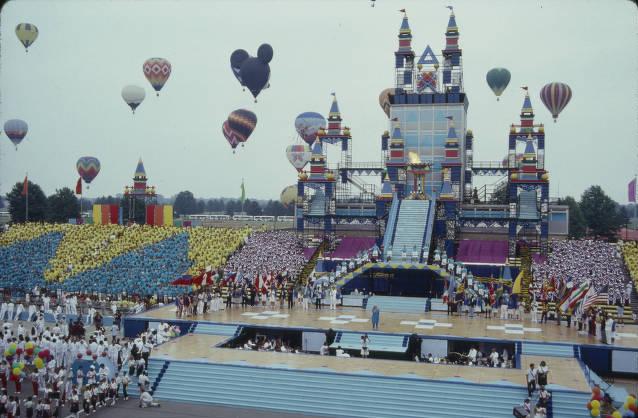
In 1984, Cuban American business executive Orencio Diaz and civic leaders Sandy Knapp, Mark Miles, and Nancy Orr attended the Pan American Sport Organization Congress in Mexico City to present Indianapolis’s bid to host the 1987 games. Diaz’s work as the translator and main relational facilitator proved instrumental in Indianapolis’s ultimately successful proposal. The following year, the same hemispheric sports body held its meeting in Indianapolis and formally named the city as the 1987 host. Latine-headed committees charged with organizing medical care for the athletes and recruitment of Spanish-speaking volunteers attended the meeting, guided by Indianapolis leaders of Mexican, Cuban, Colombian, and Puerto Rican background, including Orencio Diaz, Josue Villalta, Alfredo “Fred” Garcia, Graciela Espinosa, Elba Gonzalez, and Hilton Cancel. The Hispano Center, the newly formed Greater Indianapolis Hispanic Chamber of Commerce (founded in 1981), and Fiesta Indianapolis assisted the Latine-headed committees.
1988: Hispanic Education Center
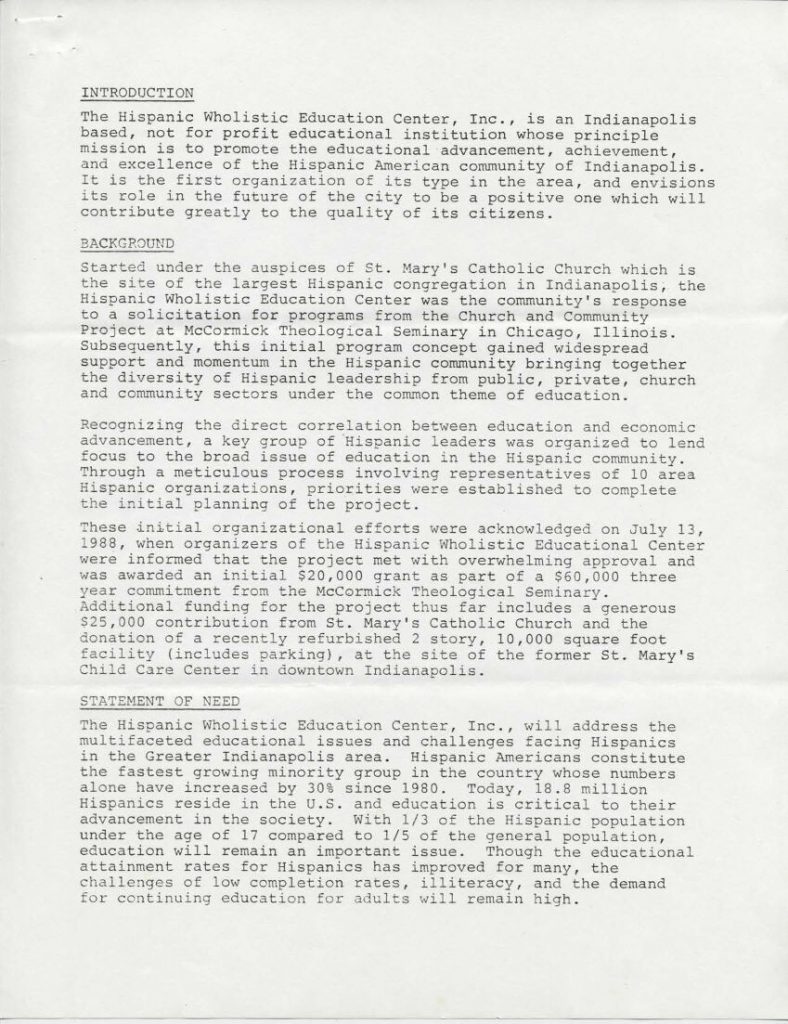
The Hispanic Holistic Center, also called the Hispanic Education Center, opened its doors in 1988. It offered after-school care, youth and adult education classes, English as a second language classes, and citizenship preparation courses.
1990s
4,525 Mexicans and Mexican Americans in Indianapolis and Marion County per US Census
During the 1990s, Marion County’s Hispanic population exploded by almost 300 percent. Local Latine-serving community institutions responded to national public health crises and economic transformations through targeted programming and initiatives across Indianapolis.
Expand sections below for more info.
1990–1995: HIV/AIDS Advocacy
During the early 1990s, the Hispano-American Multiservice Center, renamed El Centro, expanded its services and became a local advocate for HIV/AIDS awareness and support within Indianapolis’s Latine community.
In 1990, El Centro displayed twenty sections of the Names Project AIDS Quilt, created by prominent LGBTQ+ activist Cleve Jones, who had grown up in West Lafayette, Indiana. The exhibition, meant to raise awareness of the epidemic’s effect on Indianapolis’s Latine communities, was organized by El Centro youth counselor Chris Gonzalez and executive director Monica Medina. A 1992 Centers for Disease Control grant provided funding for El Centro to host a leadership camp for Latine youth, focused on HIV/AIDS education. El Centro also provided anonymous HIV/AIDS testing through federal grants.
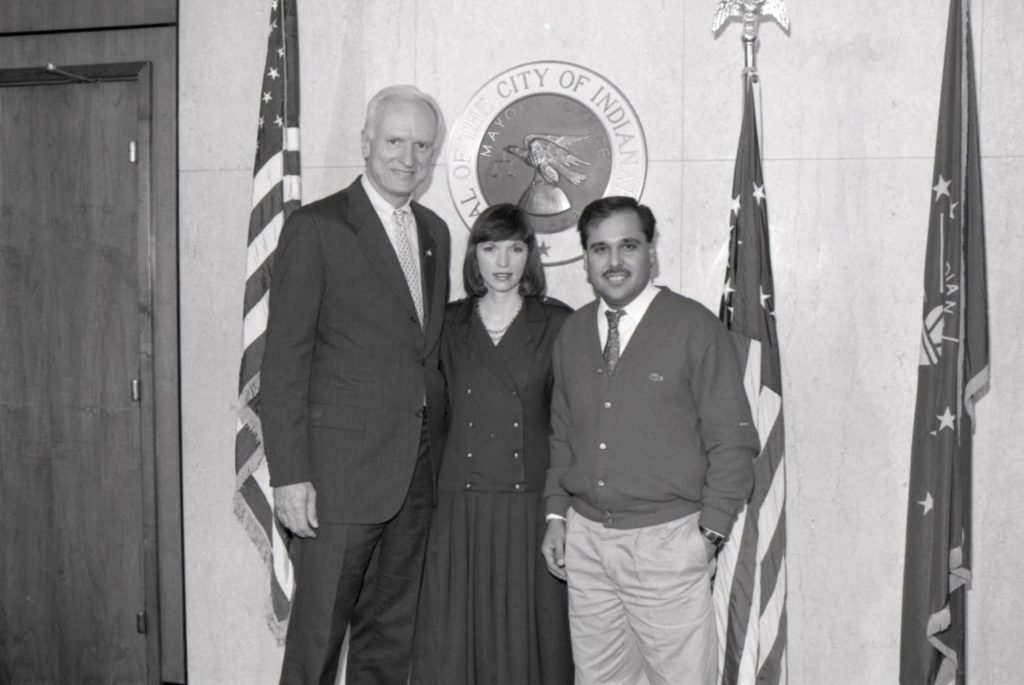
However, El Centro’s Spanish-language HIV/AIDS education work, which had been led by Gonzalez, proved controversial, causing dissension within the group’s governing board. Gonzalez died in 1994, and El Centro underwent an organizational restructuring the same year. In 1995, El Centro ceased its HIV/AIDS-related programming, though it continued to address other health disparities affecting the region’s Latine population. Latine-led HIV/AIDS services would not be reestablished locally until 1998, when the Damien Center began provision of culturally specific support.
1992–1994: NAFTA and Growth of Indianapolis’s Mexican-Owned Businesses
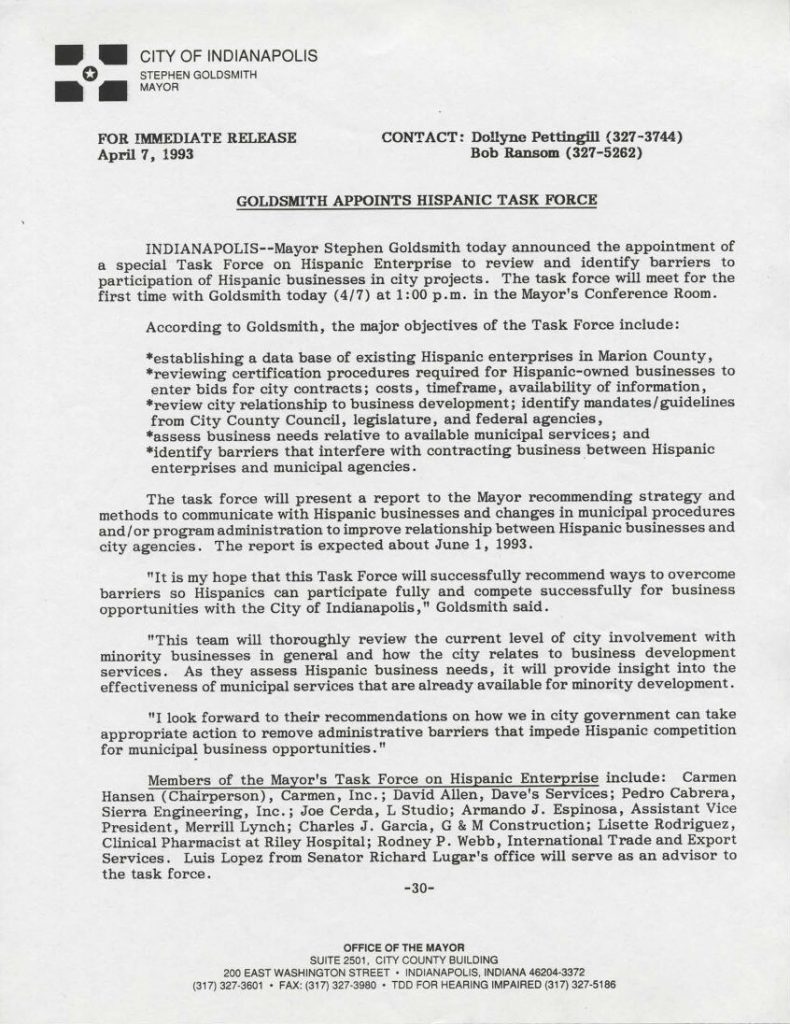
The signing of the North American Free Trade Agreement (NAFTA) in 1992 and its implementation in 1994 ended most tariffs and trade barriers on goods and services traveling between Canada, Mexico, and the United States. Due to Indianapolis’s status as a crossroads of international travel, segments of the local business community gained access to expanded markets. Indiana extended its portion of Interstate 69, finishing the continuous segment from the Canadian border at Port Huron, Michigan, to Evansville, Indiana; later extensions to the south connected I-69 to Mexico at three points. Local companies like Saniserve Corporation, owned by Gabe Aguirre, a founder of the Hispanic Chamber of Commerce, benefited from increased trade opportunities. The growth in Hispanic entrepreneurship led Mayor Stephen Goldsmith in 1993 to launch a special taskforce on Hispanic enterprises, meant in part to identify barriers to participation in city projects by local Hispanic businesses.
While NAFTA strengthened trade, it also disrupted Mexico’s agricultural sector, contributing to the displacement of many small-scale Mexican farmers. One consequence of this economic hardship was Increased migration to the US. Many newcomers settled in Indianapolis and central Indiana, increasing the population of the region’s Mexican communities.
1994: Spanish Immersion at Indianapolis Schools
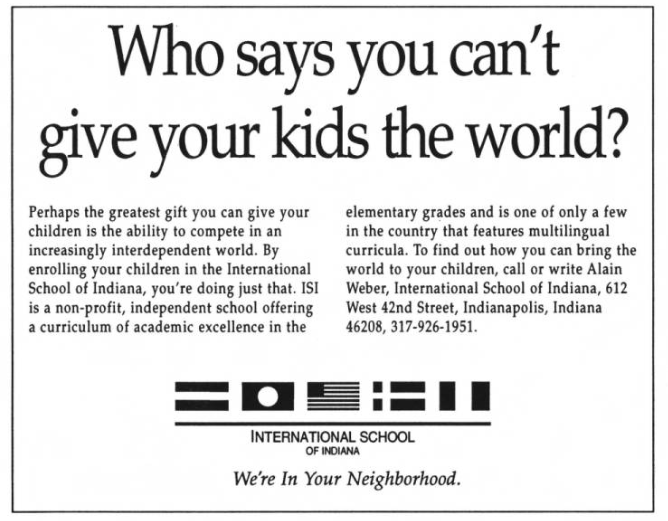
Indianapolis elementary schools started to respond to their growing Latine student populations in the 1990s. In 1994, Forest Glen, a school in Marion County’s Lawrence Township, created a widely cited model for dual-language immersion programs. That same year, the International School of Indiana, a private tuition-based institution, opened its doors as a language immersion school. It would take until 2005 for the Indianapolis Public School system to offer its first Spanish immersion program. That year, Theodore Potter School 74 transitioned from a traditional elementary school to a dual-language immersion school through a partnership with the Spanish Ministry of Education’s Visiting Teacher Program.
1995: Expanding Spanish-Language Health Offerings
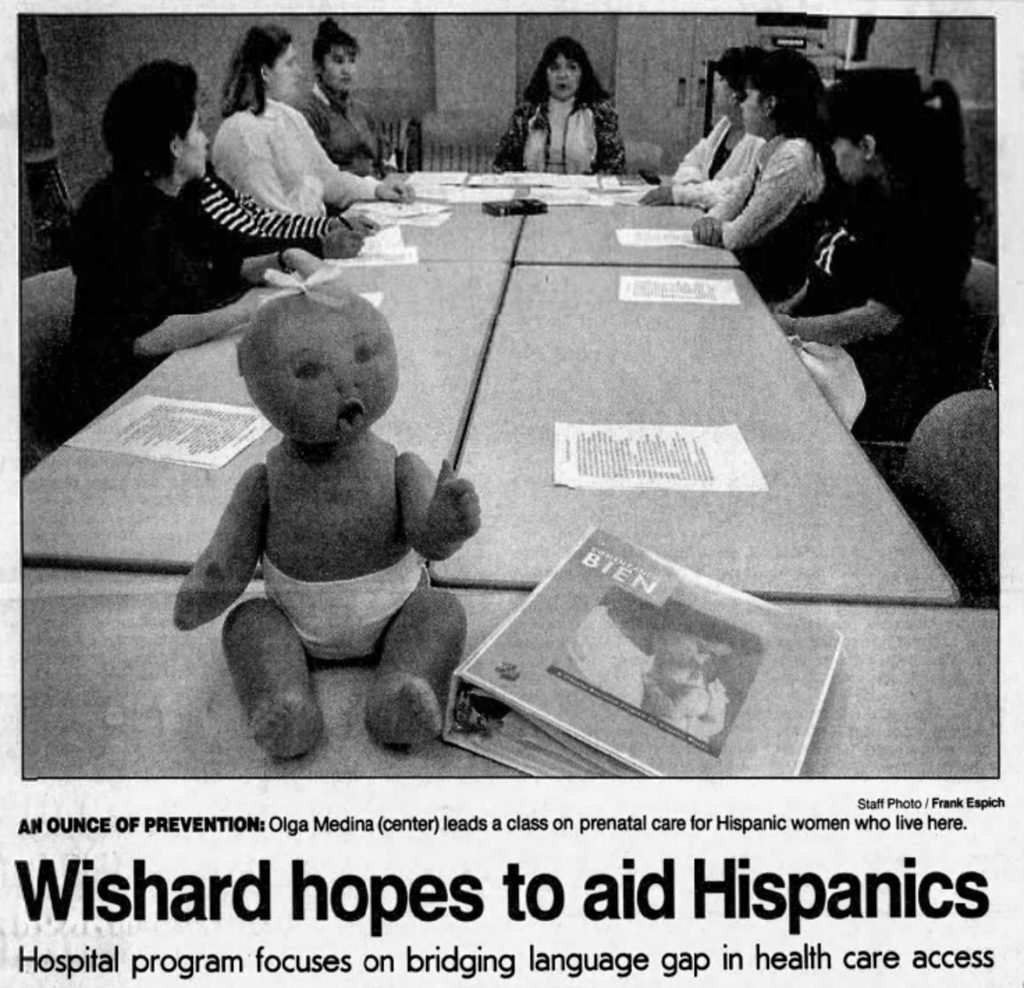
In 1995, Aida McCammon, originally from Peru, partnered with Wishard Hospital to launch the Hispanic Health Project, addressing the shortage of Spanish-speaking medical interpreters in Indianapolis hospitals. The project later incorporated training to help medical staff better serve their Spanish-speaking patients. This earned it recognition from the US Department of Health and Human Services as a model program.
1996: Expanding Spanish-Language Religious Services
In 1996, Indianapolis’s Spanish speakers obtained increased access to religious services when the city’s Roman Catholic archbishop, Daniel M. Buechlein, established the Office of Multicultural Ministry and urged Indianapolis Catholic churches with Latine parishioners to add dedicated Spanish-language masses. Yet prior to this, several local parishes had offered Spanish-language outreach programs and masses. The forerunner was St. Mary Catholic Church, which began such services in 1967 and became a Latine cultural hub, followed by St. Patrick Catholic Church in Fountain Square in 1994. After the archbishop’s 1996 instruction, the archdiocese’s Office of Multicultural Ministry integrated those parish-level efforts into a wider Spanish-Speaking Apostolate, which incorporated ongoing programs at St. Mary and St. Patrick, as well as new services at St. Monica Catholic Church in Crooked Creek and St. Philip Neri Catholic Church in the Westminster neighborhood. Within three years Spanish-language masses had also been adopted at Catholic churches in Hamilton and Johnson counties.
2000s
22,401 Mexicans and Mexican Americans in Indianapolis and Marion County per American Community Survey
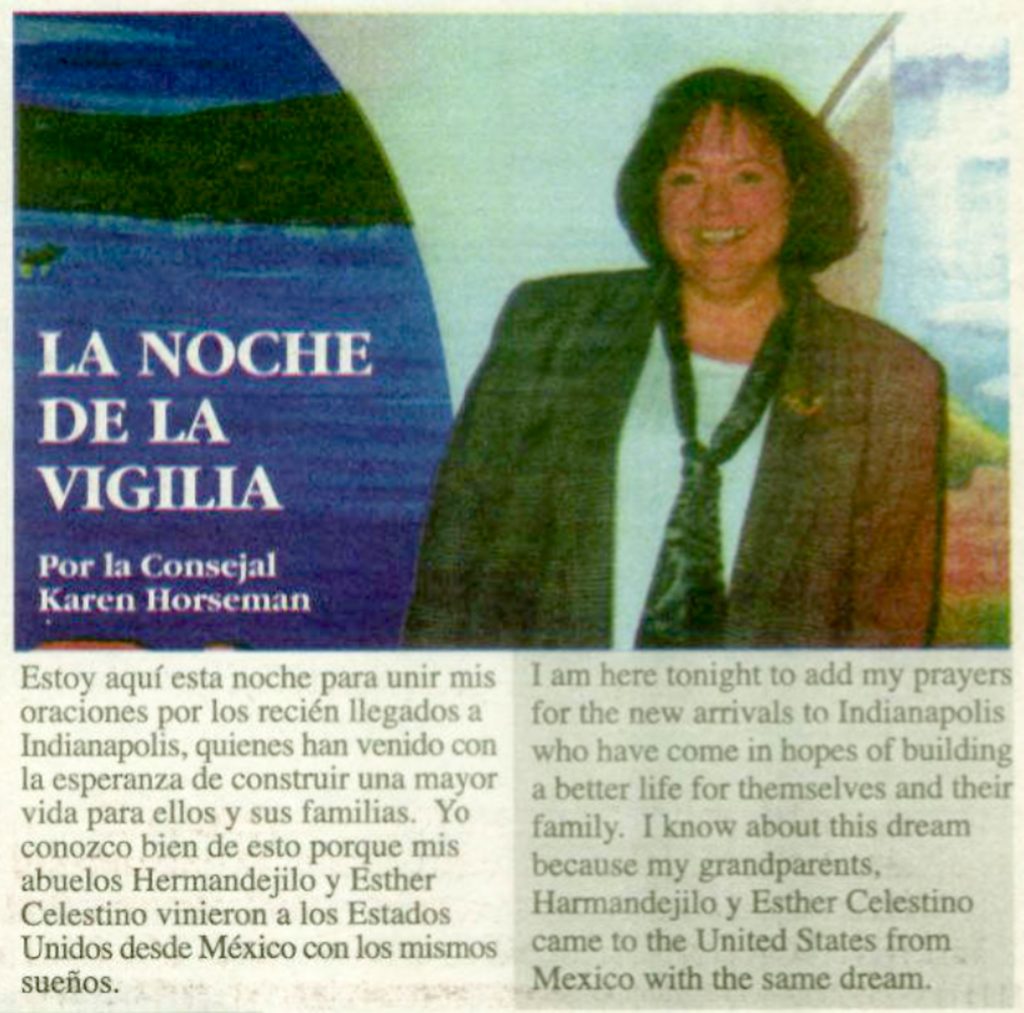
As Indianapolis’s Mexican and Mexican American population grew in the 2000s, so too did the efforts to support the needs of the city’s Mexican-descended residents through new organizations, educational programs, community services, and cultural events. In 2000, the United Way of Central Indiana release a comprehensive study of the Indianapolis Hispanic community that highlighted many of these needs and helped guide initiatives to address them. The century’s first decade featured numerous milestones that reflected the expanding presence of Indianapolis inhabitants with ties to Latin American countries, including Mexico. These included the opening of an Indianapolis Mexican consulate, the creation of multiple scholarship funds, and growing Mexican American engagement in local politics and civic life. Notable here was the election of the first Hispanic member of the Indianapolis City-County Council, Karen Celestino-Horseman, an attorney of Mexican American background.
Expand sections below for more info.
2002: The Mexican Consulate—Partners in Trade and Culture
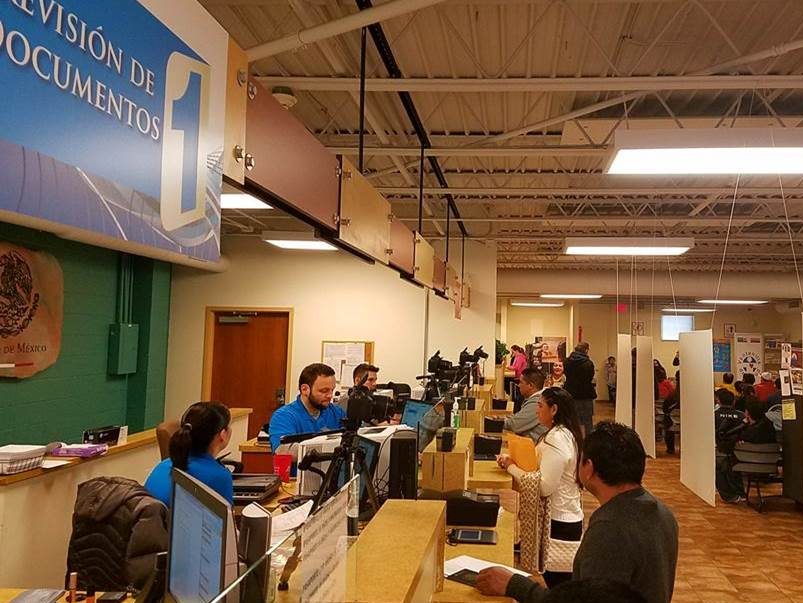
Until the 2000s, the Mexican consulate in Chicago provided mobile consular services to Indianapolis Mexican-born residents through the local El Centro community organization. But growing local need led to the opening of Indianapolis’s own Mexican consulate at Union Station in November 2002. Beyond consular assistance, the office supported cultural programs, including a Mexican Film Festival managed in partnership with the Indianapolis Public Library, and El Grito, an annual celebration of Mexican Independence Day held at Garfield Park.
In fall 2002 the Mexican Consulate began issuing a matricula consular or Mexican ID card to Indianapolis’s Mexican residents. The cards, issued regardless of the applicant’s legal status in the US, helped recipients open a bank account, conduct business, find employment, obtain a driver’s license, enroll their children in school, receive a library card, and access home utilities. In June 2003, Indianapolis mayor Bart Peterson ordered city departments to recognize the consular identification, indicating the growth and local economic significance of the city’s Mexican and Mexican American population.
The Mexican consulate also strengthened existing economic and political ties between Mexico and Indiana. These were already well established in the years preceding the consulate’s establishment. By the early twenty-first century, Mexico was tied with the United Kingdom as Indiana’s second-largest foreign export destination, with six percent of Indiana exports traveling to that market. Trade with Mexico supported 44,000 Hoosier jobs and accounted for $2.2 billion in Indiana exports.
2003: Indiana Latino Institute
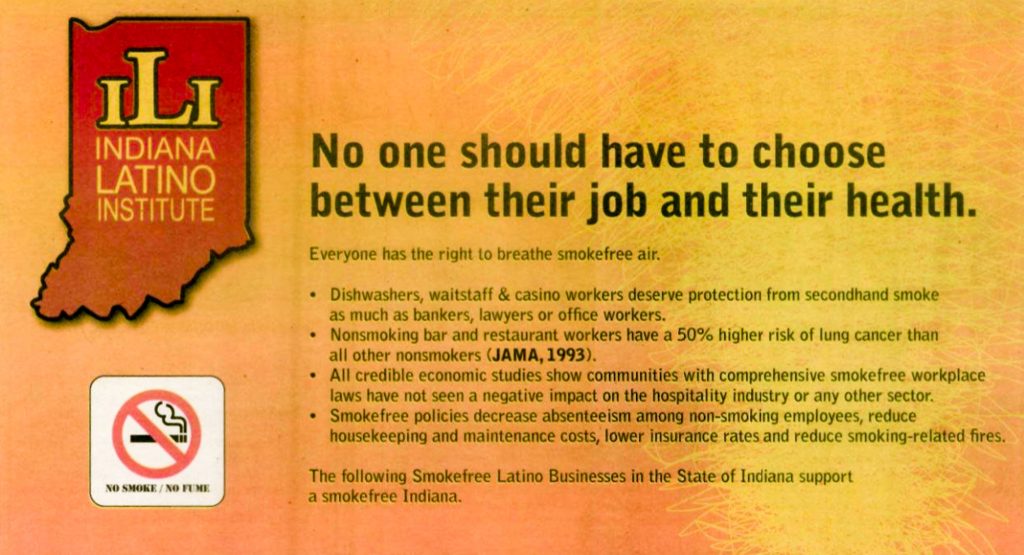
Aida McCammon co-founded the Indiana Latino Institute (ILL) in 2003. McCammon, director of Wishard Hospital’s Hispanic Health Initiative, served as the first president and CEO of the ILL. The organization addressed the disparity in health outcomes and education services facing Indianapolis’s Latine communities. Initial funding for programming to combat smoking and alcohol abuse came from the Indiana Tobacco Prevention and Cessation Agency. McCammon advocated for expanded public health education for local Latine residents and worked to implement a local and statewide ban on smoking in restaurants and bars. In 2006, Indianapolis and Marion County banned indoor smoking in public settings, and a similar statewide ban took effect in 2012.
2004: Creation of La Plaza Inc.
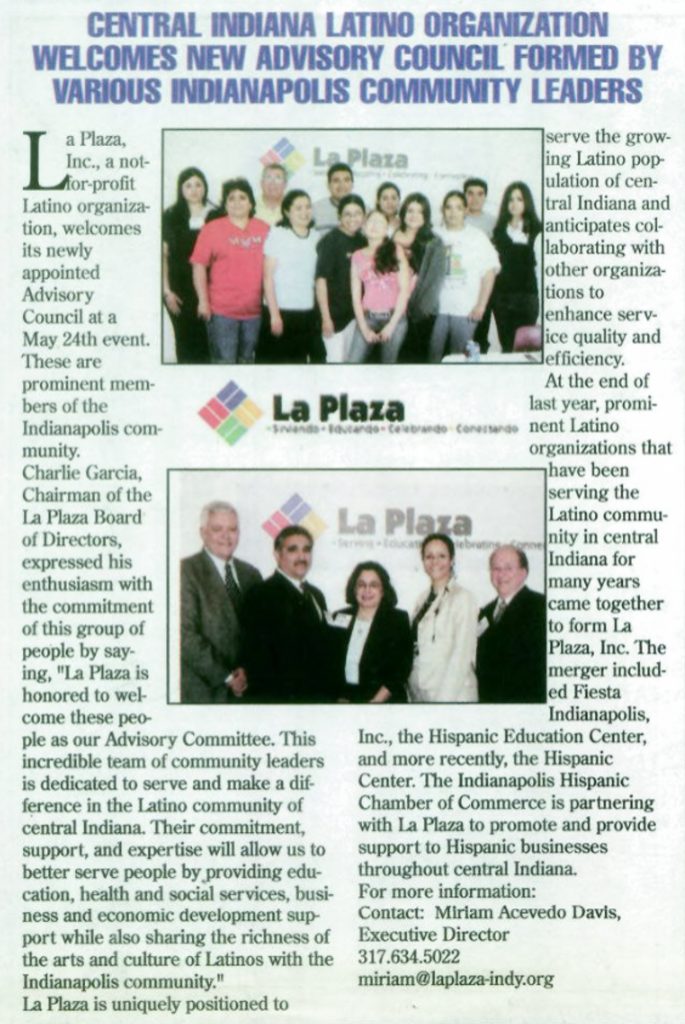
In 2004, three of Indianapolis’s organizations dedicated to serving Latine populations—the Hispanic Education Center, FIESTA Indianapolis, and the Hispanic Education Center—merged to become La Plaza Inc. The goal was to eliminate duplication of services and increase effectiveness, visibility, and financial support.
As Central Indiana’s oldest nonprofit aimed specifically at Latine community needs, La Plaza provides workforce development, social services, and education programs in Indianapolis. In 2024, the organization received the Indiana University Spirit of Philanthropy Award for its work to prevent summer learning loss for elementary and secondary students, college prep workshops for high school students, and scholarships to students entering universities.
2004–2007: Scholarship Initiatives for Latine Students
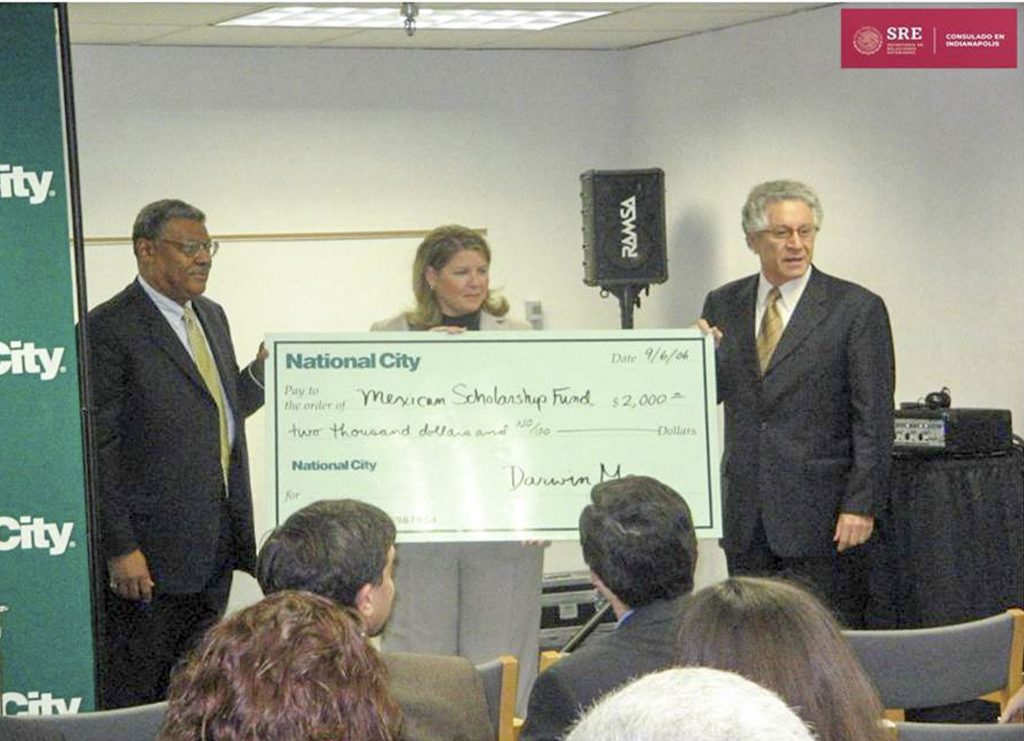
In 2004, Indiana’s first Mexican consul, Sergio Aguilera, along with his wife, Lori Efroymson-Aguilera, created the Mexican Scholarship Fund, administered by the Central Indiana Community Foundation (CICF). The scholarship supports Indiana residents of Mexican descent pursuing higher education or trade school. Since its inception, the fund has distributed more than $2.5 million to eligible students. In 2007, Aguilera appealed to USA Funds (now Strada Education Network) and CICF with a new scholarship idea called the Latino Scholarship Fund. Collaborating partners included La Plaza Inc., Indiana Latino Institute, Sociedad Amigos de Colombia, CICF, Strada Education Network, the Mexican Scholarship Fund, and Project Stepping Stone. The collaboration allowed for more scholarships, in larger amounts, to reach Latine Hoosier students. The Latino Scholarship Fund remains the largest fund specifically for Latine students in Indiana, with cumulative awards exceeding $3 million as of 2026.
2006: Immigration Justice Demonstrations
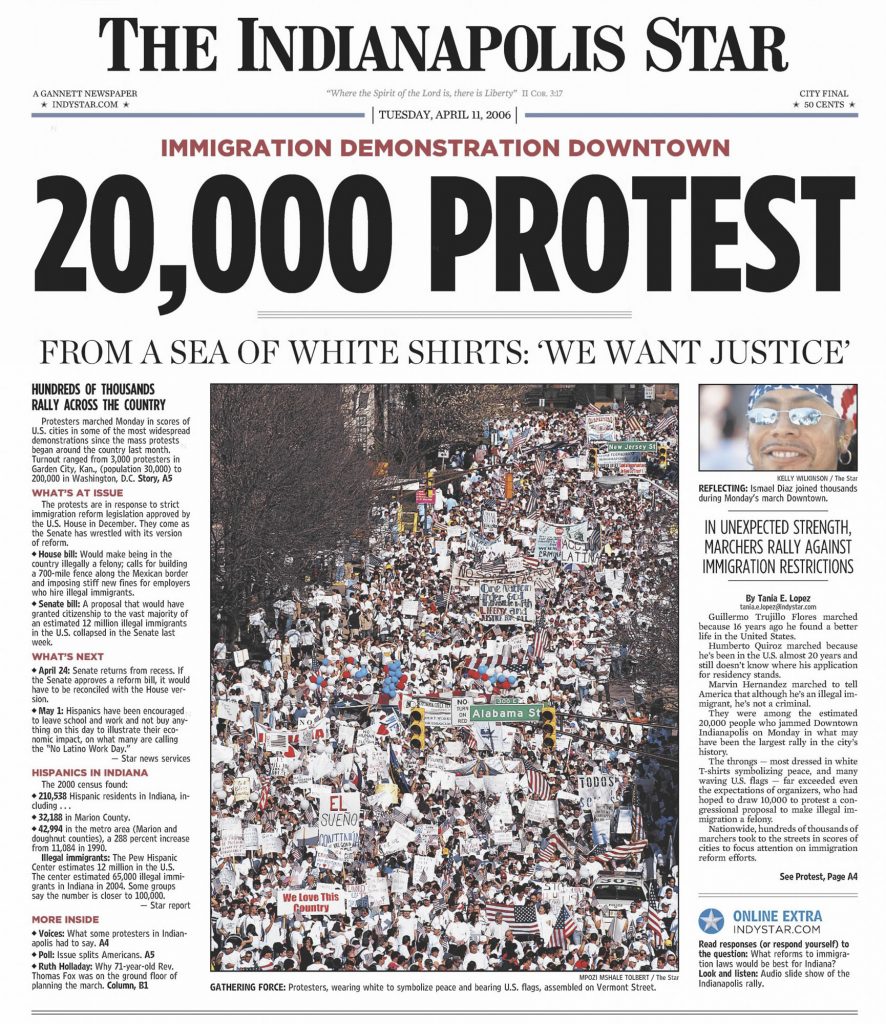
One of Indianapolis’s largest demonstrations protesting potential US anti-immigration legislation took place on April 10, 2006, the day of the national “Day of Action for Immigrant Justice.” An estimated 20,000 people marched from St. Mary Catholic Church to the Indiana State Capitol to show their opposition to the proposed federal Sensenbrenner Bill, calling for mass deportations of undocumented immigrants and criminal charges against people helping undocumented immigrants. The next month, on May 1, many of Indianapolis’s immigrant-owned businesses, such as Mama Inez Bakery, participated in “A Day without an Immigrant,” where immigrants and those who supported them were urged to abstain from work or shopping, and to keep their children home from school, as a demonstration of how heavily local economies and schools relied on immigrant participation.
2010s
67,878 Mexicans and Mexican Americans in Indianapolis and Marion County per American Community Survey
Continued growth in Indianapolis’s Mexican and Mexican American population (67,878 Mexicans and Mexican Americans in Indianapolis and Marion County per 2010 American Community Survey estimates), as well as its Latine population more generally, prompted increased advocacy efforts and community resource throughout the 2010s. During this decade, local initiatives were shaped in large measure by national policy developments. Those included debates over federal immigration policy and President Barack Obama’s 2012 creation of the Deferred Action for Childhood Arrivals (DACA) program. In Indianapolis, organizations emerged to support undocumented youth, offer needed services, and foster greater educational and career access for young adults.
Growth of Latino Advocacy and Community Services
Indianapolis’s Latine community as a whole developed new advocacy and service organizations while pressing the state government to address constituents’ needs. Groups such as the Indiana Undocumented Youth Alliance and Indiana Latino Expo expanded support for immigrants and Latine residents. Meanwhile, municipal government recognized the community’s importance through the creation of the Mayor’s Office of International and Latino Affairs.
Indiana Undocumented Youth Alliance: This group’s founding in 2011 was inspired by a peaceful political protest at the office of Indiana governor Mitch Daniels. Five undocumented immigrant students demonstrated in opposition to proposed state legislation targeting the rights of undocumented students and workers, which would largely affect the city’s Mexican and Mexican American community. The Indianapolis-based nonprofit organization was formed to provide scholarships to undocumented Indiana students seeking higher education and host workshops to inform the community on how to respond to local enforcement activities by federal immigration agents.
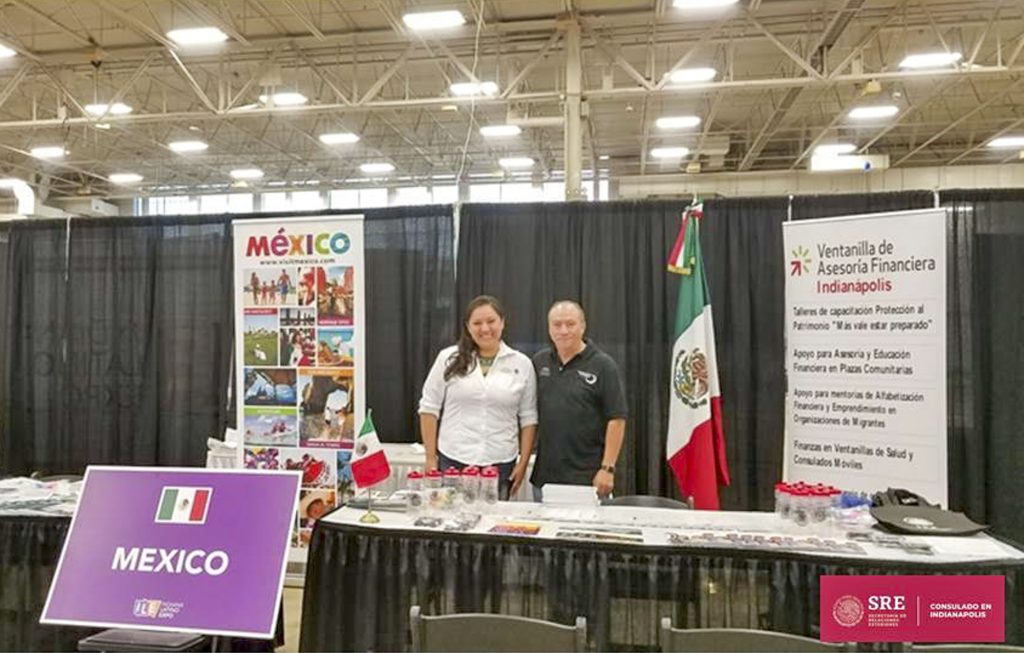
Indiana Latino Expo: The first Indiana Latino Expo occurred at the Indiana State Fairgrounds on June 23, 2012. Modeled after the Indiana Black Expo, the Indiana Latino Expo was a collaboration drawing together many Latine leaders and organizations, including those of Mexican and Mexican American ethnicities. Founders aimed to address the growing needs of the city’s diversifying Latine community. Features of the Expo included the provision of direct services, such as consular mobile clinics, from different Chicago-based Latin American consulates.
Mayor’s Office of International and Latino Affairs: In 2016, Mayor Joe Hogsett’s administration renamed the existing Office of International Affairs as the Office of International and Latino Affairs. The changed title recognized the growing size and importance of Indianapolis’s Latine community.
Supporting Latino Success from School to Profession
During the 2010s, Indianapolis Latine organizations expanded educational and career development programs. Because people of Mexican descent made up the largest segment of the city’s Latine population, these initiatives played an important role in supporting Mexican and Mexican American students and young professionals. Organizations such as the Indiana Latino Institute and La Plaza launched initiatives that helped prepare students for college, explore career opportunities, and connect with mentors.
Indiana Latino Institute Education Summit: In 2012, the Indiana Latino Institute organized its first annual Education Summit. The event focused on Indianapolis high school students. It later expanded its mission statewide, connecting Indiana teens of Latine background with colleges, trade schools, and financial aid resources, as well as offering exposure to potential employers. In 2019, the Indiana Latino Institute launched its Latino Leadership Circle, a two-year commitment to a program that aims to help young Latine professionals aged 27 to 40 develop professional skills through seminars and mentorship pairings with more experienced peers.
La Plaza Education Initiatives: La Plaza Inc. launched several education programs during the 2010s, supporting primary and secondary students while promoting college preparedness. The Leadership Institute for Latino Youth offered academic and leadership training through a summer camp designed for middle and high schoolers. The Tu Futuro program was a four-year plan to help high school students prepare for college and career paths. The Summer Discovery program for elementary-age students aimed to prevent summer learning loss through field trips and experiential educational activities.
Axis Leadership Program: In 2017, the Indiana Latino Expo collaborated with the Mayor’s Office of International and Latino Affairs to launch the Axis Leadership program. This eight-month program, geared toward young Latine professionals aged 21 to 28, provides mentorship and organizes immersive workshops to help participants develop professional skills.
Preserving Indy’s Latine Heritage
Indianapolis museums had hosted exhibits and celebrations marking the Mexican holiday of Día de los Muertos, or Day of the Dead, since the 1990s. But the 2010s marked a turning point in the public recognition of Latine history and culture. Cultural institutions such as the arts collective NOPAL Cultural and the Indiana Historical Society spearheaded efforts to celebrate Latine traditions and local experiences. These included programs to document community histories and to preserve stories that had long been absent from the historical record.
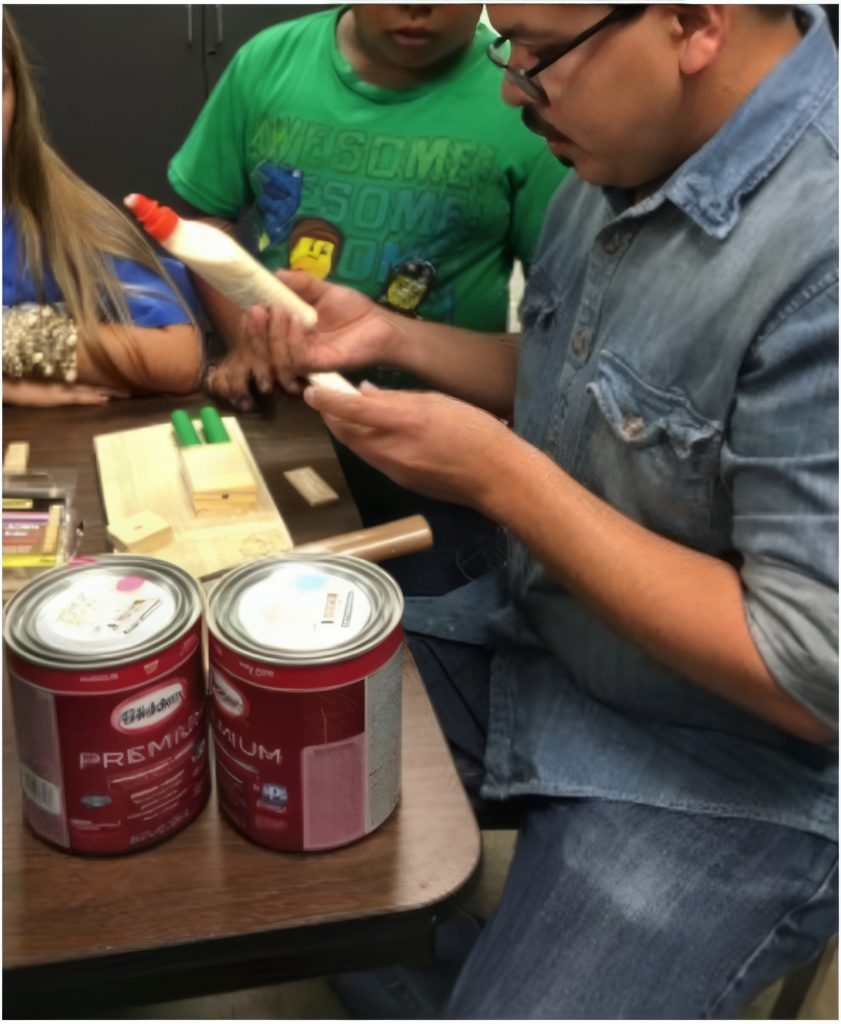
NOPAL Cultural: A local Latine grassroots art collective, NOPAL Cultural formed in 2012 to celebrate Día de los Muerto by blending traditional Mexican culture with contemporary art. Their first Día de los Muertos Catrina-inspired fashion and art show took place at the gallery Studio B in 2012. It featured the iconic Catrina skeleton figure associated with Mexico’s Day of the Dead, as well as elegantly dressed models in Mexican clothing, their faces painted to resemble skeletons. In 2013, the Eiteljorg Museum hosted NOPAL Cultural’s daylong Día de los Muertos celebration, which closed with a procession of elaborately dressed Catrina and Catrines. Community members decorated a gallery of ofrendras (altars). Since then, this Día de los Muertos celebration has continued to be the signature annual event for both the Eiteljorg Museum and NOPAL Cultural.
Indiana Historical Society’s Multicultural Collecting Initiative: In 2016, the Indiana Historical Society (IHS) launched its multicultural collecting initiative, with Nicole Martinez-LeGrand as the first coordinator. The program aimed to fill in major gaps in the organization’s holdings on the state’s history, specifically regarding Latine and Asian communities locally. In 2018, Martinez-LeGrand curated an exhibit titled Be Heard Latino, part of an ongoing IHS Be Heard exhibit series. This offering illustrated a century of Latine history in Indiana, stretching from early Mexican community experiences in the state to the development of the diversified Latin American–descended populations of recent decades.
The Lost Barrio of Indianapolis: In July 2018, Nicole Martinez-LeGrand, Multicultural Collections Curator at Indiana Historical Society, wrote “Finding Indiana’s Latino Stories,” the first of several blog posts about Indiana’s Latine communities and neighborhoods. Though that inaugural piece centered on northern Indiana, later installments turned to Indianapolis, including El Barrio, the downtown eastside neighborhood that had served as a vibrant center for Mexicans and Mexican Americans beginning in the 1930s. Though El Barrio was destroyed throughout 1967 and 1968 for the building of Interstate 65/70, Martinez-LeGrand’s blog posts restored to public attention the area’s name, significance, and principal ethnic makeup.
From a single census entry in 1850 to an established and vibrant Mexican and Mexican American population, the story of this Indianapolis community reflects both persistence and growth. Although early residents were often overlooked in official records, they helped build a foundation for themselves and their descendants. This evolving collection of institutions—neighborhoods, businesses, cultural associations, activist bodies, and community organizations—continues to shape the city that Indianapolis inhabitants share today.
Continue Exploring
Discover related stories and resources in the Encyclopedia of Indianapolis.