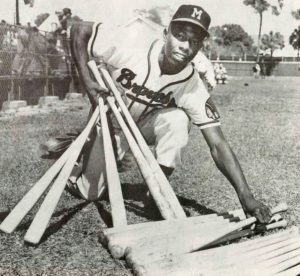
Photo info ...
Henry Louis “Hank” Aaron was a renowned baseball outfielder and hitter, best known for breaking Babe Ruth’s all-time home run record in 1974. His connection to Indianapolis is brief in calendar time but historically significant: it was the , the city’s Negro American League franchise, that gave Aaron his first professional contract, his first professional stage, and the audience of major league scouts that launched his subsequent career.
Aaron was born on February 5, 1934, in Mobile, Alabama, the third of Herbert and Estella Aaron’s eight children. He grew up poor in Mobile’s Toulminville neighborhood during the era of Jim Crow segregation, navigating the indignities of a rigidly divided South. A gifted and instinctive athlete, he played sandlot baseball as a boy while gripping the bat cross-handed, a habit he had developed on his own and that coaches would later correct. Aaron briefly played for the semipro Mobile Black Bears before attracting the attention of the Indianapolis Clowns of the Negro American League.
The Indianapolis Clowns were one of the most distinctive franchises in Black baseball. Founded by promoter , the team had passed through several identities and home cities, including spells as the Havana Red Sox, Cuban House of David, Miami Ethiopian Clowns, and Cincinnati Clowns, before joining the Negro American League in 1943 and becoming the Indianapolis Clowns in 1946. By the early 1950s, in the wake of Jackie Robinson’s 1947 integration of the formerly all-white major leagues, the National and American Leagues were drawing talent and fans away from the Negro Leagues. Though the Negro American League was weakening rapidly, the Clowns continued to field competitive teams. In 1951, seeking larger crowds and better facilities, the franchise relocated its home venue to Offermann Stadium in Buffalo, New York, while retaining the Indianapolis Clowns name and identity.
Aaron signed with the Clowns in 1952 for a salary of two hundred dollars a month, arranged by the club’s business manager, Bunny Downs, after Aaron had been discovered playing with the Mobile Black Bears in an exhibition game against the Clowns. He began with the Clowns as an eighteen-year-old shortstop and immediately blossomed, helping his team to win the 1952 Negro League World Series championship. Though he only played with the team for three months, in 26 games he achieved a .366 batting average, hit five home runs, and stole nine bases. During this spell, Aaron displayed his range of skills to regional scouts and several major league teams. Both the New York Giants and the Boston Braves scouted Aaron while he was playing with the Indianapolis Clowns. Both teams made offers, but Aaron chose Boston’s offer, which was fifty dollars more per month than the Giants had proposed. In June 1952, the Braves purchased his contract from Pollock for ten thousand dollars, a figure that reflected both their genuine assessment of Aaron’s talent and the still-depressed market for Negro League players, whose contracts cost a fraction of what a comparable white prospect would have commanded. Aaron was assigned to the Braves’ Class C affiliate in Eau Claire, Wisconsin, where he became one of the very few Black players in the Northern League.
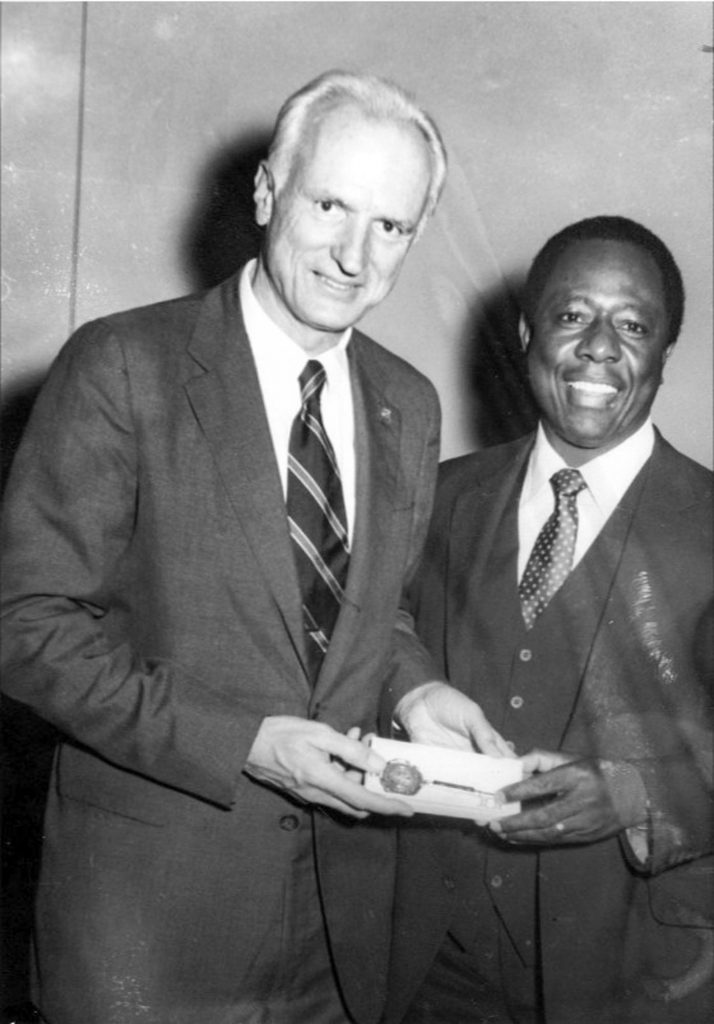
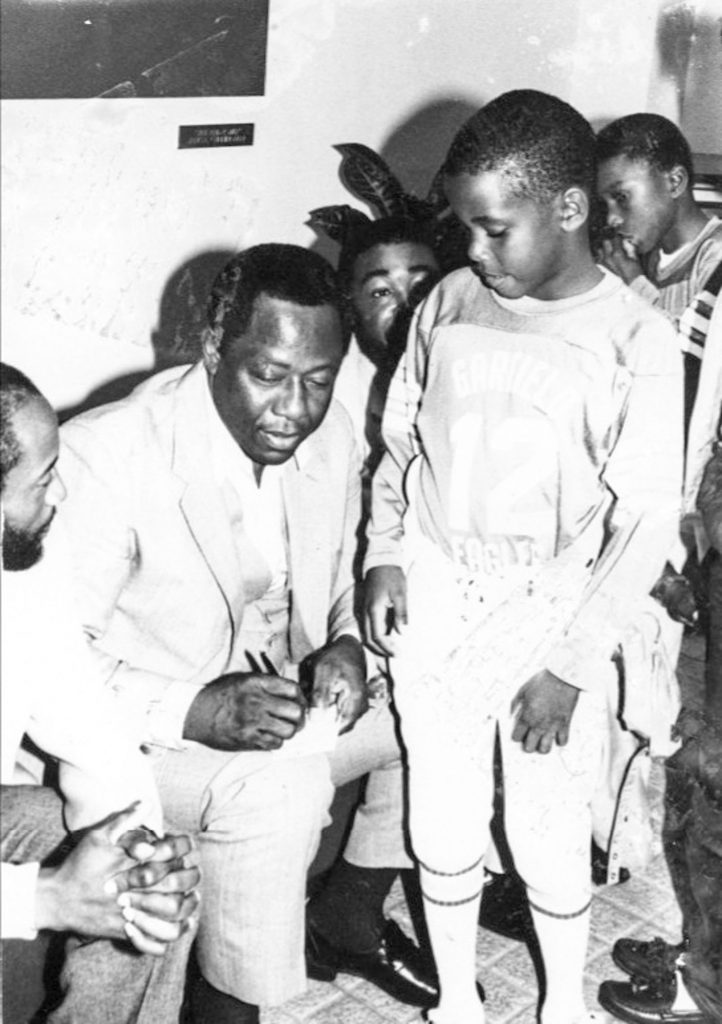
Aaron went on to spend most of his twenty-three-year career with the Milwaukee and later Atlanta Braves, before retiring in 1976 after two final seasons with the Milwaukee Brewers. He finished with 755 home runs, surpassing Ruth’s record of 714 on April 8, 1974. The weeks leading up to this moment saw Aaron targeted with racist hate mail and death threats. The outpouring required FBI involvement and, as Aaron recalled, scarred him deeply. Aaron was inducted into the Baseball Hall of Fame in 1982. He died of natural causes on January 22, 2021, in Atlanta, Georgia.
Though Aaron’s connection to the Indianapolis Clowns franchise was brief, and came while the club was using Buffalo as its home city, his time with the Clowns contributed to his later accomplishments with the Braves and beyond. Aaron’s Clowns tenure was also significant because it made him the last player with Negro Leagues experience to join a Major League Baseball team.
FURTHER READING
- Aaron, Henry, with Lonnie Wheeler. I Had a Hammer: The Hank Aaron Story. New York: HarperCollins, 1991. https://search.worldcat.org/title/214955585.
- Bryant, Howard. The Last Hero: A Life of Henry Aaron. 1st ed. New York: Pantheon Books, 2010. https://search.worldcat.org/title/436030262.
- Kelly, Matt. “Timeline of Hammerin’ Hank’s Legendary Career.” MLB.com, April 7, 2024.
- Riley, James A. The Biographical Encyclopedia of the Negro Baseball Leagues. New York: Carroll & Graf, 1994. https://search.worldcat.org/title/49057649.
CITE THIS ENTRY
APA:
Johnson, S. (2026). Henry Louis “Hank” Aaron. Encyclopedia of Indianapolis. Retrieved Oct 25, 2026, from https://indyencyclopedia.org/hank-aaron/.
MLA:
Johnson, Spencer. “Henry Louis “Hank” Aaron.” Encyclopedia of Indianapolis, 2026, https://indyencyclopedia.org/hank-aaron/. Accessed 25 Oct 2026.
Chicago:
Johnson, Spencer. “Henry Louis “Hank” Aaron.” Encyclopedia of Indianapolis, 2026. Accessed Oct 25, 2026. https://indyencyclopedia.org/hank-aaron/.

Help improve this entry
Contribute information, offer corrections, suggest images.
You can also recommend new entries related to this topic.