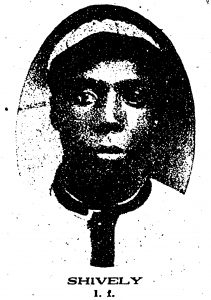
Photo info ...
George Anner Shively was a powerful left-handed baseball player who spent most of his career in the Negro Leagues with the . Standing 5 feet 8 inches and weighing 150 pounds, Shively earned the nickname “Rabbit” for his exceptional speed on the basepaths. He was regarded as a “desperate” baserunner, and his quickness gave him a wide range in the outfield. A solid defensive outfielder and one of the best bunters in Black baseball, he was an extraordinary hitter with moderate power. He was also notably superstitious about his hitting and would not let a right-handed batter use one of his bats.
Born in Lebanon, Kentucky on January 3, 1893, George Anner Shively moved to Bloomington, Indiana, with his father, Joseph, a formerly enslaved individual, before the turn of the century. Shively attended The Colored School during his youth in Bloomington. He began his professional baseball career around 1910, playing in the nearby town of West Baden, Indiana, on West Baden Sprudels.
Shively followed Taylor when he left West Baden to take over the Indianapolis ABCs in 1914. joined the team a year later, and in 1918, when Jimmy Lyons joined the ABCs, the trio was widely acclaimed as the greatest outfield in Black baseball.
As a cornerstone of the Indianapolis ABCs team that won the Western region championship in 1916, Shively established the club as one of the premier franchises in Black baseball. He was selected to the Negro League All-Star team seven times and earned two divisional Most Valuable Player honors, coming in 1914 and 1917. The ABCs barnstormed extensively across the United States, Hawaii, Cuba, and Japan, often facing white major-league players in off-season exhibitions, bringing Indianapolis Black baseball to national and international attention.
Shively left the Indianapolis ABCs in 1919 to play with the Atlantic City Bacharach Giants, but he spent the next several years moving between the East and the Midwest before settling permanently in the East. He began the 1924 season in center field with the Washington Potomacs before being released in early summer and finishing the year with the Bacharachs. Even late in his career he still had enough speed to retain the nickname “Rabbit.” Shively finished his career at the end of the 1924 season. Over his career, he also appeared briefly with Bowser’s ABCs, the Brooklyn Royal Giants, and other clubs.
After his playing career, Shively returned to Bloomington, where he worked as a roofer. He and his wife had no children. He died on June 7, 1962, at Bloomington Hospital at the age of 69 and was buried in Section D, Lot 45, of Rose Hill Cemetery.
For decades, his grave went unmarked and his baseball achievements were largely unrecognized. Interest in Shively was rekindled in 2014, when Bloomington Herald-Times sports editor Bob Hammel brought his story to the attention of noted Negro Leagues historian and author Phil Dixon. In an event at the Monroe County History Center, Dixon spoke about Shively’s career and raised funds to erect a headstone for this local Black athlete. Resulting contributions allowed the installation of limestone headstones for Shively and ten other family members who had been buried near him.
FURTHER READING
- Debono, Paul. The Indianapolis ABCs: History of a Premier Team in the Negro Leagues. 1997; McFarland & Co., 1997. https://search.worldcat.org/en/title/915562954.
- Riley, James A. The Biographical Encyclopedia of the Negro Baseball Leagues. New York: Carroll & Graf, 1994. http://archive.org/details/biographicalency00rile.
CITE THIS ENTRY
APA:
Johnson, S. (2026). George Anner “Rabbit” Shively. Encyclopedia of Indianapolis. Retrieved Oct 23, 2026, from https://indyencyclopedia.org/george-shively/.
MLA:
Johnson, Spencer. “George Anner “Rabbit” Shively.” Encyclopedia of Indianapolis, 2026, https://indyencyclopedia.org/george-shively/. Accessed 23 Oct 2026.
Chicago:
Johnson, Spencer. “George Anner “Rabbit” Shively.” Encyclopedia of Indianapolis, 2026. Accessed Oct 23, 2026. https://indyencyclopedia.org/george-shively/.

Help improve this entry
Contribute information, offer corrections, suggest images.
You can also recommend new entries related to this topic.