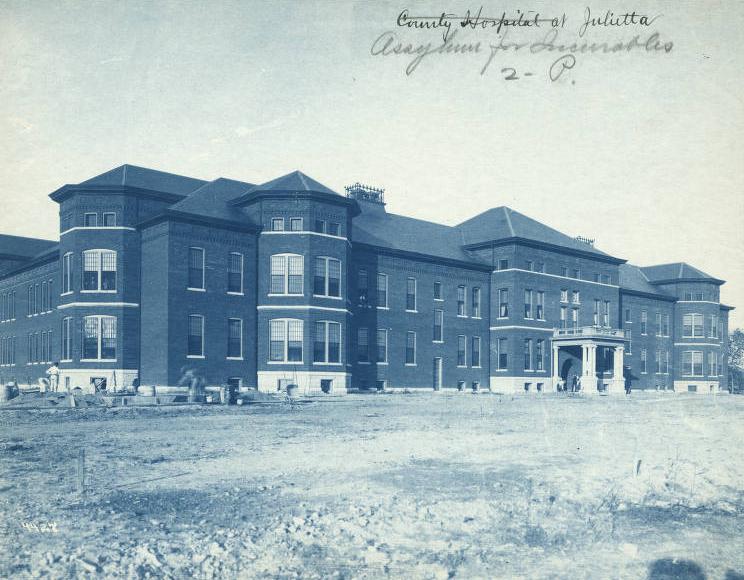
Julietta Hospital, also known as the Marion County Asylum for the Incurable Insane at Julietta, was a medical facility that opened in 1900 in order to house and treat patients with mental illness. Julietta’s creation provided a separate, county-administered facility for patients whose illnesses were deemed to be severe and irreversible. This allowed for their segregation from the poor, elderly, and other financially dependent groups housed at the county’s general poorhouse, the , located at 21st Street and Tibbs Avenue. In fewer than forty years, problems with the hospital led to its closure, which occurred in 1938. All the residents were then moved to the , leaving the property at Julietta for use as the Marion County Infirmary.
The establishment of facilities to care for the state’s poor, elderly, and infirm dates to the 1816 Indiana constitution. The General Assembly established provisions for “poor farms” where people in these categories could live and work. This would presumably imbue residents with a feeling of usefulness to society, with their own labor mitigating their dependence upon the state. However, people with mental health issues were also placed at the poorhouse, which lacked proper facilities or expertise to house and treat them.
Local physicians and social reformers pressured the General Assembly to provide separate facilities for individuals with mental health challenges. In 1827, the Indiana legislature passed a resolution to establish a hospital for the “insane” throughout the entire state. Lawmakers passed further legislation in the 1840s to provide funding and acquire land for such a facility.
The Indiana Hospital for the Insane opened in November of 1848. Over the following decades, the number of citizens who met the criteria for “insanity” grew and the hospital became overcrowded. Consequently, the hospital began sending patients deemed “incurable” back to their home counties. Calls for the construction of an appropriate facility to care for the “incurable insane,” many of whom were housed at the Marion County Poorhouse, came as early as 1881. An investigation into the poorhouse by the revealed the need to reform the conditions and management of the poorhouse due to the mixing of “insane,” “idiotic,” and poor populations in one facility. Plans for the Julietta Asylum started after the First Indiana State Conference of Charities in October of 1890. The key resolutions from this conference called for improved administration of poor asylums and for county hospitals for the “incurable insane” and “idiots.”
The Marion County Asylum for the Incurable Insane was founded in 1899 in the agricultural village of Julietta on the southeast border of and western . The first residents were transferred from the Marion County Poor Asylum to Julietta in 1900. The new Julietta building became home to a maximum of 150 patients. Patients who could work grew vegetables for the colony’s use, while an on-site dairy supplied milk for residents as well as children at the Children’s Guardian Home and the Colored Orphans Home.
In the 1920s, the county approved a plan to add an annex to the Julietta facility. The expansion came despite a negative 1921 assessment by New York–based consultant Dr. Henry C. Wright, a hospitals expert. Noting a lack of expertise by Julietta’s medical staff, Wright’s report recommended that Julietta should be closed and its residents transferred to the state-run Central State Hospital. Adding to Julietta’s troubles, the entire facility, including old and new buildings, was condemned for use in 1923 due to poor construction. Still, the expansion went ahead. Patients moved into the new wing after repairs were completed in 1924, but news coverage of the incident added to the asylum’s problems.
Julietta ceased being used as a mental hospital on December 15, 1938, when the residents were moved to the care of Central State Hospital (formerly called the Indiana Hospital for the Insane) in Indianapolis. From that time onward, Julietta was known as the Marion County Infirmary. Residents at the old infirmary on Tibbs Avenue were transferred to the new infirmary.
Over its years of use, the infirmary at the former Julietta Hospital was expanded to accommodate more patients and staff housing. In 1944, a new three-story building was erected; in 1964 the compound was expanded to 375,000 square feet; and in 1982 an Alzheimer’s unit was added. The facility underwent several name changes during these decades: first to the Marion County Home and Julietta Convalescent Center in 1964, and next to the Marion County Healthcare Center in 1983.
From 1983 to 1996, three-fourths of the residents at the center were Medicare or Medicaid patients. Restrictive state rules on Medicaid eligibility, combined with 1980s cuts to federal health-coverage programs, left many vulnerable Indiana populations uninsured or underinsured. These reductions also discouraged medical providers from accepting Medicaid and Medicare patients due to lowered reimbursement rates. Such challenges undercut the financial viability of the Marion County Healthcare Center. In 1992, the Marion County Commissioners approved a plan to transfer all remaining residents to the new Lockfield Village long-term health care facility, a move completed in 1996. The county then auctioned the land and buildings of the former Julietta Hospital site in 1997. As of 2025, it is the location of the Hope Center, a private and religiously oriented facility for women survivors of domestic sex trafficking, sexual exploitation, and sexual trauma.
FURTHER READING
- Adams, Evelyn C. “The Growing Concept of Social Responsibility Illustrated by a Study of the State’s Care of the Insane in Indiana.” Indiana Magazine of History 32, no. 1 (1936): 1–22. http://www.jstor.org/stable/27786784.
CITE THIS ENTRY
APA:
Erickson, N. (2026). Julietta Hospital. Encyclopedia of Indianapolis. Retrieved Oct 12, 2026, from https://indyencyclopedia.org/julietta-hospital/.
MLA:
Erickson, Norma. “Julietta Hospital.” Encyclopedia of Indianapolis, 2026, https://indyencyclopedia.org/julietta-hospital/. Accessed 12 Oct 2026.
Chicago:
Erickson, Norma. “Julietta Hospital.” Encyclopedia of Indianapolis, 2026. Accessed Oct 12, 2026. https://indyencyclopedia.org/julietta-hospital/.

Help improve this entry
Contribute information, offer corrections, suggest images.
You can also recommend new entries related to this topic.