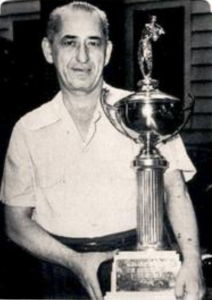
Photo info ...
Sydney S. Pollock was an American sports executive and the longtime owner of the . Pollock brought the franchise to Indianapolis from Cincinnati in 1944, built it into a four-time Negro American League (NAL) champion, signed a young to his first professional contract, and introduced the first women to play full-time in the Negro Leagues. He developed the Clowns into a nationally known combination of show business and baseball that earned them the designation the “Harlem Globetrotters of baseball.”
Pollock was a Jewish American, born in North Tarrytown, New York, on March 20, 1901, to Edward and Sarah Pollock. He started booking players for white, Black, Cuban, and women’s baseball teams in 1917. Pollock owned a barnstorming Black baseball team of mostly Cuban players, originally named the Havana Red Sox, from 1926 to 1936. With this team, he experimented with blending comedy routines and shadow-ball exhibitions (invisible ball throwing, catching, and hitting routines) with competitive play. By 1936, Pollock was booking games for the Miami Ethiopian Clowns and acquired a controlling stake in the team a year later. He built the team into a major gate attraction through the use of degrading racial characterizations such as the use of grass skirts, whiteface makeup, and slapstick comedy.
Pollock’s debasement of his players drew sharp criticism from prominent Black sportswriters and baseball executives. Pittsburgh Courier columnist Wendell Smith called the team a “fourth-rate Uncle Tom minstrel show,” and Homestead Grays co-owner Cumberland Posey accused Pollock of capitalizing on Black sympathy for Ethiopia during Italy’s invasion of the country in 1935. Pollock formed the short-lived Negro Major League (NML) in 1942, bringing the Clowns into the league and moving them from Miami to Cincinnati. When the NML folded a year later, Pollock’s team joined the NAL after he agreed to drop the Ethiopian name and the most offensive elements of the team’s showmanship.
The franchise relocated from Cincinnati to Indianapolis before the 1944 season. The team was known as the Cincinnati-Indianapolis Clowns until 1946, when it officially adopted Indianapolis as its full-time home. Under Pollock’s ownership, the Indianapolis Clowns became one of the NAL’s most financially successful teams, winning championships in 1950, 1951, 1952, and 1954. Even as other Negro League franchises folded in the wake of Major League Baseball’s integration, the Clowns thrived by drawing crowds that regularly rivaled or exceeded attendance at major league parks. Pollock energetically promoted the team: by the early 1950s, he was sending out thirty thousand press releases a year, highlighting the talent of Black athletes.
While with the Clowns, Pollock made several decisions that influenced baseball history. First, in 1951, he signed a seventeen-year-old Hank Aaron to his first professional contract. Though Aaron played only three months with the Clowns, he later noted, “Everything I learned [with the Clowns] got me ready for the big leagues. I honestly believe I wouldn’t have gotten to the big leagues as quickly as I did if I hadn’t even played those few months with the Clowns.” Aaron famously would break Babe Ruth’s career homerun record, which had stood for two decades, in 1974, while enduring a succession of racist threats. Furthermore, Aaron would become a vocal critic of racial barriers to Black advancement within the executive offices of MLB. Second, as the Negro Leagues declined, Pollock in 1953 signed Toni Stone to play second base for the Clowns, making her the first woman to play full-time in the previously all-male Negro Leagues. After Stone’s contract was sold to the Kansas City Monarchs in 1954, Pollock signed two more women, and Connie Morgan. Though critics viewed these signings as promotional gimmicks, Negro League historians note the significance of the three women, all of whom were legitimate athletes, as the first women to play major-league professional baseball.
Pollock’s legacy remains deeply contested. He was twice awarded the National Baseball Congress Plaque for Outstanding Contribution to Baseball. Yet his willingness to employ racial caricature for commercial gain and the complex dynamics of a white owner profiting from Black athletes’ labor remain central to any assessment of his career.
The Clowns withdrew from the NAL following the 1954 season. In 1955, Pollock sold a partnership in the team to his longtime friend and road manager Ed Hamman, and then the remainder of his interest in 1965. Pollock died on November 22, 1968, in Hollywood, Florida.
FURTHER READING
- Pollock, Alan J., and James A. Riley, eds. Barnstorming to Heaven: Syd Pollock and His Great Black Teams. University of Alabama Press, 2012. https://search.worldcat.org/title/795120545.
CITE THIS ENTRY
APA:
Johnson, S. (2026). Syd S. Pollock. Encyclopedia of Indianapolis. Retrieved Oct 14, 2026, from https://indyencyclopedia.org/syd-pollock/.
MLA:
Johnson, Spencer. “Syd S. Pollock.” Encyclopedia of Indianapolis, 2026, https://indyencyclopedia.org/syd-pollock/. Accessed 14 Oct 2026.
Chicago:
Johnson, Spencer. “Syd S. Pollock.” Encyclopedia of Indianapolis, 2026. Accessed Oct 14, 2026. https://indyencyclopedia.org/syd-pollock/.

Help improve this entry
Contribute information, offer corrections, suggest images.
You can also recommend new entries related to this topic.