Photo info ...
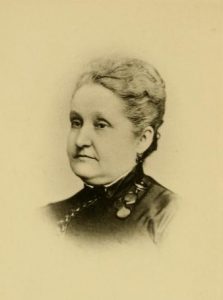
Anna Agnew was a writer who achieved recognition for her account of spending seven years as a patient at Indianapolis’s , undergoing treatment for severe symptoms from what is now known as bipolar disorder. Agnew’s autobiography, From Under the Cloud, provides a unique and detailed account of the details and experiences of daily life for patients living in the asylum.
Agnew (née Keyt) was born in 1836 to Nathan and Martha Keyt of Moscow, Ohio. While she experienced episodic symptoms of bipolar disorder beginning in childhood, later recalling that “even as a child I was always feeling a desire to take my life,” her family misunderstood her symptoms and considered her a “difficult” child. She lived with her parents until her mid-thirties, earning a modest income through her embroidery work.
In 1870, Agnew married David Agnew, a clerical worker, and the pair moved to Cincinnati, Ohio. They moved an additional two times as David pursued various job opportunities—first to Seymour, Indiana, in 1873, and then Vincennes, Indiana, around 1875. Agnew became a homemaker and cared for her three children: Nathan, William, and David.
Evidence suggests that Agnew’s symptoms had abated during these early years of her marriage. Around 1876, Agnew’s mental health began to decline. Because bipolar disorder was not understood at this time, her doctors dismissed her symptoms and misdiagnosed her with hysteria, a popular yet pseudo-medical term used to describe various behaviors that deviated from societal norms. After multiple suicide attempts over the next two years, Agnew’s mental illness worsened even further, causing her to harm one of her children.
During a state of psychosis, she poisoned her youngest son, David, using laudanum, believing she was sparing him from a future of “insanity,” and then disclosed to her husband what she had done. Her son survived the attempt on his life. After this episode, Agnew in September 1878 was institutionalized at the Indiana Hospital for the Insane (later renamed Central State Hospital) as “suicidal and homicidal,” with a diagnosis of “acute mania.”
Agnew remained hospitalized for seven years. When her confinement at Central State Hospital ended in 1885, she and her husband divorced. With nowhere to live, she stayed at the hospital for a short period and earned income by working in the sewing room. By 1886, she was living with her sister Lida in Pittsburgh, Pennsylvania.
In 1886, Agnew published From Under the Cloud; Or, Personal Reminiscences of Insanity. The book details her experiences with mental illness and life in the asylum. At the time of Agnew’s institutionalization, Central State Hospital employed a treatment labeled “Moral Therapy” for patients with mental illness. The treatment replaced abuse and restraint with compassion and kindness. While Moral Therapy was the goal of Central State Hospital physicians, Agnew’s autobiography reveals abuse at the hands of an undertrained and overwhelmed staff tasked with providing care for more than 600 individuals.
Book reviewers expressed shock over Agnew’s revelations about the patients’ treatment at Central State Hospital. Though Agnew noted that “the superintendents were invariably kind,” she went on to say the “attendants were the worst…mostly inexperienced young ladies…heap[ing] all kinds of indignities upon the patients.” She spoke highly of her prescribed treatment by her physicians (Drs. Hester, Evert, Rogers, Thomas, , and ), but noted that “the assistant superintendent made my life a perfect hell.” He placed Agnew in a ward for epileptics for one year and told the attendants not to provide her a change of clothing unless she requested it. Upon release, Agnew emerged wearing the same dress, tattered and threadbare from a year’s use. Other indignities included being “dragged by my hair to the dining room” and “beaten.” In her book, Agnew recommended that institutions hire trained nurses and middle-aged women who had experienced mental illness themselves, suggesting that such figures could more compassionately attend to the needs of those in the facilities.
Agnew’s disabling condition remained at bay for about a decade before her symptoms returned. In 1894, she was admitted to the Western Pennsylvania Hospital for the Insane at Dixmount, near Pittsburgh, where she remained until her death on March 25, 1917. By sharing the story of her Indianapolis confinement, Agnew helped illuminate the often overlooked or misunderstood realities of living with mental illness. Her work encouraged readers to advocate for improved conditions and qualified healthcare personnel in the treatment of individuals with mental health conditions.
FURTHER READING
- Agnew, Anna. From under the Cloud, or, Personal Reminiscences of Insanity. R. Clarke & Co., 1886. https://archive.org/details/fromundercloudor00agne.
- King, Lucy J. From under the Cloud at Seven Steeples, 1878-1885: The Peculiarly Saddened Life of Anna Agnew at the Indiana Hospital for the Insane. Guild Press/Emmis Pub., 2002. https://search.worldcat.org/title/50170254.
CITE THIS ENTRY
APA:
Fischer, J. E. (2026). Anna Agnew. Encyclopedia of Indianapolis. Retrieved Oct 15, 2026, from https://indyencyclopedia.org/anna-agnew/.
MLA:
Fischer, Jessica Erin. “Anna Agnew.” Encyclopedia of Indianapolis, 2026, https://indyencyclopedia.org/anna-agnew/. Accessed 15 Oct 2026.
Chicago:
Fischer, Jessica Erin. “Anna Agnew.” Encyclopedia of Indianapolis, 2026. Accessed Oct 15, 2026. https://indyencyclopedia.org/anna-agnew/.

Help improve this entry
Contribute information, offer corrections, suggest images.
You can also recommend new entries related to this topic.