Photo info ...
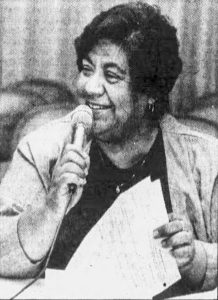
Olga Villa Parra was an activist in Indianapolis and northern Indiana who advocated for Mexican and other Latine migrant farmworkers and their families. She had earlier been involved in the 1960s Chicano movement, including the national grape boycott begun in 1965. Causes she organized for included adequate childcare and bilingual educational opportunities for farmworkers, women’s entry into the political sphere, and ministries for Spanish-speaking in their parishes.
Olga Villa was born, as one of eight children, in San Antonio, Texas, on August 30, 1943 to Julio and Maria Rodriguez Villa. The family moved in 1944 to Muskegon, Michigan, where Parra’s parents found employment as farmworkers. She graduated from Muskegon Catholic Central High School before earning a bachelor’s degree in sociology from Northeastern Illinois University and a master’s degree in religious studies from Loyola University in Chicago. She married Ricardo Parra on July 21, 1979.
Parra’s political consciousness was forged in her childhood and teen years, as she observed both her parents’ experiences as farmhands and the surrounding union culture of western Michigan. Parra later remembered growing up in “a strong working state with the United Auto Workers Union. I thought all people were in the union in those days.” Later, Parra worked directly with Cesar Chavez and the United Farm Workers in California during the national grape boycott from 1965 to 1970. She also met Martin Luther King Jr. while working with Chavez. Parra recalled, “They were contemporaries. They gave me the commitment. They talked about … poor people voting and poor people having a say in their lives.”
During the 1970s and 1980s, Parra’s activism continued in northwest Indiana, initially focusing on needs of women and children in migrant worker families. In South Bend, she co-founded El Campito Daycare Center for the children of migrant workers in that city. She became the director of the Midwest Council of La Raza (MWCLR), a regional Latino advocacy and civil rights organization. Parra organized a conference at Notre Dame called Adelante Mujer, which sought to define the political role of Latina women using Chicana and Feminist perspectives in 1972. That same year, she and her husband went to the Indiana State House in Indianapolis to protest the treatment of vegetable workers in the state.
Upon the dissolution of MWCLR, Parra directed the Midwest Hispanic Catholic Commission, based at Notre Dame University, from 1980 to 1991. She also served as a bilingual resource specialist for the South Bend Community School Corporation from 1989–1991.
In 1991 Parra and her husband moved to Indianapolis where she worked as a religion program associate at the until her 1994 retirement.
Parra’s civic engagement in Indianapolis and central Indiana focused on improving material and social conditions for the Latine populations there. Parra was associated with Hispanic migrant, Hispanic Catholic, and Spanish-language organizations in Indianapolis that created programming to improve migrant conditions and formed Hispanic missions at churches and programming at schools. She also worked with the Indianapolis–Marion County Board of Ethics to handle allegations of unethical behavior by elected officials. During her last decade, Parra became involved with the grassroots Indianapolis organization Association of Mexican Leaders in Action Inc.
One project important to Parra was elevating Indianapolis residents’ awareness of the cultural and historical significance of the annual Cinco de Mayo commemoration. Local celebrations often focused heavily on revelry and alcohol consumption. Parra, by contrast, helped assemble celebrations that promoted family connections, health, and the pursuit of higher education while highlighting Latine artists. Parra refused all alcohol and tobacco sponsorships and promotions for such events.
Parra’s activism in South Bend and elsewhere is documented in the Ricardo Parra and Olga Villa Parra Papers, held at Notre Dame University. The collection, donated by the Parras, consists of news pieces, photos, and ephemera from Chicano activist struggles in northwest Indiana and other Midwest locations from the 1970s through 1990s.
Parra and her husband moved to Muskegon, Michigan, sometime in the early 2010s. She died there in 2014.
FURTHER READING
- Tsui, Chiayi. “Finding Aid for Ricardo Parra and Olga Villa Parra Papers MS.2009.8.” Collection Guide. Julian Samora Library at the Institute for Latino Studies, October 28, 2013. https://latinostudies.nd.edu/assets/134270/ricardo_and_olgavillaparrapapers.pdf.
CITE THIS ENTRY
APA:
Martinez-LeGrand, N. (2026). Olga Villa Parra. Encyclopedia of Indianapolis. Retrieved Nov 16, 2026, from https://indyencyclopedia.org/olga-villa-parra/.
MLA:
Martinez-LeGrand, Nicole. “Olga Villa Parra.” Encyclopedia of Indianapolis, 2026, https://indyencyclopedia.org/olga-villa-parra/. Accessed 16 Nov 2026.
Chicago:
Martinez-LeGrand, Nicole. “Olga Villa Parra.” Encyclopedia of Indianapolis, 2026. Accessed Nov 16, 2026. https://indyencyclopedia.org/olga-villa-parra/.

Help improve this entry
Contribute information, offer corrections, suggest images.
You can also recommend new entries related to this topic.