Día de los Muertos, a Mexican cultural holiday occurring on November 2, has been marked in Indianapolis through institutional events since the late 1980s. Organizations participating in such local festivities have sought to bring Mexican and Mexican American cultural expressions to wider Indianapolis audiences while providing participants a sense of civic belonging.
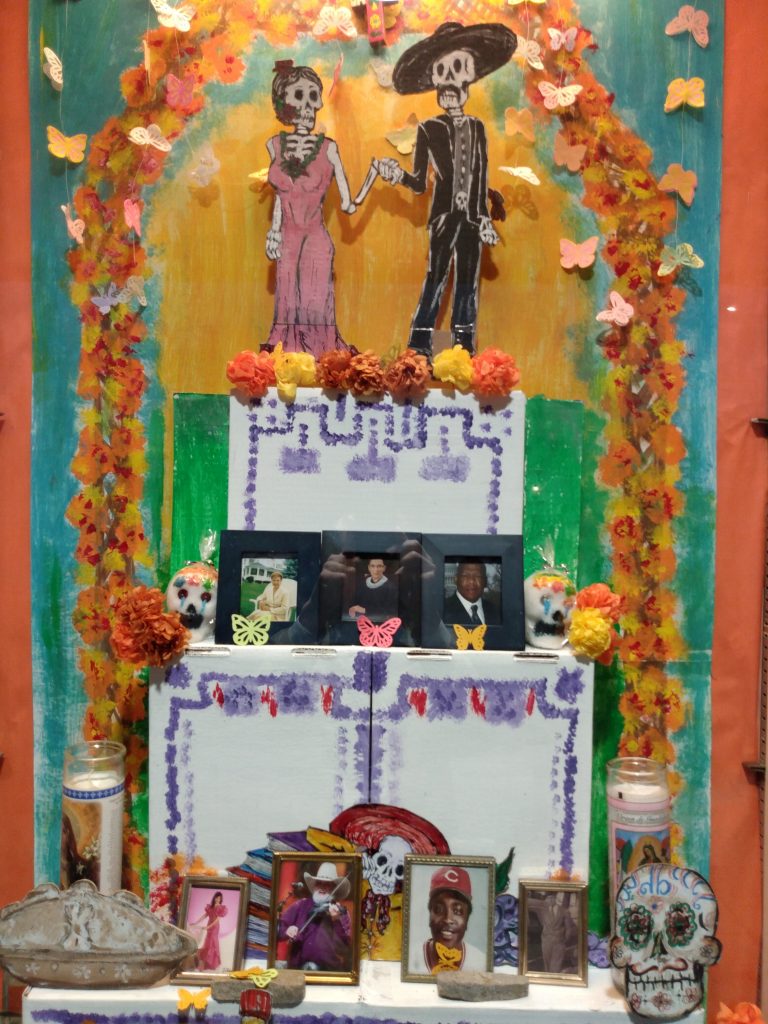
As celebrated in Indianapolis, Día de los Muertos incorporates traditions used to mark the holiday in Mexico. The holiday traces its origins to Mesoamerican Aztec, Mayan, and Tolec commemorations marking the lives, memories, and afterlife of deceased community members. Indigenous Mexican people adopted these traditions, laying the foundation for how the Day of the Dead is celebrated contemporarily. Traditions include ritual offerings of food, beverages, Mexican marigolds (cemapsuchil) and other items, all placed at altars (or ofrendas). Sugar skulls (or calaveras), an iconic symbol of the holiday, are displayed at these altars. The offerings invite loved ones to return to Earth during the two-day celebration, which symbolizes the duality of life and death. The United Nations officially designated Día de los Muertos as a form of intangible cultural heritage in 2003.
Widespread observance of Día de los Muertos in the United States came with the nation’s increase in Mexican and Mexican American inhabitants from the 1960s onward. In Indianapolis, the 1970s and 1980s saw substantial growth in metropolitan Hispanic and Latine populations and institutions. From 1990 to 2020, Indianapolis-area Hispanic and Latine populations rose from 7,681 to 115,844 in number, with a corresponding growth in institutions and cultural activities developed by and for these communities.
Possibly the earliest local reference to Día de los Muertos came decades before it was regularly observed in Indianapolis, appearing in a 1949 article. Staff writer Billy Rose described visiting a cemetery 30 miles south of Mexico City and learning about the Día de los Muertos tradition of picnicking in cemeteries from morning until evening, celebrating the holiday among the dead. Though Rose’s article may have introduced Día de los Muertos into the local public consciousness, prior to the 1980s Indianapolis Hispanics and Latinos most likely marked the holiday in the privacy of their homes.
Local observances of the holiday began in Indianapolis during the late 1980s. Some area schools and commercial venues organized educational workshops to teach people about the holiday’s significance, hosted parades featuring adults and children dressed in Catrina outfits (elaborate, colorful Victorian-style clothing with skeleton-like makeup), and constructed ofrendas. Similarly, in 1989 seventh-grade Spanish-language students at were invited to observe the day in costume. That same year, the Turandot, a gift shop at Keystone at the Crossing (see ), featured a Día de los Muertos exhibit, the first mark of commercialization of the holiday in Indianapolis.
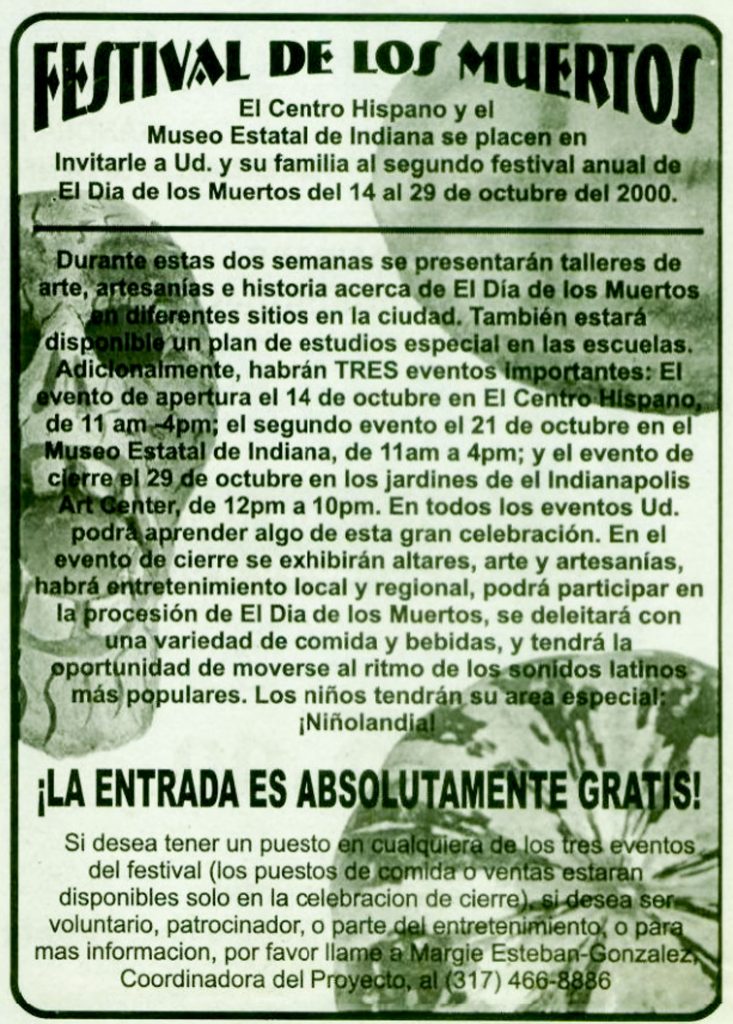
Such local commemorations expanded in the 1990s through the participation of several Indianapolis museums. began featuring material culture depicting the holiday in 1992, in its long-running exhibit called Passport to the World. Día de los Muertos masks along with brightly colored alebrijes—papier mâché figurines that are often associated with Día de Muertos but not traditionally part of the holiday’s customs—populated the exhibit, which ran through 2008. In October 1999, the presented the first of its annual “el Día de los Muertos” events, which provided information about the Mexican holiday. The held a Día de los Muertos Festival in 1999. And in November 1999, the hosted a Día de los Muertos exhibition with the theme “Milagros de la Vida” (Blessings of Life). The event included displays of altars/ofrendas honoring departed ancestors and family members, with some displayed also at community sites and workshops.
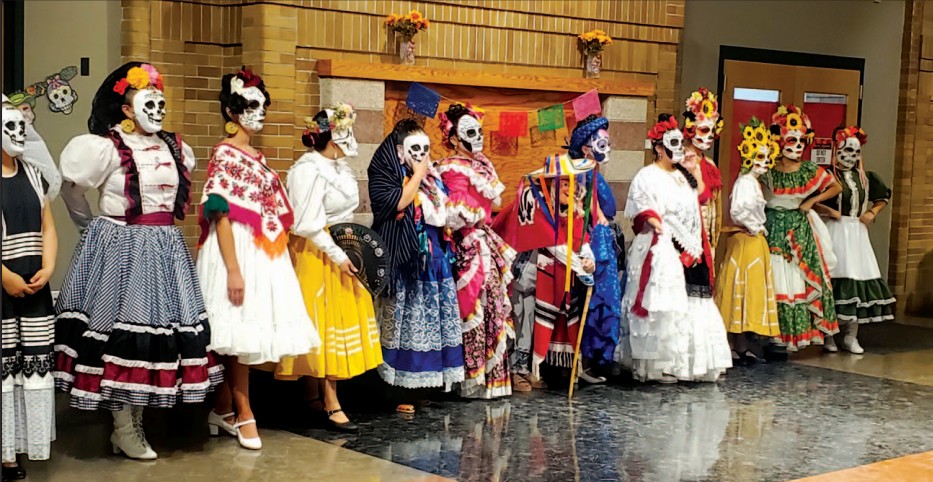
By the 2020s, additional arts and civic venues in Central Indiana had developed Día de los Muertos commemorations. These included the Nickel Plate Arts in Noblesville, Indiana, , the Fay Biccard Glick Neighborhood Center (see ), the Garfield Park Arts Center (see ), and the Indiana State Capitol. As of 2025, two cultural institutions in Indianapolis hosted annual Día de los Muertos celebrations. The Eiteljorg Museum, in collaboration with NOPAL Cultural and Arte Mexicano en Indiana, featured performances, demonstrations, and an altar exhibit. Indy’s Global Village spotlighted an artisan market as part of its Día de los Muertos celebration.
CITE THIS ENTRY
APA:
Fuqua, S., Galarce, T., Mullican, M., Verderame, J. A. & Zavaras, C. (2026). Día de los Muertos (Day of the Dead) in Indianapolis. Encyclopedia of Indianapolis. Retrieved Nov 2, 2026, from https://indyencyclopedia.org/dia-de-los-muertos/.
MLA:
Fuqua, Sakura, Tisha Galarce, Mary Mullican, Jyoti A. Verderame, and Consuelo Zavaras. “Día de los Muertos (Day of the Dead) in Indianapolis.” Encyclopedia of Indianapolis, 2026, https://indyencyclopedia.org/dia-de-los-muertos/. Accessed 2 Nov 2026.
Chicago:
Fuqua, Sakura, Tisha Galarce, Mary Mullican, Jyoti A. Verderame, and Consuelo Zavaras. “Día de los Muertos (Day of the Dead) in Indianapolis.” Encyclopedia of Indianapolis, 2026. Accessed Nov 2, 2026. https://indyencyclopedia.org/dia-de-los-muertos/.

Help improve this entry
Contribute information, offer corrections, suggest images.
You can also recommend new entries related to this topic.