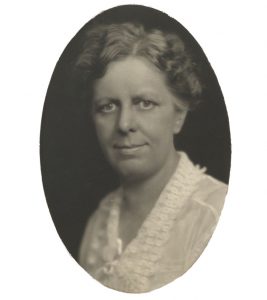
Born on June 1874 in Kassel, Germany, to Albert and Bertha Limper Storck, Adele Ida Storck immigrated to the United States with her parents at age eight, settling in Odell, Illinois, where her father worked in a hardware business. She graduated from the University of Chicago and moved to Indianapolis in 1900 after accepting a position to teach German in the system. Later, she attended classes at DePauw University.
In 1921, at age 45, Storck became the second woman to graduate from Benjamin Harrison Law School, now known as the Indiana University Robert H. McKinney School of Law in Indianapolis (see ). The Blackstone Institute at Indiana University awarded her top honors for her law thesis. She went on to become the first woman admitted to the .
Storck and Minnie Elizabeth Mason, the first female graduate from Benjamin Harrison Law School, established Storck & Mason in 1921. This was possibly the first female-owned law firm in the United States. Their office was in Indianapolis’s Knights of Pythias Building. Notably, Storck successfully fought in 1923 against a bill seeking to limit women’s work in Indiana to 48 hours per week.
In December 1925, the Indianapolis Bar Association appointed Storck to its adult probation law committee, led by her former law school professor Judson L. Stark, then the city’s deputy prosecutor. That committee’s responsibilities included developing probation-officer standards and procedures and reviewing legislation affecting probation. Storck was the only woman on the committee. Storck later served three years as a deputy prosecutor, assigned to the juvenile court under Sherwood Blue (1940-1948).
Outside the legal profession, Storck enjoyed varied interests. She sat on the board of the , served as president of the Woman’s Rotary Club, and was a member of the . A lifelong love of poetry led her to publish a compilation of verses titled Broken Chords in 1952.
Storck left a lasting impact for future women in law as one of the trailblazing female attorneys in Indianapolis and as a female business owner. Storck’s law partnership with Minnie Mason continued as a successful female-owned business for well over three decades, ending only with Mason’s death in 1955. Given the era’s gender-based social barriers, Storck’s success in pursuing higher education and her achievements in a male-dominated employment field opened up important territory for women in Indianapolis’s legal profession. Adele Ida Storck died on August 26, 1960 in Indianapolis and is buried in .
FURTHER READING
- Browne, Tiffany Benedict. “Ladies Lounge: First Woman of Indianapolis Bar Association- Adele Ida Storck.” Historic Indianapolis, November 28, 2011. https://historicindianapolis.com/ladies-lounge-first-woman-of-indianapolis-bar-association-adele-ida-storck/.
- Testa, D. M. “Challenging the ‘Double Standard of Morality:’ Indiana’s First Women Lawyers.” Untold Indiana, October 5, 2020. https://blog.history.in.gov/challenging-the-double-standard-of-morality-indianas-first-women-lawyers/.
CITE THIS ENTRY
APA:
Testa, D. M. (2025). Adele Ida Storck. Encyclopedia of Indianapolis. Retrieved Oct 2, 2026, from https://indyencyclopedia.org/adele-ida-storck/.
MLA:
Testa, Denise M. “Adele Ida Storck.” Encyclopedia of Indianapolis, 2025, https://indyencyclopedia.org/adele-ida-storck/. Accessed 2 Oct 2026.
Chicago:
Testa, Denise M. “Adele Ida Storck.” Encyclopedia of Indianapolis, 2025. Accessed Oct 2, 2026. https://indyencyclopedia.org/adele-ida-storck/.

Help improve this entry
Contribute information, offer corrections, suggest images.
You can also recommend new entries related to this topic.