The 1949 Centennial Convention of the Indiana State Medical Association (ISMA), held in Indianapolis, was a landmark gathering that showcased new technological means for transmitting medical education at long distances. While showcasing progress made in the medical field over the past 100 years, the gathering offered attendees Indiana’s first demonstration of the potential of television as a means to transmitting medical knowledge and instruction across the state.
The sponsoring group, the ISMA, had formed in June 1849 after 28 medical doctors, all professional leaders in the state, assembled in Indianapolis to create a state medical association. The organization’s goal was to promote public health, educate physicians on scientific advancements, and establish standards for medical practice.
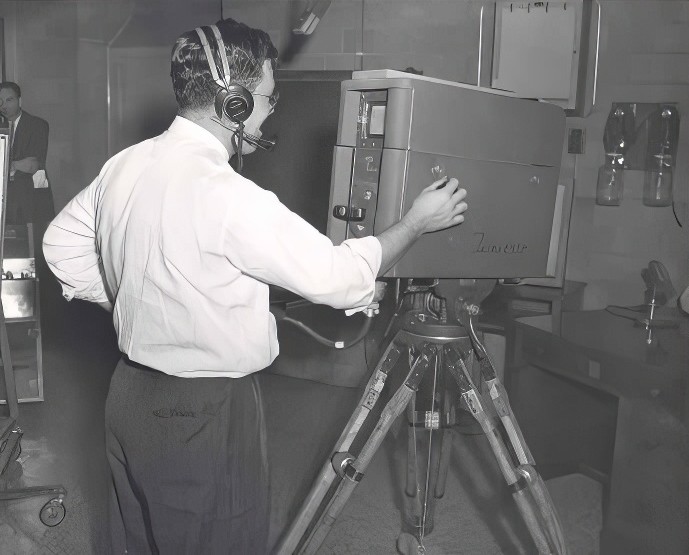
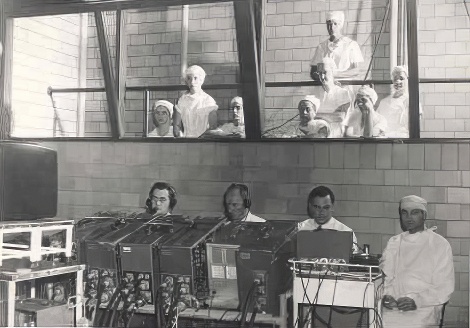
Right image: TV equipment especially installed at Indiana University Medical Center to demonstrate how TV can teach surgery, September 1949 Credit: Indiana University Indianapolis View Source
The ISMA Centennial Convention of 1949 was a noteworthy moment in medical education history, joining other landmarks in technology-assisted remote instruction transpiring at medical conventions across the nation that year. After the first live surgery transmitted on color television took place at the University of Pennsylvania in May 1949, the Annual Convention of the American Medical Association’s annual convention in June 1949 drew the first large-scale audience to view live surgery via color television. Several medical conventions at cities across the country, including the ISMA Centennial Convention in Indianapolis, followed suit later that year featuring demonstrations of live medical television as a new frontier for medical education.
In Indianapolis, the ISMA’s Centennial Convention likewise illustrated television’s use in sharing medical information and emerging practices with growing numbers of medical students and physicians. Held from September 26 to 29, 1949, at downtown’s Murat Temple (see ), the gathering attracted 2,200 ISMA members, including Indiana licensed physicians, residents, fellows, and medical students. The most visited program—the groundbreaking live medical television—attracted 1,000 attendees.
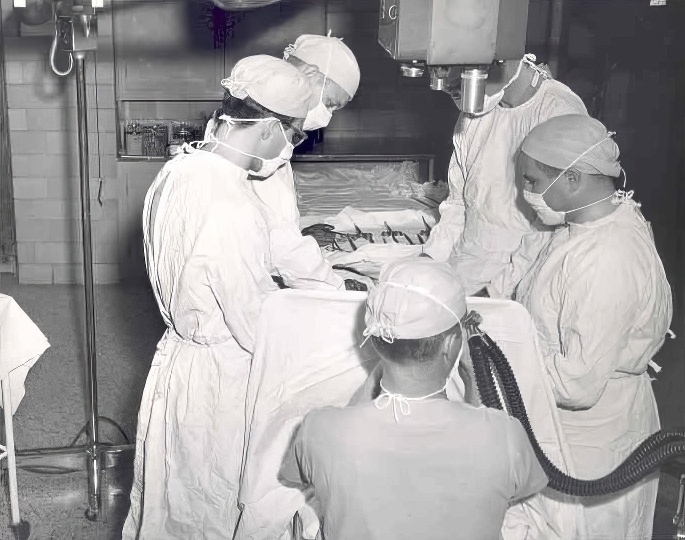
The television demonstration came out of a partnership between ISMA and the . It consisted of a three-day lineup of twenty-six clinic and surgery sessions, transmitted live from the IU Medical Center to meeting rooms at the convention venue. Numerous 16-inch home-type receivers, plus one that could show patients in life size, were used for reception of the transmissions, made over a high-frequency closed circuit. Among the highlights, drawing capacity crowds, were several rare operations performed at Robert W. Long Hospital, the IU School of Medicine’s first teaching hospital.
The 1949 Indianapolis program proved influential. With support from IU medical school dean , the ISMA and the IU School of Medicine partnered the next year to offer remote graduate-level medical education classes. These classes were transmitted to various Indiana locations via telephone—the state’s and possibly the country’s first occurrence of postgraduate .
FURTHER READING
- The author adapted this EOI entry from their original article:
- Bruner Stroup, Karen. “1949 Indiana State Medical Association Convention Brings Television to IU School of Medicine Education.” Indiana University School of Medicine, October 1, 2025. https://medicine.iu.edu/blogs/pediatrics/1949-isma-convention-brings-tv-to-iu-school-of-medicine-education.
CITE THIS ENTRY
APA:
Bruner Stroup, K. (2026). Centennial Convention of the Indiana State Medical Association. Encyclopedia of Indianapolis. Retrieved Oct 24, 2026, from https://indyencyclopedia.org/centennial-convention-isma/.
MLA:
Bruner Stroup, Karen. “Centennial Convention of the Indiana State Medical Association.” Encyclopedia of Indianapolis, 2026, https://indyencyclopedia.org/centennial-convention-isma/. Accessed 24 Oct 2026.
Chicago:
Bruner Stroup, Karen. “Centennial Convention of the Indiana State Medical Association.” Encyclopedia of Indianapolis, 2026. Accessed Oct 24, 2026. https://indyencyclopedia.org/centennial-convention-isma/.

Help improve this entry
Contribute information, offer corrections, suggest images.
You can also recommend new entries related to this topic.