Photo info ...
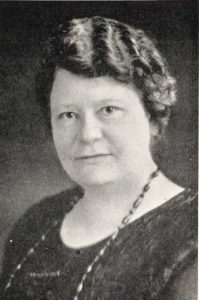
Ada Estelle Schweitzer was an Indianapolis-based physician and an advocate for children’s and women’s health. By the 1920s, Schweitzer had collaborated with hundreds of local, state, and national organizations to advance infant and maternal welfare. Her work is largely credited with advancing the passage of the Sheppard-Towner Maternity and Infancy Act of 1921, which provided federal funding to states for maternal- and infant-care programs. In Indiana, Schweitzer is also known for organizing the eugenics-laced from 1920 to 1932.
Born in LaGrange County on August 29, 1872, Ada Estelle Schweitzer attended Michigan State Normal College and, after teaching for several years, she entered Indiana Medical College (see ). Following her 1907 graduation, Schweitzer found employment at the Indiana State Laboratory because of her work in bacteriology while in medical school. This job allowed Schweitzer to focus on her true passion: addressing diseases affecting pregnant women and infants.
Working alongside physician , the secretary of the state board of health, Schweitzer soon found outlets for her research into pediatric diseases beyond conferences and publications. Hurty was an advocate of progressive reforms as well as eugenic thought, and in Schweitzer he saw a figure able to promote hygiene principles to new audiences. By the 1910s, Schweitzer was leading Indiana’s Division of Infant and Child Hygiene, where she promoted the message that better babies could be “produced” by better childrearing practices.
Schweitzer circulated her recommendations through lectures, mothering classes, and numerous publications. The latter included reports for the Indiana State Board of Health such as “Infant Conservation” (1919), “Child Hygiene and the Doctor” (1920), “Vitamins and Health” (1928), and “A Doctor Looks at a Child’s Teeth” (1932). At least in part because of Schweitzer’s efforts, Indiana’s infant mortality dropped considerably.
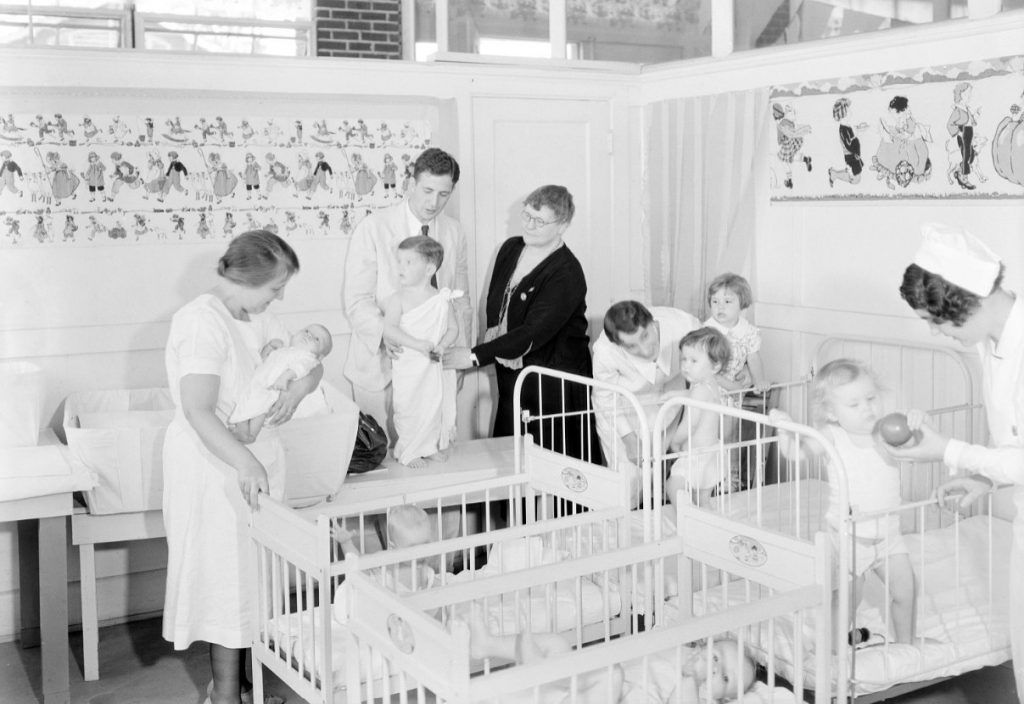
However, the hallmark of Schweitzer’s career was the creation of the Better Babies Contest, held at the starting in 1920. For twelve years, the contest brought parents, children, and doctors together in a mix of pageantry, medical education, and frivolity. Infants were clothed in matching togas, and medical professionals rated them by characteristics such as development, height, weight, and mental aptitude.
Controversy surrounded Schweitzer’s work. Her efforts helped to normalize as a worldview among middle-class Hoosiers, lending a positive veneer to practices that included racial and ethnic discrimination, pseudoscientific justification of socio-economic inequalities, and sometimes sterilization of populations deemed “defective.” With the State Fair’s Better Baby contests, both supporters and detractors noted that infants were being judged much like animals housed in the nearby barns. Indeed, eugenicists and agriculture reformers viewed the Better Babies Contest as a venue for judging the breeding of “human livestock.” Furthermore, while her work with hygiene and disease prevention held the potential to benefit all Hoosier children, Schweitzer aimed her outreach chiefly at white, middle-class, native-born mothers. African Americans and immigrants were generally excluded not just from the Better Baby contests but also from her larger public health endeavors.
Schweitzer’s public career largely came to an end with the . A , Schweitzer was not retained when the political winds brought Paul V. McNutt into the governor’s office. Not only were she and her staff dismissed, but McNutt’s reorganization of state government ended her position altogether. She found employment with the Children’s Bureau in Washington, DC, later joining the staff of , a private facility for the treatment of mental and nervous conditions in Indianapolis. She also continued to be active in the Methodist Church (see ). Schweitzer died on July 2, 1951.
FURTHER READING
- Gugin, Linda C., and James E. St. Clair, eds. Indiana’s 200: The People Who Shaped the Hoosier State. Indiana Historical Society Press, 2015. https://search.worldcat.org/title/907810772.
- Huerter, Mary Elise. “Prenatal Screening: Quality Control and the Genetics Gateway.” Master’s Thesis, Indiana University, 2007. https://doi.org/10.7912/C2/418.
- Stern, Alexandra Minna. “‘We Cannot Make a Silk Purse Out of a Sow’s Ear’: Eugenics in the Hoosier Heartland.” Indiana Magazine of History 103, no. 1 (2007). https://scholarworks.iu.edu/journals/index.php/imh/article/view/12254.
CITE THIS ENTRY
APA:
Lantzer, J. S. (2026). Ada Estelle Schweitzer. Encyclopedia of Indianapolis. Retrieved Nov 24, 2026, from https://indyencyclopedia.org/ada-estelle-schweitzer/.
MLA:
Lantzer, Jason S. “Ada Estelle Schweitzer.” Encyclopedia of Indianapolis, 2026, https://indyencyclopedia.org/ada-estelle-schweitzer/. Accessed 24 Nov 2026.
Chicago:
Lantzer, Jason S. “Ada Estelle Schweitzer.” Encyclopedia of Indianapolis, 2026. Accessed Nov 24, 2026. https://indyencyclopedia.org/ada-estelle-schweitzer/.

Help improve this entry
Contribute information, offer corrections, suggest images.
You can also recommend new entries related to this topic.