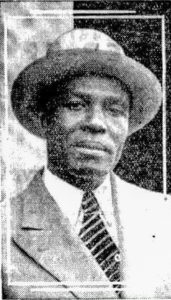
Photo info ...
William “Dizzy” Dismukes was a pitcher, manager, sportswriter, and front-office executive who spent nearly five decades in Black professional baseball, including key seasons in Indianapolis. As a top pitcher for the Negro Leagues team, Dismukes helped his squad to a championship in 1916 before becoming player-manager for the ABCs. Dismukes threw using a submarine-style delivery, a rare underhanded pitch where the thrower releases the ball near ground level while bending the torso sideways. Despite the nickname “Dizzy,” he was regarded as one of the game’s most cerebral competitors.
Born on March 13, 1890, in Birmingham, Alabama, Dismukes grew up in that city and attended Talladega College for half a semester. He took up professional baseball at age seventeen, joining the East St. Louis Imperials in 1908. The ABCs brought him to Indianapolis to pitch a single game against Birmingham in 1909. The appearance was inauspicious, with Dismukes giving up seventeen hits in a 9–2 loss, but it inaugurated a long relationship with the team. After stints with other clubs, Dismukes played from 1910–11 for legendary manager West Baden Sprudels, based at the West Baden Springs Hotel in southern Indiana, where he became the team’s most effective pitcher.
Taylor moved to Indianapolis to take charge of the ABCs in 1914, and Dismukes followed in late April of 1915. He would, with several brief interruptions, play for or manage the Indianapolis squad over the next nine years. Dismukes established himself as the pitching anchor during the 1915 season, achieving a 13–3 win-loss record on the mound with the ABCs, and a 19–5 record with barnstorming appearances included. His best season in Indianapolis came in 1916, when he posted a 13–4 record with the ABCs. In a postseason series to crown the champion of western Black baseball, Dismukes led the ABCs past the Chicago American Giants, with Indianapolis winning 3 games to 1.
Dismukes left the ABCs to manage the Dayton Marcos in 1918. His season was interrupted by , where he served as a sergeant in the 809th Pioneer Infantry, stationed in Europe from September 1918 to July 1919. In 1920, with the war over, he rejoined the ABCs, now a charter member of Rube Foster’s new Negro National League (NNL). Dismukes posted an 11–6 record in the inaugural NNL season. When C. I. Taylor died unexpectedly in February 1922, Taylor’s widow, Olivia Taylor, gained ownership of the team and turned to Dismukes as field manager for the 1923 season. Key players Ben Taylor and left the team to play in the Eastern Colored League (ECL) before Dismukes began in the role, but the strong outfielder helped Dismukes’s squad finish the season in fourth place. However, when Charleston followed former teammates Taylor and Mackey to play in the ECL at the start of the 1924 season, the ABCs struggled to remain competitive. They fell to a 4–17 record by June 1924 before being dropped from the NNL’s roster of teams at midseason. This ended Dismukes’s time in Indianapolis.
Off the field, Dismukes skillfully chronicled the ABCs’ history. In a 1924 article for the Pittsburgh Courier, an African American newspaper with nationwide distribution, he provided a concrete firsthand account of the team’s origins. Dismukes continued to write a regular column for the Courier called “Dizzy Says,” contributing observations on players and the state of the game that remain valuable to contemporary historians of Black baseball.
After leaving Indianapolis, Dismukes managed teams across the Negro Leagues, including squads in Memphis, St. Louis, Birmingham, Detroit, and Chicago, and served at times as secretary of the NNL. In 1942, he became the personnel director and traveling secretary for the Kansas City Monarchs, a role he held for the next decade. Notably, he helped bring Jackie Robinson to the Monarchs in 1945. After the racial integration of Major League Baseball, Dismukes served as a scout for the New York Yankees from 1953 to 1954 and for the Chicago White Sox from 1955 to 1956.
Dismukes never married and continued working in baseball into his late sixties. Amid declining health, he later moved in with a sister in Campbell, Ohio, where he died on June 30, 1961, of arteriosclerosis. He is buried at Mount Hope Veterans Memorial Cemetery.
FURTHER READING
- Debono, Paul. The Indianapolis ABCs: History of a Premier Team in the Negro Leagues. Jefferson, NC: McFarland, 1997. https://search.worldcat.org/title/36543491.
CITE THIS ENTRY
APA:
Johnson, S. (2026). William ‘”Dizzy” Dismukes. Encyclopedia of Indianapolis. Retrieved Oct 19, 2026, from https://indyencyclopedia.org/william-dismukes/.
MLA:
Johnson, Spencer. “William ‘Dizzy’ Dismukes.” Encyclopedia of Indianapolis, 2026, https://indyencyclopedia.org/william-dismukes/. Accessed 19 Oct 2026.
Chicago:
Johnson, Spencer. “William ‘Dizzy’ Dismukes.” Encyclopedia of Indianapolis, 2026. Accessed Oct 19, 2026. https://indyencyclopedia.org/william-dismukes/.

Help improve this entry
Contribute information, offer corrections, suggest images.
You can also recommend new entries related to this topic.