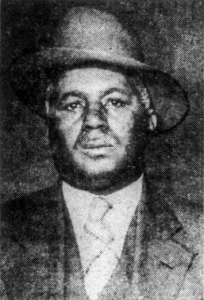
Photo info ...
(Aug. 15, 1887–Dec. 15, 1960). Warner Jewell was an Indianapolis businessman, Negro League baseball team owner, and Republican Party politician.
Jewell was born in Old Rocky Hill, Kentucky, to John Davidson and Pernie Jewell. Jewell likely attended the area’s segregated, one-classroom school for Black children, and it is unlikely that he received more than an elementary-school education, as formal high schools for African American pupils were few in the region surrounding Old Rocky Hill.
Jewell came to Indianapolis in 1908. He became involved with a community-based team called the Indianapolis Cubs in 1912. At the same time, Jewell operated a pool hall at 1700 Northwestern Avenue near Northwestern Park, where Ran Butler’s baseball team, a segregated all-Black semi-professional unit, first played home games. At the end of the 1916 season, a dispute between Indianapolis ABCs co-owners and Thomas Bowser led to the formation of two separate ABC teams. Bowser sold his faction to Jewell, who called his team Jewell’s ABCs.
Jewell’s ABCs initially operated as a semi-professional farm club, playing its 1917 home games at Northwestern Park. Due to the demolition of Federal League Park after the 1916 season, the team had to share Northwestern Park and with both Taylor’s ABCs and the . Averse to continuing that arrangement, Jewell’s ABCs barnstormed during most of the 1918 season. Jewell negotiated using Exhibition Park in Richmond, Indiana, as his team’s home field from June 2, 1918, until the end of the season. That venue had been built for the Richmond Quakers, a white baseball team, in 1917, but low ticket sales due to a player shortage during had left the stadium vacant. While in Richmond, Jewell’s team called itself the Richmond ABCs.
Jewell’s ABCs returned to Indianapolis for the 1919 season. Taylor’s ABCs ran into the same problem as the Richmond Quakers had, with World War I military service cutting into his roster, causing the team to sit out the season. Thus, Jewell’s ABCs became Indianapolis’s primary Negro League representative, though they played a limited schedule. In 1923, Jewell moved the team to Danville, Illinois, to play home games at Three-I League Park. After Taylor’s death in 1922 and the 1924 demise of his team under the ownership of his widow, Olivia Taylor, Jewell reorganized his own ABCs for the 1925 season. He posted $1,000 to secure a franchise in the Negro National League (NNL), partnering with Robert “Rube” Page and John Overton of the Page and Overton Coal Company. The 1925 team finished with a disappointing 17–57 record. In 1926, Jewell hired Bingo DeMoss as player-manager, and the team improved to 43–45 but folded at season’s end when Jewell could not sustain the financial losses brought on by poor attendance.
Beyond baseball, Jewell maintained various business interests throughout his life. In 1913, he operated a restaurant on Northwestern Avenue (later Dr. Martin Luther King Jr. Street). He was known for driving a large touring car, manufactured in Indianapolis, which he would use to transport players and showcase local pride.
Jewell was active in politics for much of his adult life. A Republican precinct committee member since 1920 and friend of Governor Harry E. Leslie, Jewell was appointed State House custodian in 1930. He later served as chief custodian at City Hall when Robert H. Tyndall was mayor, and he worked as a doorman during the 1945 and 1947 Indiana General Assembly sessions. In 1933, Jewell became president of the Fourth Ward Republican Club, and in 1934 he was appointed county chairman in charge of “Negro” precincts for Marion County. His political activities continued into the early 1950s. In 1951, he was vice-president of the newly chartered Hoosier Republican League and, in 1952, he joined the crowd that greeted Republican vice-presidential nominee Richard Nixon during a brief Nixon campaign appearance at Indianapolis’s .
Jewell died at Watts Nursing Home in Indianapolis from cardiac issues. He is buried at . While Jewell lacked the baseball acumen and personal financial resources needed to sustain a successful Negro National League franchise, he is remembered for his sports entrepreneurship amid Jim Crow, his association with the city’s longest-running Negro League franchise, and his work representing the African American community in Indiana Republican Party politics.
FURTHER READING
- Debono, Paul. The Indianapolis ABCs: History of a Premier Team in the Negro Leagues. 1997; McFarland & Co., 1997. https://search.worldcat.org/en/title/915562954.
- Dixon, Euell. “The Indianapolis ABCs (1907-1942).” Black Past, 2020. https://blackpast.org/african-american-history/the-indianapolis-abcs-1907-1942/.
CITE THIS ENTRY
APA:
Johnson, S. (2026). Warner Jewell. Encyclopedia of Indianapolis. Retrieved Mar 24, 2026, from https://indyencyclopedia.org/warner-jewell/.
MLA:
Johnson, Spencer. “Warner Jewell.” Encyclopedia of Indianapolis, 2026, https://indyencyclopedia.org/warner-jewell/. Accessed 24 Mar 2026.
Chicago:
Johnson, Spencer. “Warner Jewell.” Encyclopedia of Indianapolis, 2026. Accessed Mar 24, 2026. https://indyencyclopedia.org/warner-jewell/.

Help improve this entry
Contribute information, offer corrections, suggest images.
You can also recommend new entries related to this topic.