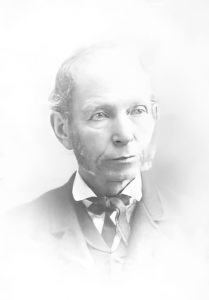
Photo info ...
(Mar. 29, 1817 – Apr. 30, 1895). John Herron was a 19th-century Indianapolis real-estate investor who owned numerous properties in the northwestern part of Indianapolis. His philanthropy shaped the city’s arts community, particularly through a major bequest to the Art Association of Indianapolis. Herron stipulated that the money, estimated at $225,000, be used to establish an art museum and art school bearing his name, which the Association carried out with the opening of the John Herron Art Institute in 1902. The neighborhood is named after the school and , the training camp for Union soldiers during the .
Herron was born in Carlton-in-Craven, England, to George and Nancy Herron. Six months after his birth, the Herrons immigrated to Penn, Chester County, in southeastern Pennsylvania, before relocating eight years later to Oxford, Pennsylvania. In 1839, George Herron moved to Cincinnati, Ohio, for a brief period before settling the entire family (his wife and five children) in Franklin County, south of Mount Carmel, Indiana. John Herron worked as a farmhand and oversaw operations on his father’s 160-acre farm. By the time he married Electa D. Turrell on December 23, 1869, he owned the family farm.
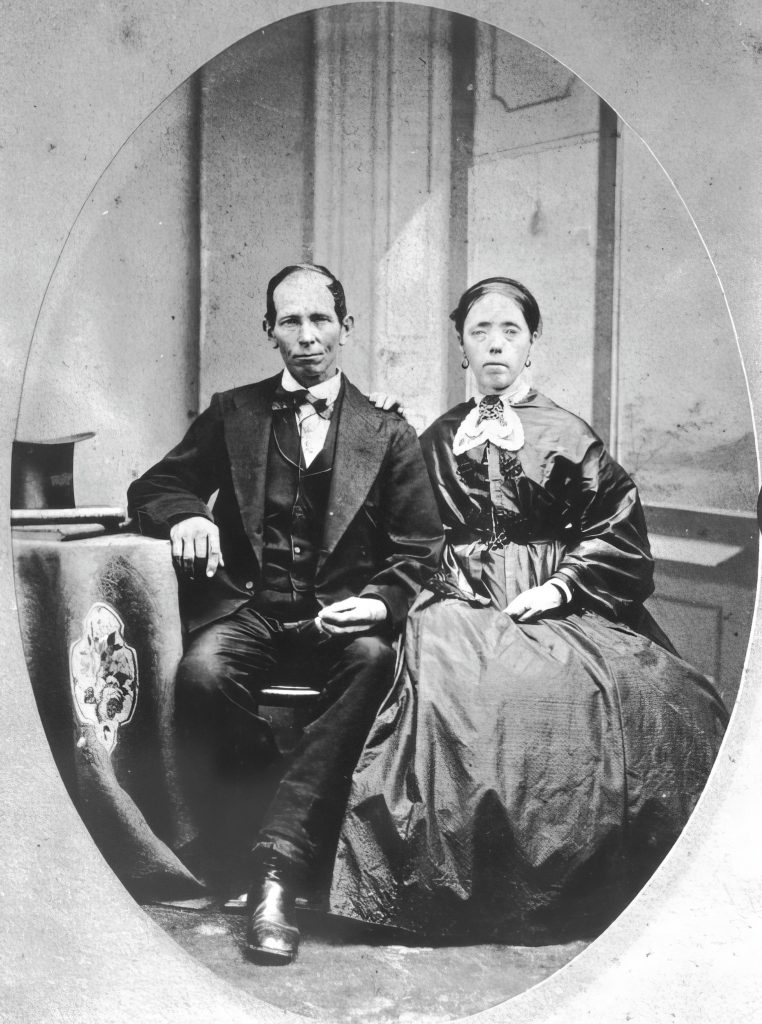
Herron invested the couple’s money in real estate in Indianapolis. On November 8, 1881, the couple moved to 781 N. Illinois Street in the Indianapolis neighborhood today known as the along with Herron’s sister, Ann. Within a few months, Herron, his wife, and sister had moved to 330 S. College Avenue, south of 16th Street and College Avenue. Herron came to own more than 100 properties throughout the the city, in the and neighborhoods.
After the deaths of his sister in 1891 and wife in 1892, Herron’s niece, Anna E. Turrell, moved into the Herron home as caregiver to her nearly blind uncle. The two traveled to Los Angeles to improve his health. In 1895, Herron died there from burns he sustained in a fire at the boarding house they were staying at. His family returned his remains to Indiana and buried them in their plot at Mount Carmel Cemetery. Herron’s longtime legal advisor, Ambrose Stanton, was executor of the will.
Herron bequeathed close to $225,000 to the Art Association of Indianapolis to establish an art museum and school bearing his name. , head of the Art Association, used the funds to establish the John Herron Art Institute, which opened in 1902. The association selected Tinker House, home of Hoosier artist at 16th and Pennsylvania streets, as the Institute’s inaugural home. The Institute soon outgrew the building’s space, so it demolished Tinker House to make room for a larger building that officially opened on November 20, 1906. From the Herron bequest, Sewell used $150,000 for artwork, $10,000 to operate the school, and $65,000 to procure the grounds and construct the building for the Institute. The Institute was later split into , home of the Indianapolis Museum of Art and the in 1967.
Within months of Herron’s death, several distant cousins, William and Elizabeth West, and James and John Harrison, contested the validity of his will. In September 1895, they claimed Herron, when drafting his will, was not of sound mind and was under undue influence to leave his estate to the Art Association. They sought the proceeds of a property, which had not yet been sold, that was valued at $25,000. While Herron, in his lifetime, had maintained no connection to the Art Association or to the arts more generally, the courts in October 1897 reached a provisional decision to uphold the will. Litigation of Herron v. Stanton continued for almost 20 years, with the ultimate decision in favor of the plaintiff.
Several institutions bearing Herron’s name continue to reflect the legacy of his bequest and the educational and arts opportunities it created. The John Herron Art Institute moved from its home at 16th and Pennsylvania streets to the campus of (IUPUI) in 2005. The building at 16th and Pennsylvania streets was later used to start Herron High School, a classical and liberal arts , established in 2006. A second high school, Herron-Riverside, was established at the old in 2017.
FURTHER READING
- Harrison Center. “The John Herron Art Institute.” November 19, 2017. https://www.harrisoncenter.org/blog/john-herron-art-institute.
- Lorentz, Lisa. “Friday Favorite: Art History.” Historic Indianapolis, May 2, 2014. https://historicindianapolis.com/johnherroncampus/.
- Warkel, Harriet G., Martin F. Krause, S L. Berry, and Herron School of Art. The Herron Chronicle. Herron School of Art, 2003. https://search.worldcat.org/en/title/51518328.
CITE THIS ENTRY
APA:
Kingen, K. (2025). John Herron. Encyclopedia of Indianapolis. Retrieved Mar 24, 2026, from https://indyencyclopedia.org/john-herron/.
MLA:
Kingen, Kyle. “John Herron.” Encyclopedia of Indianapolis, 2025, https://indyencyclopedia.org/john-herron/. Accessed 24 Mar 2026.
Chicago:
Kingen, Kyle. “John Herron.” Encyclopedia of Indianapolis, 2025. Accessed Mar 24, 2026. https://indyencyclopedia.org/john-herron/.

Help improve this entry
Contribute information, offer corrections, suggest images.
You can also recommend new entries related to this topic.