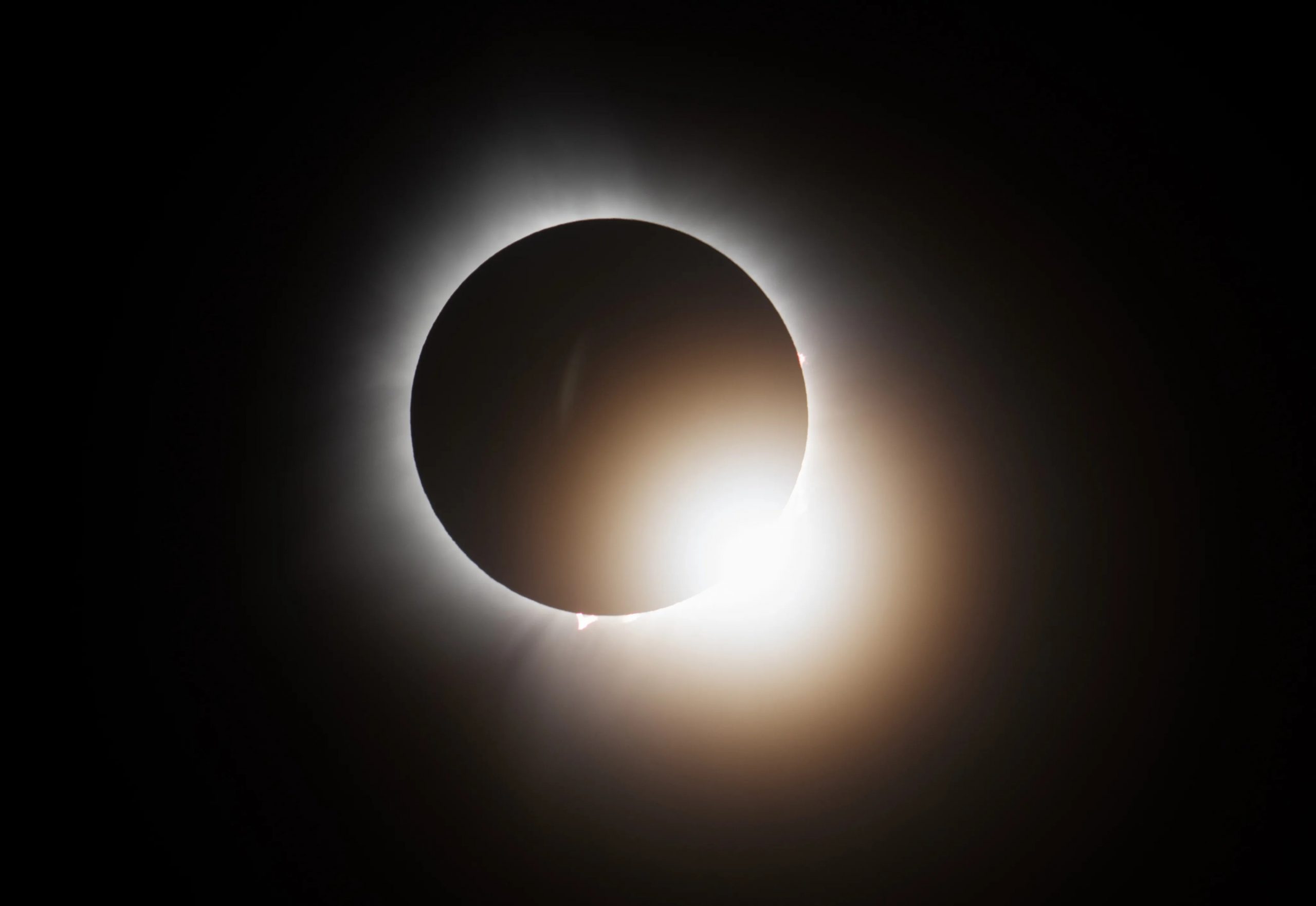
On April 8, 2024, Indianapolis experienced a total solar eclipse that began at 3:06 p.m. Eastern Daylight Time and lasted almost four minutes. A total solar eclipse is a rare celestial phenomenon that involves the moon passing between the sun and Earth in perfect alignment and being close enough to Earth to completely block the face of the sun. These two conditions permit the moon to cast an extremely large shadow (or “umbra”) onto Earth. Though a total solar eclipse occurs somewhere in the world about every 18 months, any specific location in the northern hemisphere will fall within the path of totality only about every 375 years on average, due to the variance in the path of the eclipse. The last total solar eclipse to pass over Indianapolis occurred in September 1205, and another will not take place there until 2099.
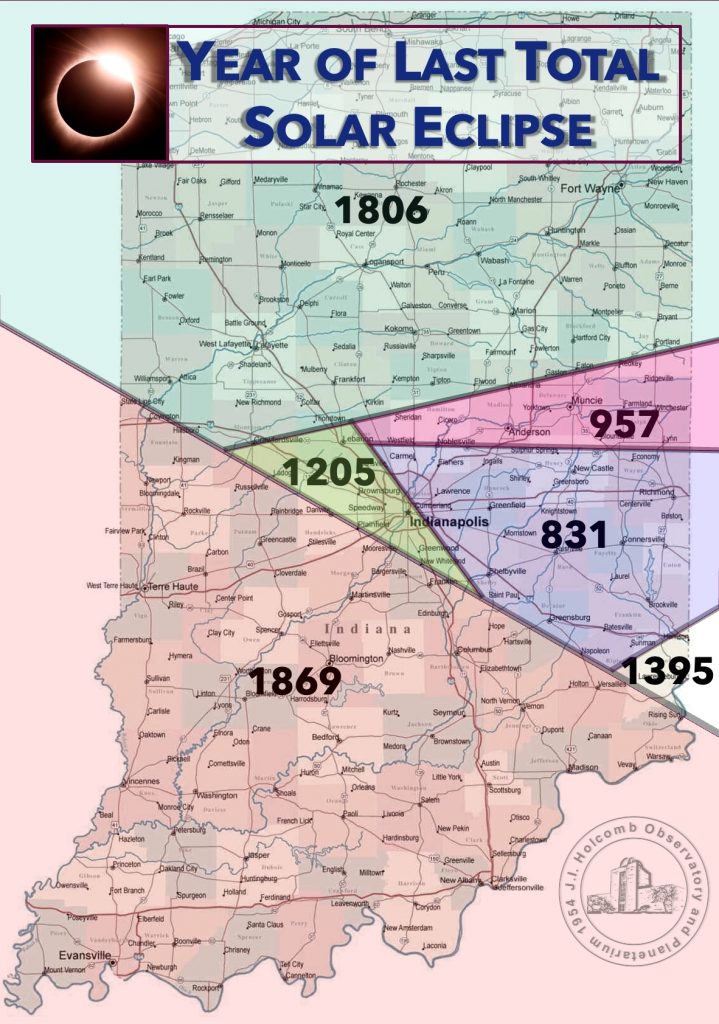
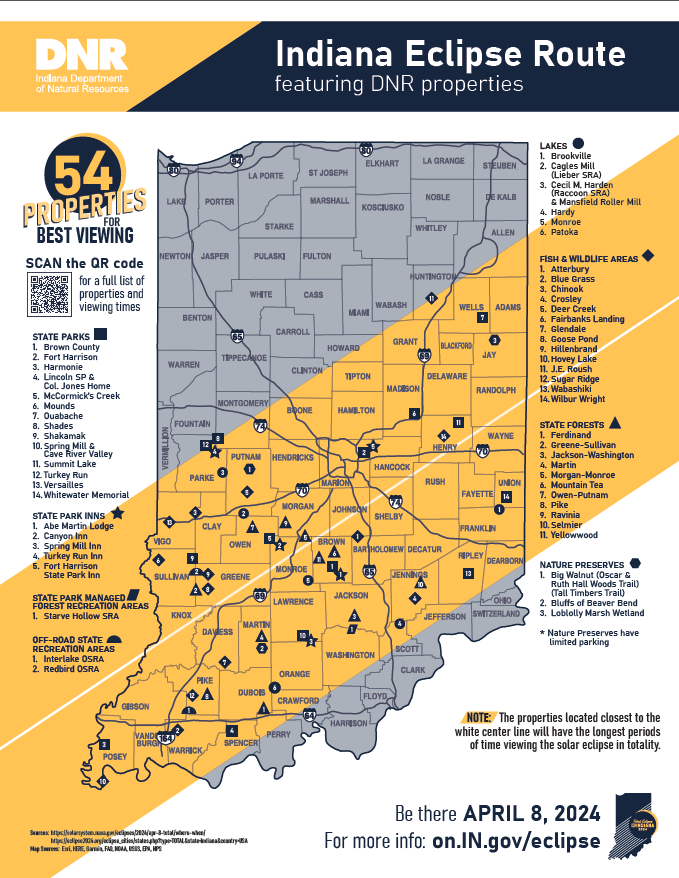
The total solar eclipse of 2024, dubbed the Great North American Eclipse by media outlets, was noteworthy because of the size and duration of the path of totality. The 115-mile wide and 3,200-mile-long path of totality ran from Mexico to Canada on April 8, 2024. It allowed for a greater area of viewing than the total solar eclipse of 2017, whose path of totality spanned from Oregon to South Carolina (70 miles wide and 2,496 miles long), with the longest duration of totality lasting two minutes and 42 seconds at Carbondale, Illinois.
Viewers of the total solar eclipse of 2024 in Indianapolis experienced a dark sky and a 10-degree Fahrenheit temperature drop. The sun’s spiky white corona was visible around the moon’s edges in a phenomenon known as Baily’s Beads. These spiky beads merged into a single bright ring, called the diamond ring effect, immediately before totality. The ring effect remained during totality and immediately after but disappeared as the moon shifted out of alignment with the sun and Earth. Explosions on the sun’s surface and extending from its corona looked like streamers due to heightened activity of the sun’s magnetic field that coincidentally occurred simultaneously with the eclipse.
Many people considered Indianapolis, with its central location in the path of totality, a prime destination for watching the spectacle. Over preceding weeks, Indiana’s governor, Eric Holcomb, began preparing for a large influx of visitors to the state and more specifically to Indianapolis. Concerned about the potential needs of Indiana’s emergency response, transportation, communication, and critical infrastructure systems, Holcomb signed an executive order (Order 24-05) allowing the mobilization of security, first-aid staff, and volunteers in the event of an emergency.
NASA distributed eclipse glasses through organizations such as the . Scientific, medical, and public health professionals sought to educate the public on safe viewing practices, including the use of ISO 12312-2 standard glasses designed to reduce visible sunlight to safe levels and block nearly all solar ultraviolet and infrared radiation.
Many local organizations arranged educational programs to celebrate the total solar eclipse. staged an Eclipse Extravaganza, highlighting the event through science, arts, and humanities activities. hosted a Total Eclipse at the Park event with presentations about the eclipse, dinner, and games. The at provided telescopes with expert-guided eclipse viewing and planetarium shows. hosted a Lunacy Festival with food trucks and live music performed by members of the . Restaurants and local eateries curated eclipse-themed menus. The organized “the world’s largest viewing site for the 2024 total solar eclipse,” which served as a broadcast location for NASA TV.

While crowds were smaller than expected, estimated that Indianapolis was the most booked tourist site within the path of totality. Using data from area hotels and home-share platform Airbnb, Visit Indy estimated that 125,000 visitors representing all 50 states and 35 countries traveled to Indianapolis to view the 2024 eclipse.
CITE THIS ENTRY
APA:
Meeker, L. (2025). Total Solar Eclipse in Indianapolis. Encyclopedia of Indianapolis. Retrieved Sep 20, 2026, from https://indyencyclopedia.org/total-solar-eclipse-in-indianapolis/.
MLA:
Meeker, Liana. “Total Solar Eclipse in Indianapolis.” Encyclopedia of Indianapolis, 2025, https://indyencyclopedia.org/total-solar-eclipse-in-indianapolis/. Accessed 20 Sep 2026.
Chicago:
Meeker, Liana. “Total Solar Eclipse in Indianapolis.” Encyclopedia of Indianapolis, 2025. Accessed Sep 20, 2026. https://indyencyclopedia.org/total-solar-eclipse-in-indianapolis/.

Help improve this entry
Contribute information, offer corrections, suggest images.
You can also recommend new entries related to this topic.