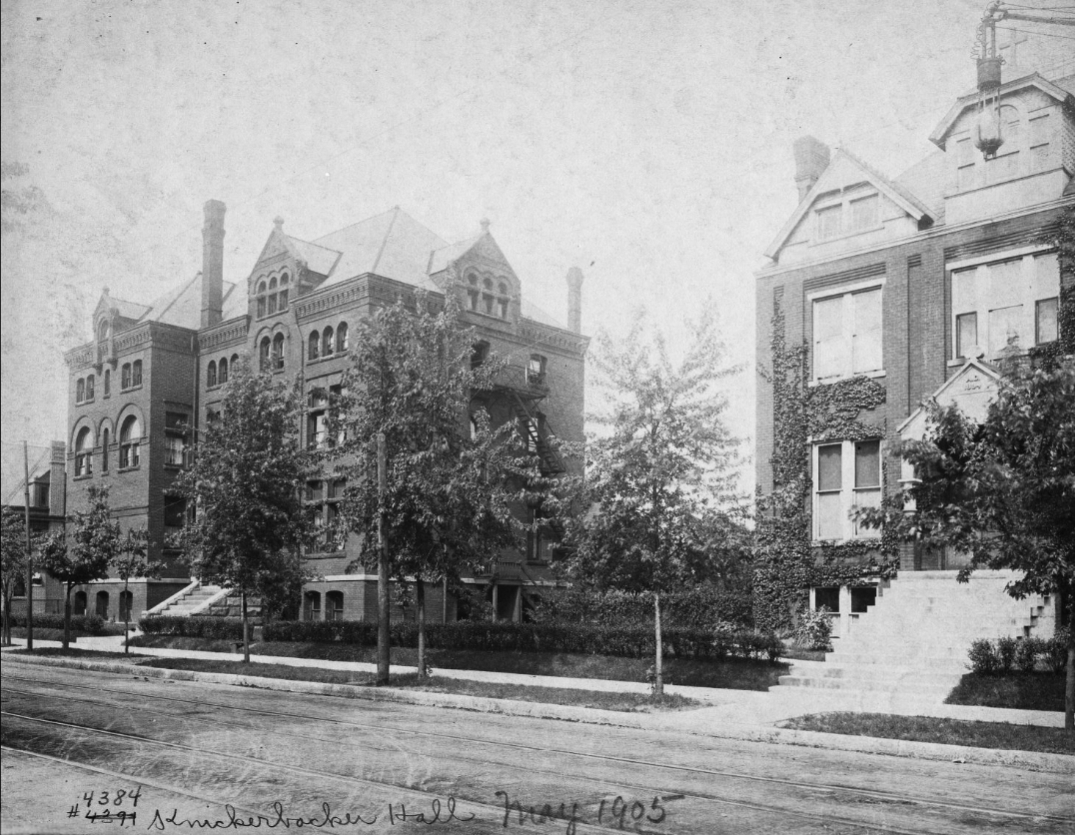
Knickerbacker Hall was an boarding and day school for girls, located within the complex of buildings developed around Grace Church in Indianapolis. The Episcopalian Church opened the school in September 1891 as Saint Mary’s Hall. It served as the new home for the Indianapolis Institute for Young Ladies (later renamed the Diocesan School for Girls), a small boarding and day school for girls founded in 1885. The Right Reverend D. B. Knickerbacker served as Bishop of the Episcopal Diocese of Indiana at the time the school opened; though he refused to allow the school to be named after him during his lifetime, the diocese renamed it in his honor after the bishop’s death in 1895. The building that housed the school was razed in 1940.
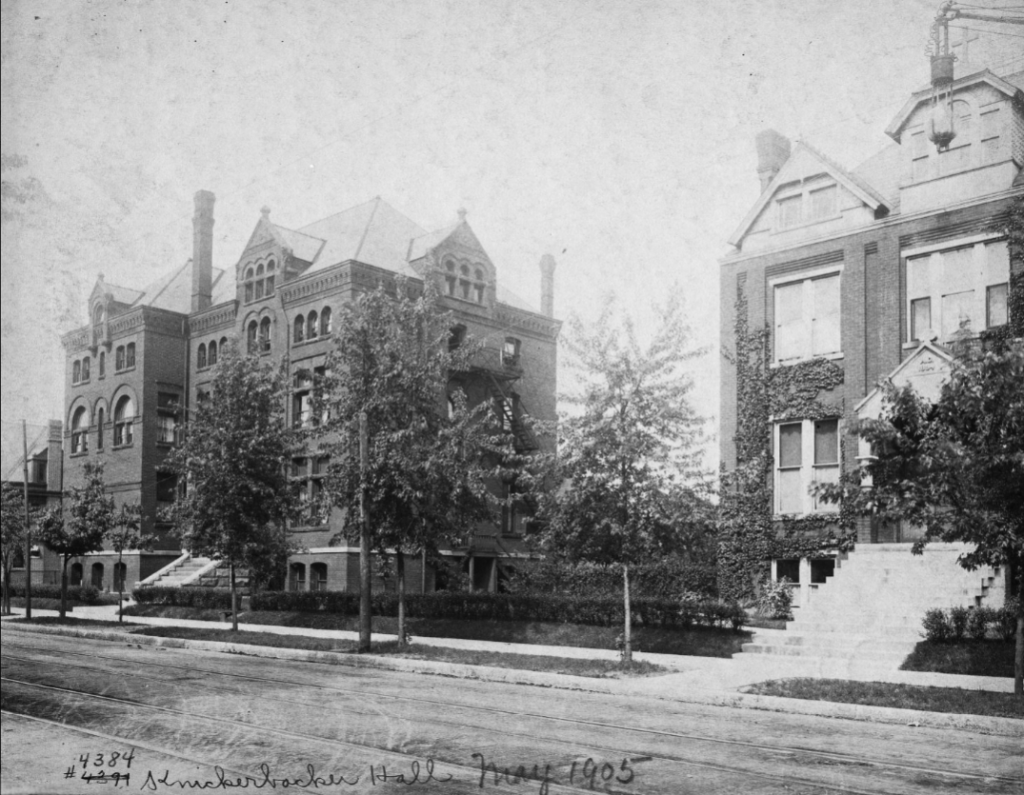
Located at 1541–1545 Central Avenue (originally 1505 Central Avenue until a street renumbering circa 1905), Knickerbacker Hall stood four stories tall and included a large general schoolroom, gymnasium, studio, laboratory, music room, drawing room, parlor, and bedrooms for boarding students. In addition to providing education to girls, the school also offered classes to the public.
Initially, the Rev. George E. Swan and his wife operated the school as a private enterprise under diocesan supervision. Low enrollment and financial instability forced the trustees of the Episcopal Diocese to take over management of Knickerbacker Hall. The trustees appointed Mary B. Perin McGuffey, a former assistant principal at a school in Minnesota, as principal. By 1897, the school had about 20 students. Mary Helen and Susan Yerkes, in turn, succeeded Perin McGuffey as principal.
Despite a slow start, by 1898 enrollment had increased to 80 students. The school expanded in 1901 to accommodate the growing student body. A three-story brick addition completed that year contained classrooms, music rooms, a gymnasium, a laboratory, and studio space. The following year, the school had 60 day students and 33 dorm students drawn from 10 states.
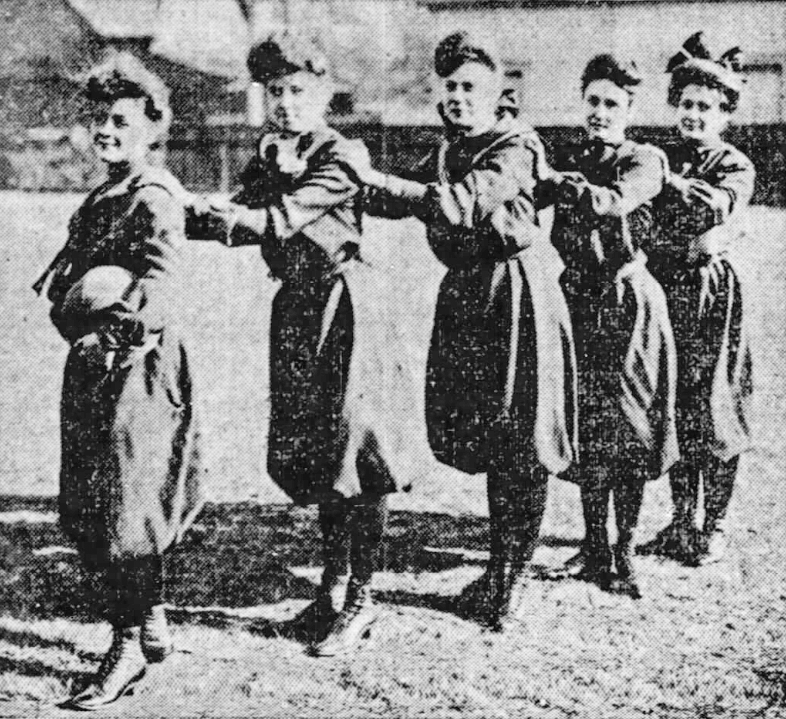
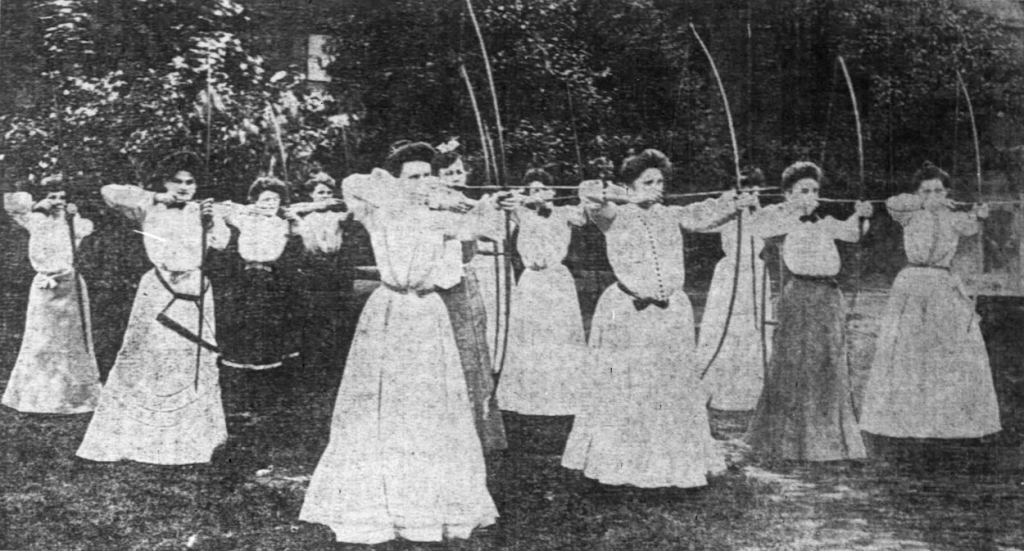
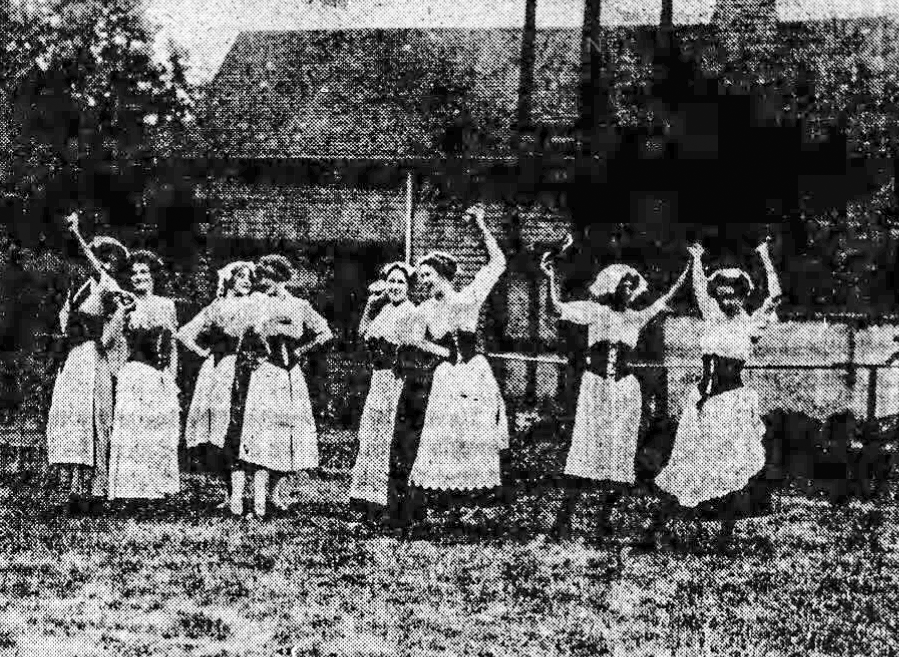
In 1907, , formerly an assistant at May Wright Sewall’s Girl’s Classical School (see ), leased the property from the Episcopal Church. She took over management of Knickerbacker Hall while merging her own school into the existing school at the site. Landers continued this arrangement until she relocated the combined school, comprising her own institution and Knickerbacker Hall, to the W. E. Stevenson home at 2049 N. Meridian Street in 1912.
After Landers’s departure, the Episcopalian Council, a diocesan governing body, agreed to convert the vacant building into Knickerbacker Lodge, an institution providing low-cost housing for young working women earning less than $9 per week. The Council made improvements to the building, and it reopened in October 1912 under the church’s supervision. About 45–50 young women lived there each year, paying room and board fees of between $2.50 and $5 per week.
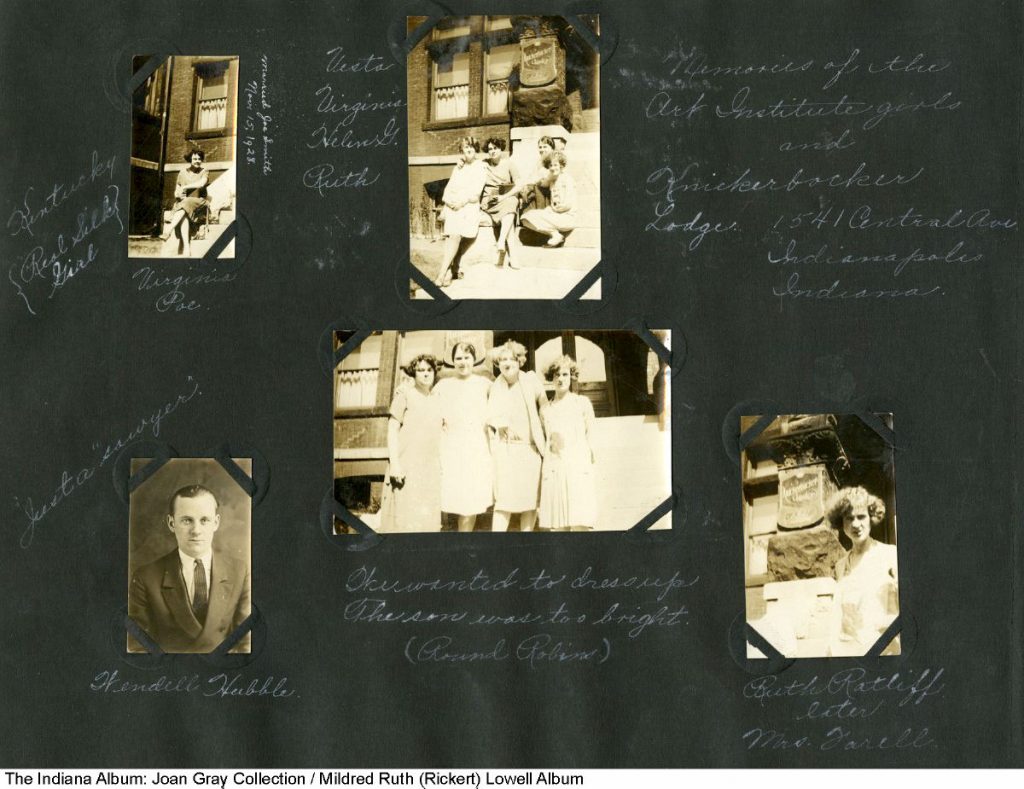
Knickerbacker Lodge’s role as a women’s residence was brief. In 1914, educator Wendell S. Brooks used the building to operate his eponymous institution named the Brooks School for Boys, established to provide college-preparatory education for male students. In 1920, amid financial problems at the school, a group of local businessmen purchased the school’s assets and changed the institution’s name to The Boys’ Preparatory School of Indianapolis. This school moved to a campus at 3050 Cold Spring Road in 1929 and became Park School (see ). After this departure from the Knickerbacker Lodge building, the Episcopalians used the building and others that had been constructed on the property as boarding houses for working men and women.
By the end of the 1930s, Knickerbacker Hall had been vacant for several years. Though proposals had circulated for repurposing the building as a community center, these never came to fruition. In 1940, Bishop Richard A. Kirchhoffer and the Cathedral Board of Trustees decided the building would be razed: consequently, Knickerbacker Hall was demolished in July 1940.
FURTHER READING
- Schouten, Rudy. “Then & Now: Knickerbacker Hall, 1545 Central Avenue.” Historic Indianapolis, August 17, 2017. https://historicindianapolis.com/knickerbacker-hall/.
CITE THIS ENTRY
APA:
Fischer, J. E. (2025). Knickerbacker Hall. Encyclopedia of Indianapolis. Retrieved Sep 25, 2026, from https://indyencyclopedia.org/knickerbacker-hall/.
MLA:
Fischer, Jessica Erin. “Knickerbacker Hall.” Encyclopedia of Indianapolis, 2025, https://indyencyclopedia.org/knickerbacker-hall/. Accessed 25 Sep 2026.
Chicago:
Fischer, Jessica Erin. “Knickerbacker Hall.” Encyclopedia of Indianapolis, 2025. Accessed Sep 25, 2026. https://indyencyclopedia.org/knickerbacker-hall/.

Help improve this entry
Contribute information, offer corrections, suggest images.
You can also recommend new entries related to this topic.