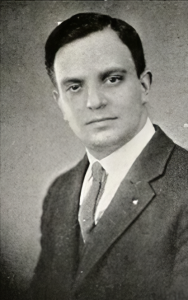
Photo info ...
Waheeb Salim Zarick was an Indianapolis doctor, medical educator, and Arab American community leader. He established his medical practice, while also teaching anatomy at the Indiana University School of Dentistry, during a time when there were few Arab American physicians in the United States. As a civic leader, Zarick helped new and established Arab immigrants in Indianapolis develop organizational networks that fostered both the retention of homeland traditions and a deepening involvement with local and regional philanthropy and politics.
Zarick was born on March 9, 1895 in Tripoli, Syria (today Tripoli, Lebanon, not to be confused with the Libyan city of the same name). He and his parents left their home country in 1899, settling in 1902 in Frankfort, Indiana, where he attended local public schools. Zarick attended the University of Michigan followed by the Indiana University School of Medicine, from which he earned an MD degree in 1927.
In medical school, Zarick was active in student organizations. This included membership in Tau Kappa Alpha and the Debate Team, and roles as secretary of the Skeleton Club and president of the Cosmopolitan Club (a club for domestic and immigrant students) and the French Circle.
Upon graduation, Zarick became active in the Indianapolis medical community as a practitioner, public health advocate, and educator. He treated patients in his own practice, served as a staff physician for the Indianapolis Public School system, and taught the second-semester general anatomy course for dental students as a non-tenure-track assistant professor at Indiana University’s School of Dentistry.
In the civic realm, Zarick was deeply involved in Syrian-Lebanese social life. He was a member of St. George Orthodox Syrian Church and a leader of the , one of seven Indianapolis Syrian clubs. In 1936, the seven clubs hosted the inaugural meeting of the Midwest Federation of Syrian American Clubs, which brought approximately 500 members of Syrian American clubs from 11 midwestern states to Indianapolis. Convening at the Brotherhood headquarters at East Riverside Drive and Pruitt Street along , delegates heard a welcome address from Mayor , and they later elected Zarick as the first president of their regional organization. In this role, Zarick oversaw the federation’s growth, which included the establishment of a newspaper, , and the development of an extensive network of community service and philanthropic endeavors.
As a hobby, Zarick also performed regularly as a magician. This included appearances across Indiana, at venues such as the and the . He served in a volunteer role as president of the Indiana Society of Magicians.
Waheeb Zarick died on June 28, 1938 of a coronary occlusion at the age of 43, leaving behind a wife and son. Though his early death cut short his career as a medical professional and community leader, Zarick’s contributions had created new paths for Syrian and Lebanese immigrants to participate more fully in Indianapolis’s public life. He is buried at .
FURTHER READING
- The author adapted this EOI entry from their original article:
- Curtis, Edward E. IV. “Healing Hoosiers for a Century: The Doctors.” Arab Indianapolis, December 15, 2020. https://arabindianapolis.com/healing-hoosiers-for-a-century-the-doctors/.
CITE THIS ENTRY
APA:
Curtis, E. (2025). Waheeb Salim Zarick. Encyclopedia of Indianapolis. Retrieved Apr 3, 2026, from https://indyencyclopedia.org/waheeb-salim-zarick/.
MLA:
Curtis, Edward E., IV. “Waheeb Salim Zarick.” Encyclopedia of Indianapolis, 2025, https://indyencyclopedia.org/waheeb-salim-zarick/. Accessed 3 Apr 2026.
Chicago:
Curtis, Edward E., IV. “Waheeb Salim Zarick.” Encyclopedia of Indianapolis, 2025. Accessed Apr 3, 2026. https://indyencyclopedia.org/waheeb-salim-zarick/.

Help improve this entry
Contribute information, offer corrections, suggest images.
You can also recommend new entries related to this topic.