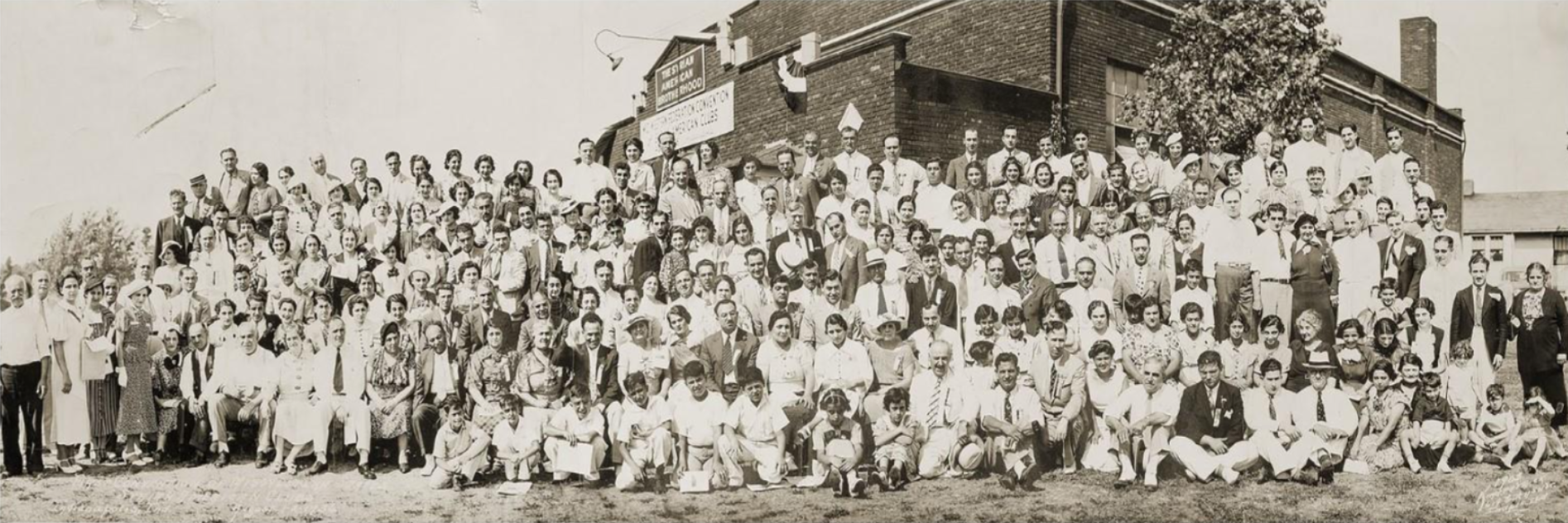
The Syrian American Brotherhood Hall was one of the city’s several ethnic clubs. It nurtured patrons’ forms of ethnic solidarity while furthering their participation in the wider civil society of Indianapolis. The hall played a significant role in Arab American national history in the 1930s.
The hall’s parent organization, the Syrian American Brotherhood, was founded by Arab Americans, mainly immigrants, in 1919. The Brotherhood sponsored social events throughout the 1920s and focused on raising money for its own home in the early 1930s. In the mid-1930s, the Brotherhood purchased the former Temple Baptist Church at 2245 East Riverside Drive, with a view of the South Grove Golf Course located across the street in .
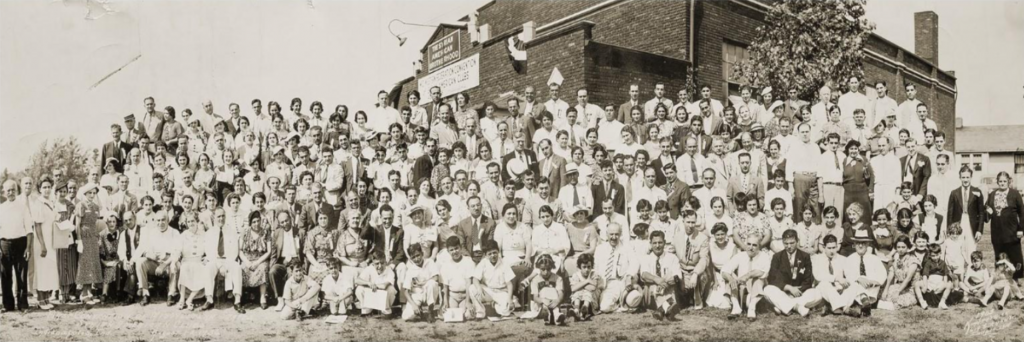
In 1936, members of the Syrian American Brotherhood used the hall to host the organizing conference for the Midwest Federation of Syrian American Clubs. Hundreds of delegates arrived from Illinois, Iowa, Kansas, Kentucky, Michigan, Minnesota, Missouri, Nebraska, Ohio, and Wisconsin, and toured the . Indianapolis mayor spoke at the conference, which featured dancing and music provided by the . Conference delegates elected Indianapolis resident as the first president of the Midwest Federation.
In 1930s and 1940s Indianapolis, the Syrian American Brotherhood Hall provided a space to unite the Arab American community’s philanthropic efforts. In 1938, the venue hosted a benefit celebrating President Franklin D. Roosevelt’s birthday, with proceeds going to , and other charities. During , the Syrian Brotherhood used the hall to fete US military service members and sell war bonds to support the war effort.
As the city’s premier site for Arab American social and civic activities, the hall became a de facto center for the celebration of Levantine culture, the shared cultural identity of countries in the subregion of West Asia, of which Syria is a core representative. Throughout the 1930s, local organizations such as the Syrian Crescent Club, the Syrian Young Men’s Club, the Syrian So-Fra (Sorority-Fraternity) Club, and the Binnette L’Yome (Women of Today) used the Syrian American Brotherhood Hall for their functions. Oftentimes these groups served Syrian-Lebanese food with a backdrop of Arab American music at their affairs. The Syrian American Brotherhood celebrated its 20th anniversary at the hall on April 30, 1939, with Indianapolis Syrian poet Habib Farrah reciting “a history of the Brotherhood in Arabic poetry.”
The hall remained the epicenter of the Syrian-Lebanese community until the last large fundraisers took place there in 1958. However, during the post–World War II years, the hall faced challenges due to the movement of many middle-class Syrian and Lebanese urban residents to outlying suburbs of Indianapolis. Additionally, many Arab American metropolitan residents shifted their community-building efforts from ethnic organizations to religious congregations. By 1960, the building had been sold to the Bethesda Temple. Though Arab American residents of Indianapolis would continue to contribute to the civil society of central Indiana, the sale of the Syrian American Brotherhood Hall marked the end of an era in which the metropolis’s Syrian community had its own public space as a civic and cultural locus.
FURTHER READING
- The author adapted this EOI entry from their original article:
- Curtis, Edward E., IV. “Syrian American Brotherhood on Riverside Park.” Arab Indianapolis, December 22, 2020. https://arabindianapolis.com/syrian-american-brotherhood-on-riverside-park/.
CITE THIS ENTRY
APA:
Curtis, E. (2025). Syrian American Brotherhood Hall. Encyclopedia of Indianapolis. Retrieved Apr 3, 2026, from https://indyencyclopedia.org/syrian-american-brotherhood-hall/.
MLA:
Curtis, Edward E., IV. “Syrian American Brotherhood Hall.” Encyclopedia of Indianapolis, 2025, https://indyencyclopedia.org/syrian-american-brotherhood-hall/. Accessed 3 Apr 2026.
Chicago:
Curtis, Edward E., IV. “Syrian American Brotherhood Hall.” Encyclopedia of Indianapolis, 2025. Accessed Apr 3, 2026. https://indyencyclopedia.org/syrian-american-brotherhood-hall/.

Help improve this entry
Contribute information, offer corrections, suggest images.
You can also recommend new entries related to this topic.