The neighborhood of Sunshine Gardens is located on the far southwest side of Indianapolis. The neighborhood is bounded by to the west, Interstate 465 on the north, and substantial gravel pits on the south and east edges, which effectively make the neighborhood an island. The sole routes into the neighborhood are via Concord Street on the south and Thompson and Epler roads to the east.
Originally, much of the land which is now the Gardens was owned by Indianapolis banker , one of the largest landowners in from 1915 to 1925.
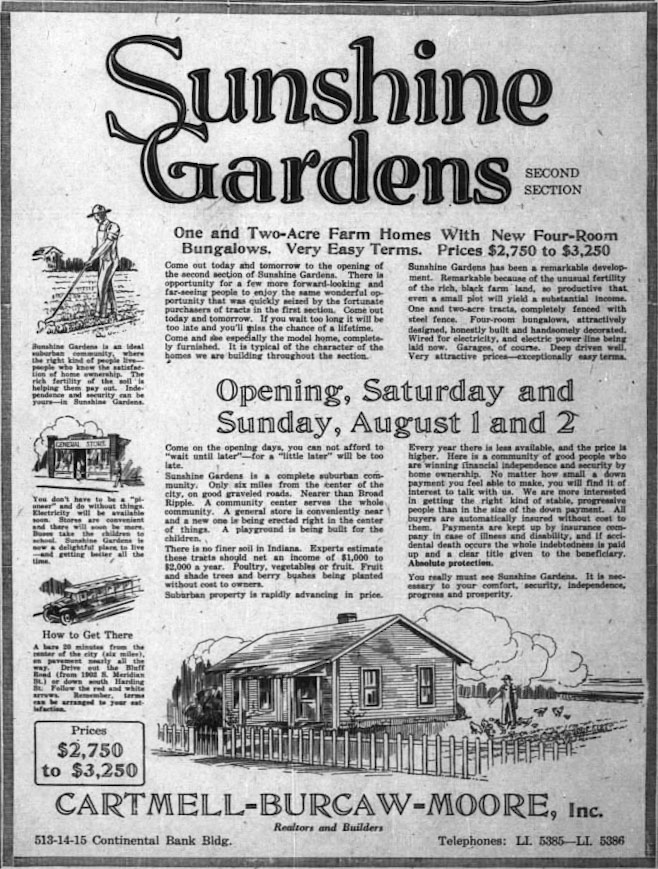
Sunshine Gardens was subdivided for development in the early 1920s. Capitalizing on its rural location, developers promoted the area to potential homebuyers by promising spacious two-acre lots where residents could keep chickens, cultivate vegetable gardens, and escape from urban “dirt and noise and smoke” into the neighborhood’s “clean healthful air.”
Other benefits touted by the neighborhood’s developers included its “home farm” nature with three- to four-room bungalow-style homes and parcels containing a garage, shed, driven well, and fencing for chickens and other animals. Developers used the idea of living in a new subdivision in the heart of “truck garden land” to entice city dwellers to a rural-adjacent lifestyle, highlighting the attraction of fresh local produce (truck garden produce). Targeting potential residents with agricultural interests, sales materials framed the neighborhood as one “designed to supply the farm living people of the city and county with a small tract just beyond city limits, yet in touch with markets and other conveniences.”
The neighborhood designers also characterized Sunshine Gardens as particularly suitable for older residents past their working years, claiming it was constructed to support not only the health and safety but also the independence of elderly inhabitants.
Though neighborhood architects promoted Sunshine Gardens’s positives, its position along the White River created a hazard. While the community was largely unaffected by the region’s , the slightly less-severe Flood of 1943, which damaged property across Indianapolis, compelled the evacuation of Sunshine Gardens and other neighborhoods along the river due to the failure of levees.
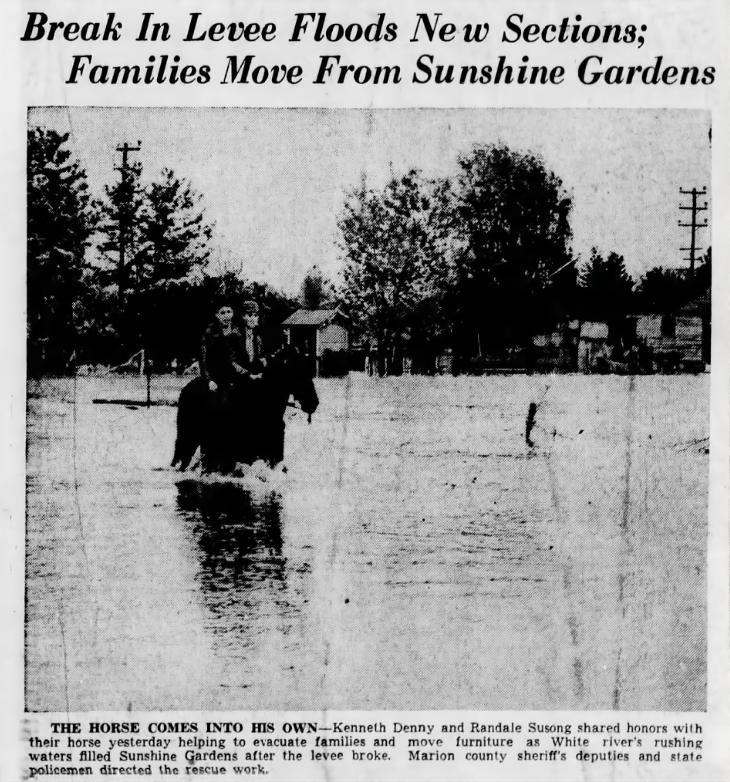
The federal Office of Civilian Defense (OCD), local law enforcement, and military personnel from Fort Benjamin Harrison assisted in the 1943 flood response. Initial efforts to reinforce the Sunshine Gardens levee were successful, but the water levels overtopped the levee and inundated the neighborhood on May 18.
Amphibious jeeps were used in the rescue and evacuation effort. The levee failure led to the flooding of “thousands of acres of farms and gardens around the Sunshine Gardens area, and the displacement of about 1000 residents,” according to the Indianapolis News. The levees were updated and reinforced in 1947, but floods in 1964 again threatened Sunshine Gardens, though this time the waters stopped just short of topping the levees. Barring future upgrades to the levee, the menace of flooding remains for the residents of Sunshine Gardens.
A newer danger to the neighborhood lies in its proximity to the IPL Harding Street power plant. Coal-dust contamination to the air and ground water, in a neighborhood largely reliant on wells for drinking water, has been a topic of discussion among public health officials since 2000.
FURTHER READING
- Campbell, Angela, Micaela Knox, and Katelynn Sinclair. “Welcome to Sunshine Gardens.” Climates of Inequality, November 27, 2022. https://climatesofinequality.org/project/welcome-to-sunshine-gardens/.
- The author adapted this EOI entry from their original article:
- Fujawa, Ed. “An Island In The Sun: The Sunshine Gardens Neighborhood of Indianapolis.” Class 900 Indy, March 19, 2019. https://www.class900indy.com/post/an-island-in-the-sun-the-sunshine-gardens-neighborhood-of-indianapolis.
CITE THIS ENTRY
APA:
Fujawa, E. (2026). Sunshine Gardens. Encyclopedia of Indianapolis. Retrieved Apr 5, 2026, from https://indyencyclopedia.org/sunshine-gardens/.
MLA:
Fujawa, Ed. “Sunshine Gardens.” Encyclopedia of Indianapolis, 2026, https://indyencyclopedia.org/sunshine-gardens/. Accessed 5 Apr 2026.
Chicago:
Fujawa, Ed. “Sunshine Gardens.” Encyclopedia of Indianapolis, 2026. Accessed Apr 5, 2026. https://indyencyclopedia.org/sunshine-gardens/.

Is this your community?
Do you have photos or stories?
Contribute to this page by emailing us your suggestions.