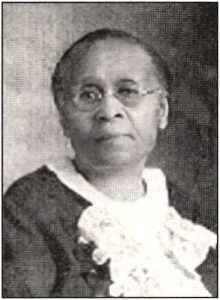
Mary Ellen Cable was an influential educator to Indianapolis elementary school students and to women entering the field of teaching. Through her ties to local Black civic organizations and her leadership of numerous schools for African American children, Cable implemented and helmed initiatives to improve the lives of the children and female educators in her orbit.
Mary Ellen Cable (née Montgomery) was born on September 19, 1861 in Leavenworth, Kansas. She was one of seven children born to Henry and Ann Ellen Steel Montgomery. Cable graduated from Leavenworth High School, and she attended Leavenworth Teachers’ Normal School in the 1870s. She taught elementary school in Fort Scott, Kansas, and then in Topeka, Kansas, in 1881, where she met her husband, George Washington Cable, also a teacher. The couple had one son, Dr. Theodore Cable, born in Topeka on September 3, 1892.
The family moved to Indianapolis in 1893, where George accepted a position at the post office and Mary accepted a teaching position for “colored children” at No. 19 (IPS). She transferred to IPS No. 23 in 1898, to teach mathematics.
In 1903, Cable took a yearlong position as principal of the newly opened Robert Gould Shaw School No. 40, an institution for African American children. The next school year, she moved to the McCoy School No. 24 where she assumed the principalship for almost 20 years. Here, she oversaw the elementary school vegetable garden project. Cable hoped these gardens would foster good citizenship among the students and spur residents in the neighborhood known as the District to plant gardens and improve property upkeep.
In 1916–17, Cable worked with the of Indianapolis to battle the growing problem of tuberculosis among Black children in IPS. Indeed, at School No. 24 the school nurse regularly treated new cases of the disease in the student population. To combat the problem, Cable established one of the first three fresh-air classrooms in Indianapolis (see ).
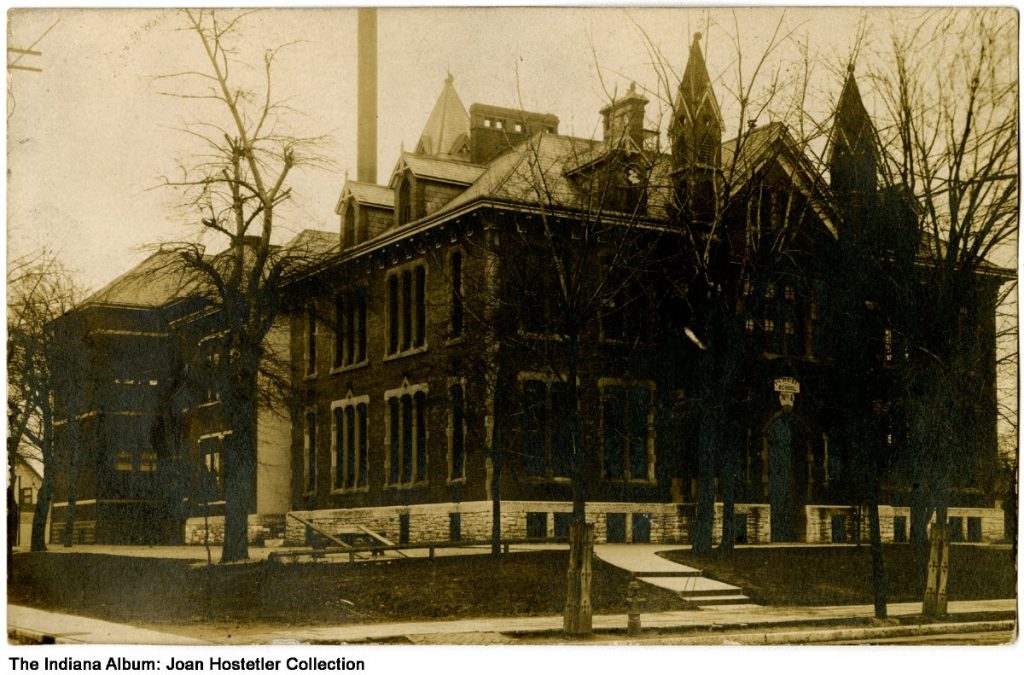
Cable ended her career at IPS No. 4, where she served as principal from 1922–33. Aiming to offer the 5th to 8th grade students a means to grow beyond a typical education, she organized student councils to promote student leadership, foster communication between students and teachers, and improve the school community. The councils allowed participating students to take part in the life of the school, particularly disciplinary issues involving their classmates.
During Cable’s 45-year tenure at IPS, she served as teacher, director of practice teaching, and principal at five schools: Schools 19, 23, 40, 24, and 4. While Cable was director of practice teaching, the Board of School Commissioners certified 61 Black educators whom Cable trained, 5 of whom went on to become principals.
In addition to her work at IPS, Cable was active in social and civic groups. In 1912, as president of the Colored Women’s Civic Club, a local philanthropic group, Cable organized the first Indiana chapter of the , the organization’s westernmost branch at that time. She served as Indiana’s first NAACP president. She belonged to , the Browning Literary Society, and sorority.
Cable died on September 18, 1944.
In 1953, a new IPS No. 4 was built and dedicated to the memory of Mary Cable. The original IPS No. 4, where Cable had been principal, stood empty beginning in 1953 and was razed in 1957. After Judge of the US District Court for the Southern District of Indiana required IPS to adopt a system-wide desegregation plan in 1971, IPS No. 4 slowly accepted white students through a controversial bussing plan that moved white students to IPS No. 4 and Black students to formerly all-white IPS institutions. In 1980, the Board of School Commissioners cited “underutilization” as a reason to close Mary Cable School No. 4. The school’s vacancy and proximity to created an opportunity for the university to move its Department of Speech, Theater, and Communications from the Marott Building on Meridian Street to the Cable School building closer to campus. The university leased the building from IPS from 1980 to 1986 before purchasing it at the end of the lease, naming it the Cable Building. The university demolished the structure in 2006, citing asbestos contamination as the reason. IUPUI constructed the Cable House residence hall on the site in 2016.
FURTHER READING
- Ferguson, Earline Rae. “The Woman’s Improvement Club of Indianapolis: Black Women Pioneers in Tuberculosis Work, 1903- 1938.” Indiana Magazine of History, Volume 84. https://scholarworks.iu.edu/journals/index.php/imh/article/view/10888/15486.
- Greiff, Glory June. Public Schools and the Neighborhood Life-Cycle. Indianapolis: Indianapolis Regional Office Historic Landmarks Foundation of Indiana, 1985. https://search.worldcat.org/en/title/11875899.
- Hine, Darlene Clark. When the Truth is Told: A History of Black Women’s Culture and Community in Indiana, 1875–1950. Indianapolis: the National Council of Negro Women, 1981. https://archive.org/details/whentruthistoldh1981hine.
- Thornbrough, Emma Lou. “The History of Black Women in Indiana.” Black History News & Notes, 1983. https://images.indianahistory.org/digital/collection/p16797coll66/id/15/rec/4.
CITE THIS ENTRY
APA:
Ferguson, E. R. & Verderame, J. A. (2025). Mary Ellen Cable. Encyclopedia of Indianapolis. Retrieved Oct 8, 2026, from https://indyencyclopedia.org/mary-ellen-cable/.
MLA:
Ferguson, Earline Rae and Jyoti A. Verderame. “Mary Ellen Cable.” Encyclopedia of Indianapolis, 2025, https://indyencyclopedia.org/mary-ellen-cable/. Accessed 8 Oct 2026.
Chicago:
Ferguson, Earline Rae and Jyoti A. Verderame. “Mary Ellen Cable.” Encyclopedia of Indianapolis, 2025. Accessed Oct 8, 2026. https://indyencyclopedia.org/mary-ellen-cable/.

Help improve this entry
Contribute information, offer corrections, suggest images.
You can also recommend new entries related to this topic.