The Indianapolis Arrows was a proposed Major League Baseball (MLB) franchise that represented the city’s attempt to secure a third major professional sports team during the 1980s. Though the team never materialized, the effort to acquire an MLB team generated significant public enthusiasm and demonstrated Indianapolis’s growing prominence as a major-league sports city, one which had developed extensive fan bases for the existing NBA team and following the arrival in 1984 of the NFL squad.

Bringing an MLB expansion team to Indianapolis was part of Mayor vision to use sports and tourism branding to revitalize the city since 1982. Two years later, the new MLB commissioner, Peter Ueberroth, supported the idea of expansion teams and suggested that Indianapolis would be considered as home to the next MLB team. In April 1985, Ueberroth had outlined three requirements for cities seeking expansion teams: broad-based local ownership, local government support, and demonstrated fan support.
Hudnut had a plan to demonstrate local government support for an expansion team. On July 7, 1982, Hudnut announced the formation of a 40-member Indiana Major League Baseball Committee to pursue an MLB team for Indianapolis. The timing reflected the city’s ambitious sports-centered development strategy under Hudnut, who helped transform Indianapolis into what civic leaders marketed as the “Amateur Sports Capital of the World.”
Local entrepreneur and venture capitalist provided a path to broad-based local ownership through the incorporation of Indianapolis Arrows Inc. in December 1983. As president of the organization, Angotti assembled a group of prominent Indianapolis business leaders and philanthropists who hoped to be the ownership group for the team. The group included Indianapolis businessman and civic leader and E. David Elmore, a Chicago-based owner of several minor league baseball teams.
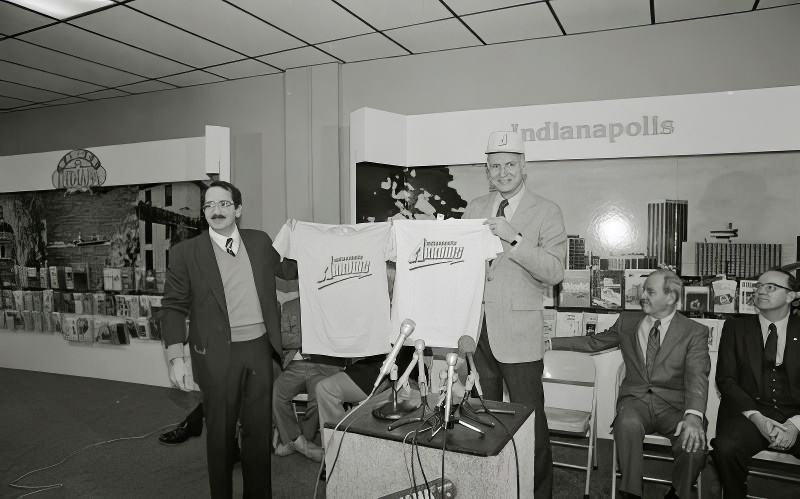
Hudnut and Angotti announced the name of the team at a press conference on February 12, 1985: the Indianapolis Arrows. Binford explained that the arrow symbol connected the team to the minor league Indianapolis Indians. They presented posters and announced an agreement with to televise Arrows games. The group identified three potential stadium options: a reconfigured , a renovated (home of the professional minor league ), or a new baseball-specific facility. However, the group emphasized it would not pursue an MLB franchise without the city’s firm commitment to finance a stadium.
On June 6, 1985, the Arrows launched a presale campaign for season tickets. Based on survey results from 1983, the exploratory group projected that 15,000 season tickets could be sold. The $50 deposits for seats were held in escrow and earned 5.5 percent interest, with a guarantee for a full refund if Indianapolis did not receive a franchise by the end of 1987. More than 12,000 season ticket deposits were placed. Expectant fans made Arrows merchandise, including t-shirts and hats, common sights around Indianapolis during the summer of 1985.
With visible public support for an MLB franchise, the question of where it would play remained unanswered. Engineering studies revealed significant problems with adapting the Hoosier Dome to baseball use. The Department of Parks and Recreation deemed Bush Stadium an impractical choice due to the costly renovations that would be required. Building a new stadium, with an estimated price tag of approximately $68 million, was considered politically difficult so soon after taxpayers had funded completion of the Hoosier Dome.
In August 1985, Angotti’s frustration with Mayor Hudnut reached a peak. National media outlets claimed Indianapolis had little chance gaining an expansion team without a firm plan to build a stadium. Hudnut committed to construct one upon acquisition of a team. Though securing an expansion team remained Angotti’s goal, he and his group considered other options for obtaining a franchise, including purchasing existing teams. They unsuccessfully pursued the financially strapped Oakland Athletics and Pittsburgh Pirates.

In November 1985, Hudnut led a delegation to New York to pitch Indianapolis as the home of an MLB expansion team to the MLB’s long-range planning committee. The delegation could not provide concrete stadium plans, whereas other cities making presentations already had venues in place. By late 1985, it became clear that the MLB would not move quickly on expansion. An August 1985 agreement between team owners and the players’ union had limited expansion through 1990 to two National League teams. On December 31, 1985, Angotti refunded all charter ticket holders their deposits plus 5.5 percent interest. In letters to each subscriber, he explained that expansion was not imminent, but he remained optimistic that the Arrows would take the field before the decade’s end. Angotti left the Arrows organization in 1988.
The team never materialized. Indianapolis’s chances for an expansion team were low, given its proximity to existing National League franchises in Chicago, St. Louis, and Cincinnati. The 1991 expansion franchises ultimately went to Denver (the Colorado Rockies) and Miami (the Florida Marlins), with both teams beginning play in 1993. As the noted at the time, three factors contributed to Indianapolis being passed over: geographic proximity to existing teams, the lack of a stadium deemed suitable by MLB executives, and the MLB’s preference for larger media markets.
FURTHER READING
- Fujawa, Ed. “Aiming High: A Brief History of the Indianapolis Arrows Baseball Team.” Class 900 Indy, May 21, 2024. https://www.class900indy.com/post/aiming-high-a-brief-history-of-the-indianapolis-arrows-baseball-team.
CITE THIS ENTRY
APA:
Johnson, S. (2025). Indianapolis Arrows. Encyclopedia of Indianapolis. Retrieved Mar 10, 2026, from https://indyencyclopedia.org/indianapolis-arrows/.
MLA:
Johnson, Spencer. “Indianapolis Arrows.” Encyclopedia of Indianapolis, 2025, https://indyencyclopedia.org/indianapolis-arrows/. Accessed 10 Mar 2026.
Chicago:
Johnson, Spencer. “Indianapolis Arrows.” Encyclopedia of Indianapolis, 2025. Accessed Mar 10, 2026. https://indyencyclopedia.org/indianapolis-arrows/.

Help improve this entry
Contribute information, offer corrections, suggest images.
You can also recommend new entries related to this topic.