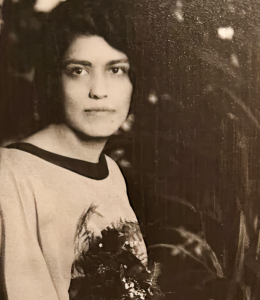
Photo info ...
Ann Kurker Zarick was a successful and well-known leader within Syrian and Lebanese women’s and youth organizations in Indianapolis during the 1930s and 1940s. She fostered numerous club activities that helped local Syrian and Lebanese youth and women find paths to greater inclusion within the broader civic community. The reputation she gained through such work eventually allowed her to take on leadership positions in larger regional Arab American organizations. Since these groups were largely male dominated at the time, Zarick’s ascent to prominent roles within them made her a trailblazer for Indianapolis’s Arab American women.
Ann Kurker was born on May 10, 1897, to Jabren and Sophia Izazes Kurker, both of whom had immigrated to Illinois from Syria. The Kurkers raised their five children in an Arabic-speaking household. Kurker trained to be a stenographer, and in 1918, she found work at Indianapolis’ , which made uniforms for the American Expeditionary Forces in . In 1926 Kurker married , a medical student at Indiana University. The Zaricks had a son, Joseph.
The couple resided near Brookside Park on the city’s east side. Many Syrians relocated to this area from the central , bringing with them grocery stores and other services for the Arab community. Due to social segregation by ethnicity and national origin in this era, Syrian and Lebanese residents of Indianapolis formed numerous clubs as a vehicle for participating in local civil society. Zarick and her husband were active members of the area’s Syrian-Lebanese community. Ann herself soon became heavily involved in a number of civic groups for women and for Syrian Americans. For instance, she took up positions on the Woman’s Auxiliary for the Indianapolis Medical Society and helmed publicity work for the Brookside Mothers Club in the 1930s.
Zarick’s evolving activities indicated how single-sex organizational spaces could help women develop leadership skills that could then be used in mixed-gender settings. Zarick used her leadership skills to become the first Arab American woman from Indianapolis with a leadership role inside a male-dominated regional ethnic group, the Midwest Federation of Syrian American Clubs. In 1939, after her husband’s death, both men and women chose Zarick to represent the Indianapolis Arab American community at the annual meeting of the Midwest Federation of Syrian and Lebanese Clubs in Omaha, Nebraska. Here she was elected secretary of this regional organization. The next year, she led Indianapolis’s delegation to the Midwest Federation annual convention held in Peoria, Illinois. Three thousand delegates attended the meeting to discuss the formation of a national federation of Syrian and Lebanese clubs. Zarick’s presence at these meetings marked a shift in women’s acceptance among members of Indianapolis’s Syrian and Lebanese civic organizations.
Locally, Zarick served as an adviser for youth clubs. She guided Indianapolis’s Syrian and Lebanese youth in organizations such as the Wits Sub-Debs for girls, which had non-Arab members but mostly Syrian-Lebanese members, and the Squires Club for boys. These clubs, both established in 1946, played an important part in youth culture in the post–World War II years. According to a Life magazine feature one year earlier, such clubs were “epidemic” in Indianapolis, with the article attributing their popularity to the gradual abolishment of high school sororities in Indiana and a purported natural inclination by Indianans to join groups. In Indianapolis alone, an estimated 6,000 young people were members of 700 different clubs, which staged skits, held dinners, and sponsored other youth-oriented activities. Ann Zarick mentored the Syrian and Lebanese youth who were in clubs open to any nationality background, which were formally associated with the Midwest Federation of Syrian and Lebanese Clubs.
Zarick died on January 27, 1970.
Zarick’s success as a local and regional leader suggests how the establishment of local women’s clubs made it possible for Arab American women to build networks, participate in Indianapolis’s charitable sector, and celebrate both Arab and American identities during the twentieth century’s first half. Zarick embodied a noteworthy example of female influence in male-dominated civic and youth organizations.
FURTHER READING
- The author adapted this EOI entry from their original article:
- Curtis, Edward E., IV. “Arab American Leader Ann Zarick, 1930s.” Arab Indianapolis, December 31, 2020. https://arabindianapolis.com/arab-american-leader-ann-zarick-1930s/.
CITE THIS ENTRY
APA:
Curtis, E. (2025). Ann Kurker Zarick. Encyclopedia of Indianapolis. Retrieved Apr 3, 2026, from https://indyencyclopedia.org/ann-kurker-zarick/.
MLA:
Curtis, Edward E., IV. “Ann Kurker Zarick.” Encyclopedia of Indianapolis, 2025, https://indyencyclopedia.org/ann-kurker-zarick/. Accessed 3 Apr 2026.
Chicago:
Curtis, Edward E., IV. “Ann Kurker Zarick.” Encyclopedia of Indianapolis, 2025. Accessed Apr 3, 2026. https://indyencyclopedia.org/ann-kurker-zarick/.

Help improve this entry
Contribute information, offer corrections, suggest images.
You can also recommend new entries related to this topic.