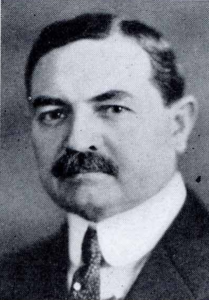
Alfred M. Glossbrenner was an Indianapolis businessman, civic leader, and political figure, best known for his long association with the Levey Printing Company and his involvement in local Republican politics. Notably, Glossbrenner lost his bid for mayor of Indianapolis in 1929 in a landslide that signaled voter’s disenchantment with the Republican party’s ties with the Ku Klux Klan.
Born on August 15, 1869 in Jeffersonville, Indiana, to William J. and Jane Rowan Glossbrenner, he moved to the south side of Indianapolis with his family in 1882. Though largely self-educated, he attended public schools for six years, first in Jeffersonville and then in the Indianapolis Public Schools. Glossbrenner began working at a young age, first as a newsboy and later as a department-store cash boy and elevator operator. He then worked as a record keeper maintaining a broad range of records at a retail coal company by day and attended night school at Granger Business School where he studied commercial law for one year. At 18, he joined Levey Brothers and Company, a printing firm, focusing on the firm’s finances as a bookkeeper and general office assistant.
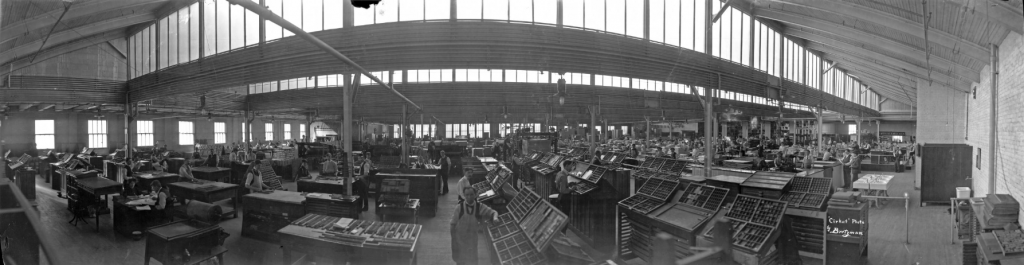
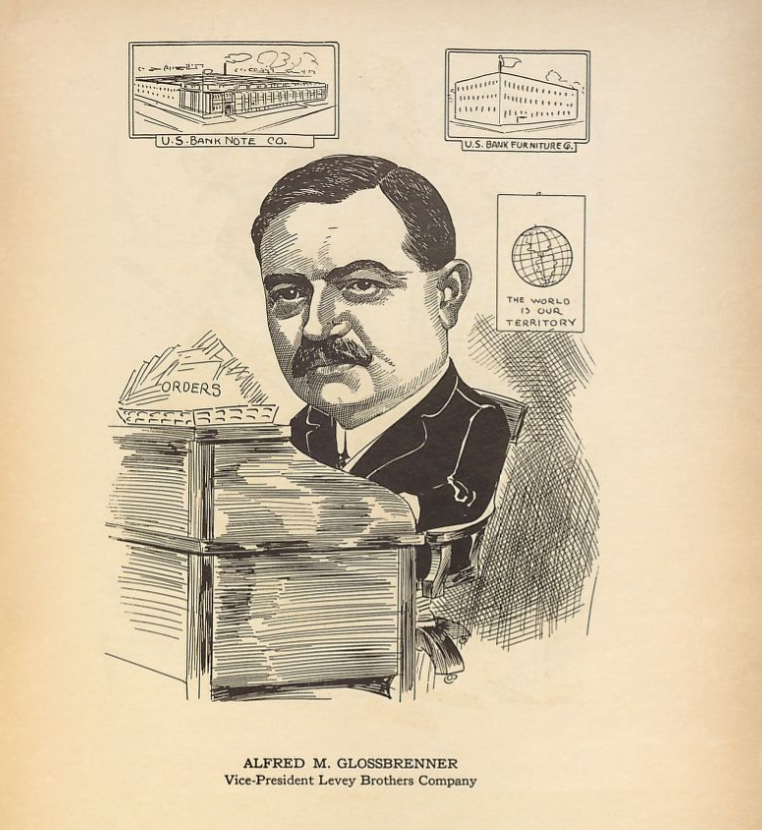
At Levey Brothers, Glossbrenner advanced through various key positions, ultimately becoming the company’s president in 1915. Three years later, Glossbrenner wrote, The Levey Interest Reckoner, which was essentially a book of loan amortization tables. The book provided a comprehensive overview of basic interest calculation principles through more complex applications. A distinguishing feature of Glossbrenner’s publication was his study into the historical context of interest calculation, from ancient Babylonian practices to then-contemporary financial models. Financial scholars continue to consider Glossbrenner’s work a culturally important exploration of interest calculation concepts. He remained with the company for 50 years until his death in 1938.
Under Glossbrenner’s management, Levey Printing became a leader in banking publications, and he was often referred to as the “Dean of Bank Advertising.” He played a key function in founding the United Typothetae of America, a national association of master printers, where he served in several supervisory roles, including president. In 1904, he helped establish a trade school of printing at Indianapolis’s Winona Technical Institute, which later became part of the Carnegie Institute of Technology.
In addition to his business career, Glossbrenner was active in public service. He was elected to the Indiana House of Representatives for its 61st General Assembly in 1898 and served on the state Republican Party’s executive committee. He is credited with suggesting Albert J. Beveridge as a candidate for US Senate and played a significant role in his successful election in 1906.
In 1929, Glossbrenner was the Republican candidate for mayor of Indianapolis, but lost to his Democratic opponent, Reagan H. Sullivan. Observers credited Glossbrenner’s loss partly to his close association with political kingpin George W. Coffin, whose ties to the undermined Glossbrenner’s mayoral prospects. He held an honorary position as chairman of the City Sinking Fund Commission, a group responsible for ensuring the city’s financial health, for nearly 30 years and was a trustee of the . He also served as director of the .
Glossbrenner also served in various civic and business organizations. He was president of the Indianapolis Board of Trade, a member of the board of governors of the Indiana State Chamber of Commerce, and an executive committeeman of the Indiana Manufacturers Association. During World War I, he served on the executive committee of the Indianapolis Liberty Loan campaign. His civic involvement included service as a trustee of the North Methodist Episcopal Church and membership in several local clubs, including the , , Indianapolis Country Club (see ), and University Club.
Glossbrenner was prominent in Masonic circles. He was a thirty-third degree member of the Scottish Rite and an active member of its Supreme Council, a Knights Templar, and a Noble of the Mystic Shrine (see ). He was also a member of the Sons of the American Revolution.
Glossbrenner married Minnie M. Stroup in 1894. They had three sons: Daniel Independence, Alfred Stroup, and George Levey. He died in Indianapolis, one week after celebrating his fiftieth year with Levey Printing Company.
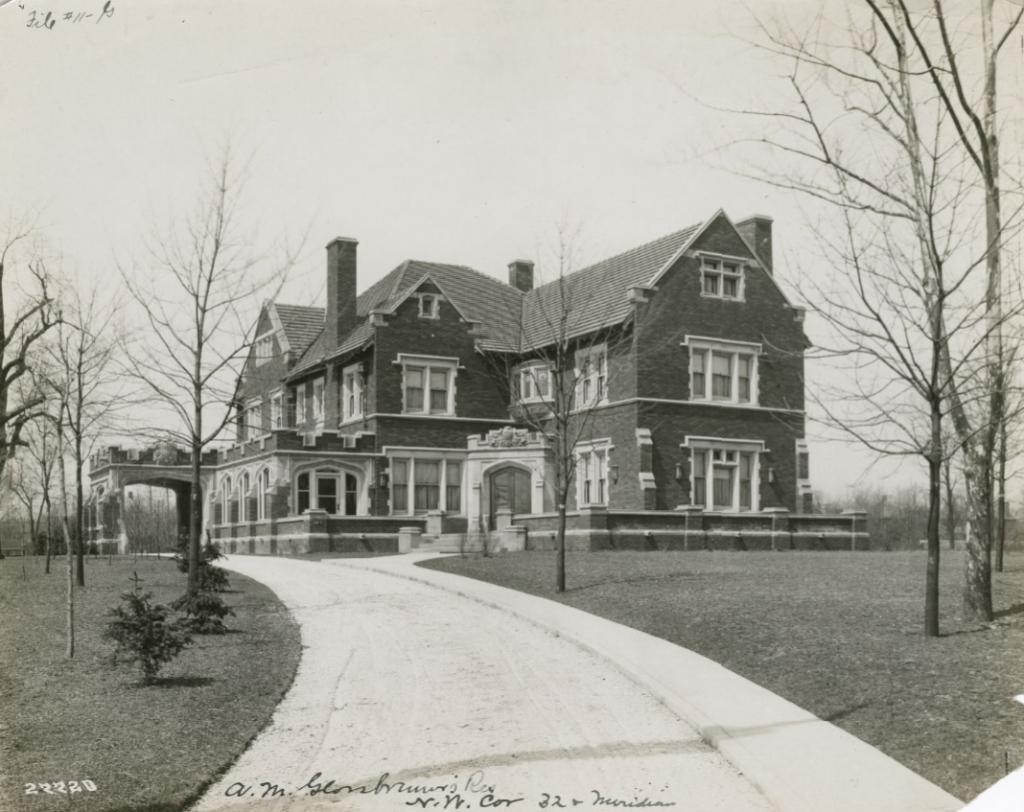
Glossbrenner built his 7500-square-foot Jacobethan Revival–style home, the Alfred M. Glossbrenner Mansion, from 1908 to 1910. It was listed on the National Register of Historic Places in 1982 and has been used as the home office of Indianapolis-based R & B Architects since 2016.
Glossbrenner died on November 13, 1938.
FURTHER READING
- Florestano, Dana J. “Glossbrenner Mansion.” National Register of Historic Places Inventory/Nomination Form. Dana J. Florestano, Architect, AIA, 1978. https://secure.in.gov/apps/dnr/shaard/r/1d198/N/Glossbrenner_Alfred_M_Mansion_Marion_CO_Nom.pdf.
- Glossbrenner, Alfred. “Discovering Alfred M. Glossbrenner.” Historic Indianapolis, November 30, 2013. https://historicindianapolis.com/discovering-alfred-m-glossbrenner/.
CITE THIS ENTRY
APA:
Johnson, S. (2025). Alfred M. Glossbrenner. Encyclopedia of Indianapolis. Retrieved Apr 4, 2026, from https://indyencyclopedia.org/alfred-glossbrenner/.
MLA:
Johnson, Spencer. “Alfred M. Glossbrenner.” Encyclopedia of Indianapolis, 2025, https://indyencyclopedia.org/alfred-glossbrenner/. Accessed 4 Apr 2026.
Chicago:
Johnson, Spencer. “Alfred M. Glossbrenner.” Encyclopedia of Indianapolis, 2025. Accessed Apr 4, 2026. https://indyencyclopedia.org/alfred-glossbrenner/.

Help improve this entry
Contribute information, offer corrections, suggest images.
You can also recommend new entries related to this topic.