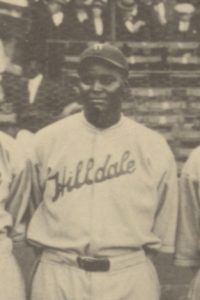
Photo info ...
James Raleigh Mackey played three seasons as the catcher for the . Known as a master catcher and adroit switch-hitter, Mackey’s keen sense for the game led him to a lifetime batting average of .335 in the Negro Leagues and .326 in 14 exhibitions games played against white major-league baseball teams. In recognition of achievements as a respected strategist and mentor during his 30-year baseball career, Mackey was posthumously inducted into the Baseball Hall of Fame in 2006.
James Raleigh Mackey was born on July 27, 1897 on a cotton farm in Eagle Pass, Texas, to sharecroppers John Dee and Beulah (Wright) Mackey. In 1900, records indicate Beulah Mackey as the head of the household, which included James Mackey and his two brothers, Ray and Ernest. The family moved to Guadalupe County, Texas, where Beulah Mackey married Montgomery Merriweather in 1910. The family moved to the next county, Caldwell County, where the Mackey boys went to school; James Mackey attended through the tenth grade in Prairie Lea, Texas. Records indicate that he fathered a daughter, Narcissus, with an unknown woman in 1914. He married Ora Lee Dorn in Luling, Texas, on October 20, 1917, and played semi-pro baseball with the Luling Oilers alongside his brothers. Mackey and his wife divorced in 1919, after which he began his long career in baseball.
Mackey made his debut with the Indianapolis ABCs of the Negro National League on July 13, 1920, after leaving the San Antonio Black Aces of the Texas Colored League. During his three seasons in Indianapolis, Mackey served as a utility man, playing a variety of positions including catcher and shortstop while learning under manager , regarded as a master teacher. He shared catching duties with aging star Louis Santop before becoming the team’s full-time catcher. Mackey developed his skills playing alongside established ABC stars such as , , , and “Crush” Christopher Columbus Holloway. In 1923, when Ed Bolden formed the Eastern Colored League, Mackey left Indianapolis to join the new league’s franchise in Hilldale, Pennsylvania, as part of the talent war between the two Negro Leagues.
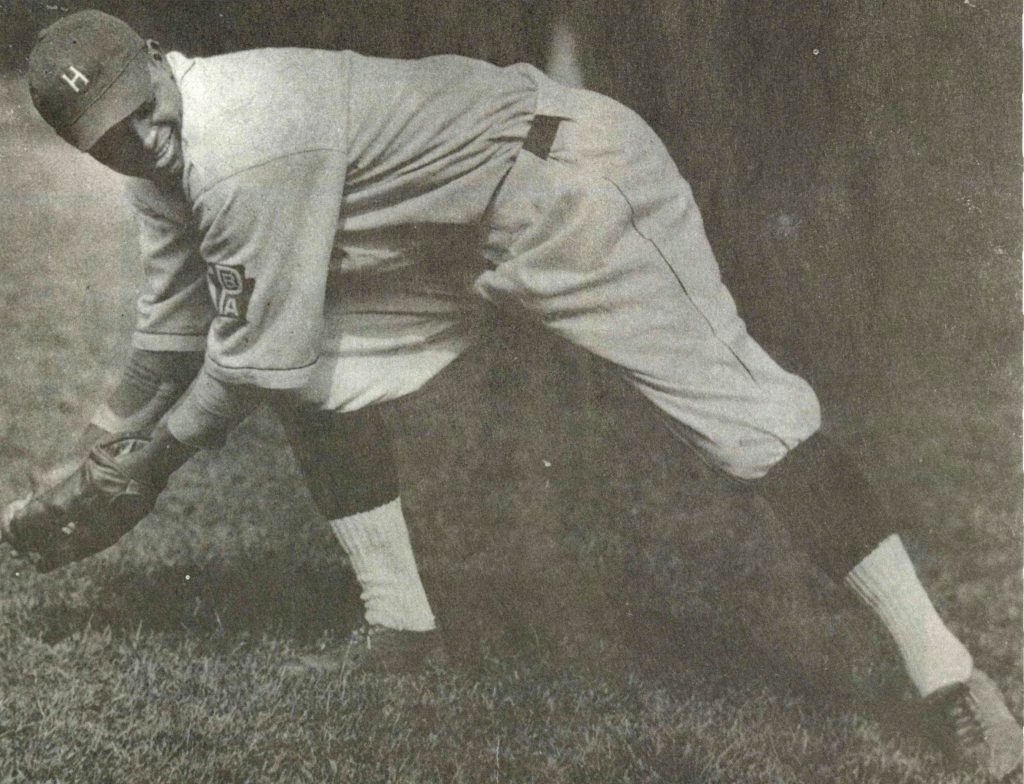
As a catcher, Mackey was known for his behind-the-plate banter. During his time with the Hilldale Daisies, he earned the nickname “Biz” for constantly “giving batters the business” while crouched behind them. He would also question the legality of a bat with the umpires as another distraction tactic. By the end of the 1923–1924 season, the Philadelphia Inquirer and Pittsburgh Courier were referring to Mackey as “Biz” in their articles. Over a career spanning nearly three decades with teams including Hilldale, the Philadelphia Stars, the Baltimore Elite Giants, and the Newark Eagles, Mackey established himself as one of the premier catchers in Negro League history. Known for his defensive mastery and ability to throw out baserunners from a crouch, he posted a lifetime batting average of .326. Even at age 36, his defensive skills in the 1933 East-West All-Star game were described as “far above those of other catchers.”
Mackey became an influential mentor to younger players who would later integrate Major League Baseball. While managing the Baltimore Elite Giants in 1937, he signed and trained teenager Roy Campanella, who credited Mackey with teaching him the fundamentals of catching. Campanella later stated, “In my opinion, Biz Mackey was the master of defense of all catchers.” While working with the Newark Eagles, Mackey mentored Larry Doby, Monte Irvin, and Don Newcombe, and managed the team to its only Negro League World Series championship in 1946. Hall of Famer James Thomas “Cool Papa” Bell declared, “I believe Biz Mackey was the best catcher I ever saw.”
On May 7, 1959, Campanella honored his mentor at the Los Angeles Coliseum, where 90,000 people filled the stadium for “Roy Campanella Day.” Campanella invited Mackey to the game and told the crowd, “This is the man that gave me all of the techniques in my catching ability, that started me out at a young age.” Mackey died on September 22, 1965 in Los Angeles and was buried in the city’s Evergreen Cemetery. His contributions to baseball were recognized posthumously when he was among 17 African American players and executives, active between 1880 and 1960, who were elected to the National Baseball Hall of Fame in 2006.
FURTHER READING
- Baseball Hall of Fame. “Biz Mackey.” Accessed February 23, 2026. https://baseballhall.org/hall-of-famers/mackey-biz.
- James A. Riley. The Biographical Encyclopedia of the Negro Baseball Leagues. With Internet Archive. Carroll & Graf Publishers, 1994. http://archive.org/details/biographicalency00rile.
- Rainey, Chris. “Biz Mackey.” Society for American Baseball Research. Accessed February 23, 2026. https://sabr.org/bioproj/person/biz-mackey/.
CITE THIS ENTRY
APA:
Johnson, S. (2026). James Raleigh “Biz” Mackey. Encyclopedia of Indianapolis. Retrieved Oct 13, 2026, from https://indyencyclopedia.org/james-mackey/.
MLA:
Johnson, Spencer. “James Raleigh “Biz” Mackey.” Encyclopedia of Indianapolis, 2026, https://indyencyclopedia.org/james-mackey/. Accessed 13 Oct 2026.
Chicago:
Johnson, Spencer. “James Raleigh “Biz” Mackey.” Encyclopedia of Indianapolis, 2026. Accessed Oct 13, 2026. https://indyencyclopedia.org/james-mackey/.

Help improve this entry
Contribute information, offer corrections, suggest images.
You can also recommend new entries related to this topic.